Clear Sky Science · en
Faunal exploitation at the elephant hunting site of Lehringen, Germany, 125,000 years ago
Ancient hunters by a vanished lake
Imagine standing on the shore of a small lake in northern Germany 125,000 years ago. The climate is warm, elephants roam the woods, and Neanderthals share the landscape with giant deer, bears, and beavers. At a place called Lehringen, the fossils from this lakeside, together with a 2.38‑meter wooden spear, let scientists reconstruct how these early humans hunted and used animals. The study behind this article revisits the old finds with modern methods and shows that Neanderthals were capable, flexible hunters who could bring down even an elephant and make careful use of many different creatures.
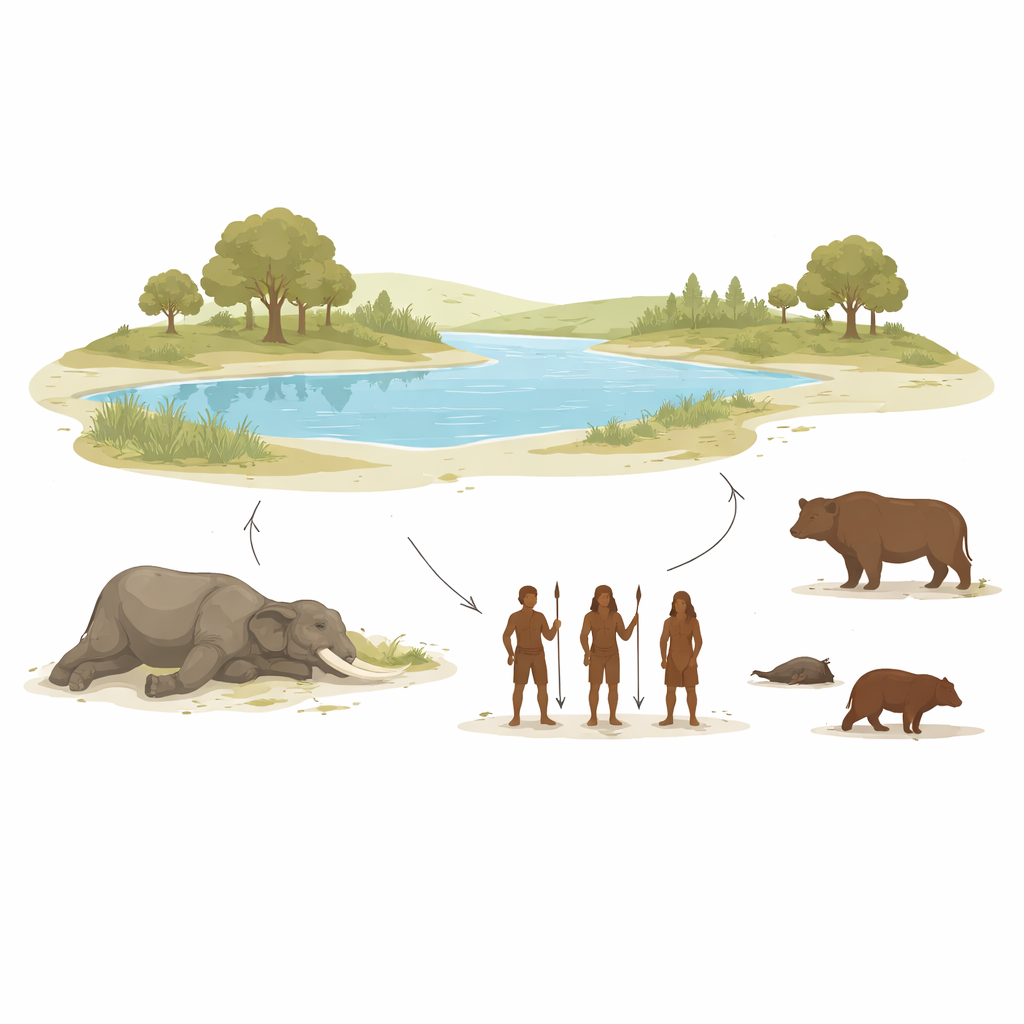
A lakeside snapshot in deep time
The Lehringen site lay in a shallow depression that once held a lake, later filled with layers of peat and lime-rich mud. When the deposits were quarried in 1948, workers uncovered the partial skeleton of a straight‑tusked elephant lying in these ancient lake beds, along with a remarkably well‑preserved wooden spear and stone flakes. Later study of pollen, shells, and other plant and animal remains showed that this setting dates to a warm phase between ice ages, when forests and wetlands covered the region. The lake appears to have been a “hot spot” on the landscape, repeatedly drawing animals and Neanderthals to its water and food over many centuries.
Reading stories from damaged bones
The authors carried out the first systematic, modern analysis of all the animal bones from Lehringen, focusing on tiny marks and fractures that reveal how they were treated after death. Under the microscope, they distinguished cut marks left by stone tools from tooth marks left by carnivores or damage caused by sediment and time. They examined skeletons and fragments from many species, including elephant, aurochs (wild cattle), deer, beaver, bear, wolf, turtles, and large fish, and used comparative collections and protein fingerprinting to confirm which animal some of the less obvious bones came from.
Evidence for an elephant hunt
The straight‑tusked elephant is the centerpiece of the site. Much of its skeleton was recovered, including ribs, vertebrae, and limb bones. Several ribs and vertebrae carry sharp, V‑shaped cut marks. Many lie on the outer sides of the ribs, consistent with slicing away meat from the flanks and back. A particularly telling rib bears a series of parallel cuts on its inner surface, the side that originally faced the lungs and heart. These marks match what is expected when people reach into the chest to remove organs from a fresh carcass. There is little weathering or heavy gnawing by carnivores, suggesting that Neanderthals gained early, primary access to the body rather than scavenging an old carcass. The animal was a prime‑aged, likely male elephant, not a frail or sick individual, and the spear was found between its ribs. Together, these clues strongly support the idea that Neanderthals hunted, killed, and butchered this huge animal.
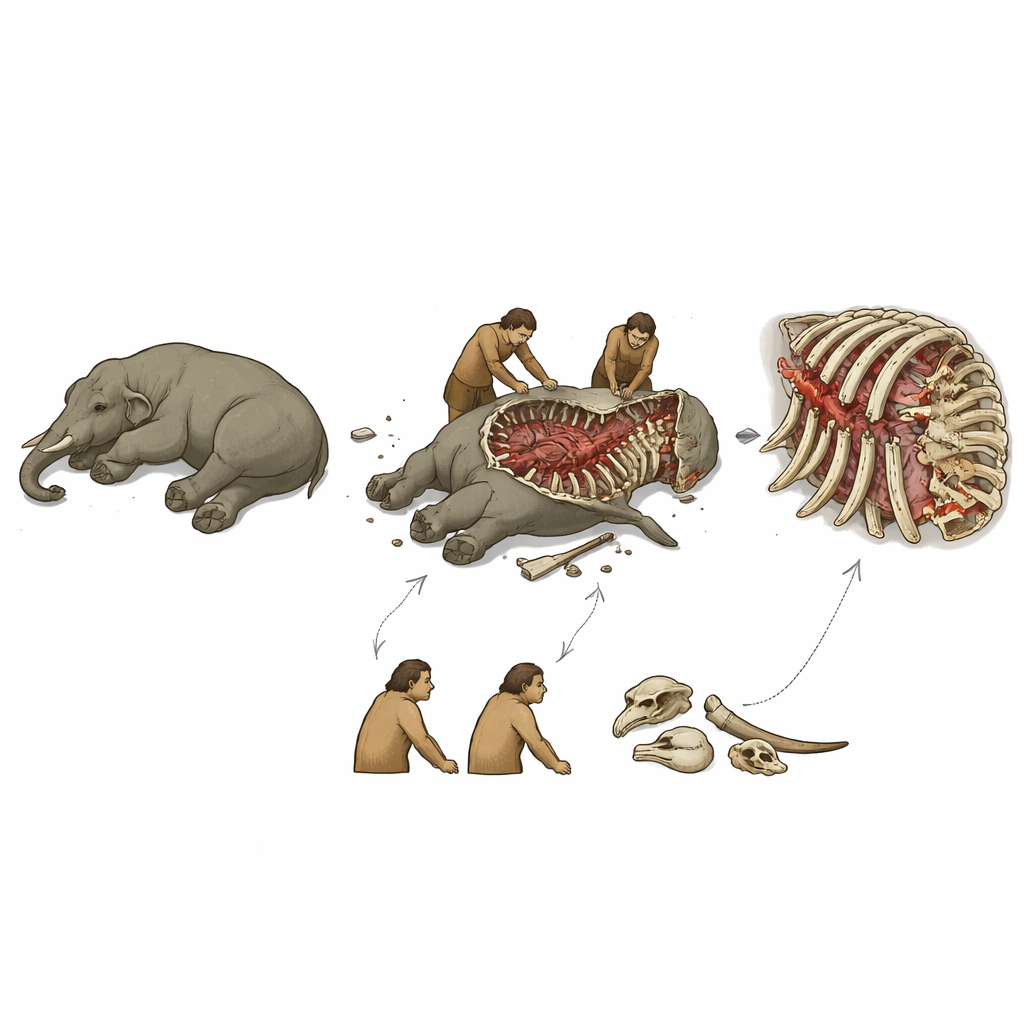
A varied menu, not just giant game
The elephant was not the only target. Bones from beavers show cut marks where limbs were separated, flesh removed, and skin likely stripped from the jaws and lower face; one skull bears damage that may mark the fatal blow. A brown bear femur shows both fine cut marks from removing meat and impact scars from breaking the bone open to reach the rich marrow. A pelvis and rib from a bear also carry slicing marks. Wild cattle remains include cut marks on a jaw and back vertebra, evidence of meat removal, even though much of the damage on these bones comes from wolves gnawing on them. These signs, spread through different layers, indicate that Neanderthals revisited the lakeside over time and routinely exploited a wide range of animals—from dangerous bears to fat‑rich beavers—alongside fish and turtles that attest to use of aquatic resources.
What this reveals about Neanderthals
By tying the spear, stone tools, and bone damage together, the study resolves long‑standing doubts about Lehringen. The pattern of marks shows that Neanderthals there were not simple scavengers but organized hunters able to bring down a healthy elephant at close range and process it efficiently, with a special interest in high‑energy organs and fat. At the same time, they were flexible foragers who took advantage of many different species available around the lake. For a general reader, Lehringen offers a vivid scene of Neanderthal life at the northern edge of their range: expert woodworkers and stone‑tool users, cooperating to tackle huge prey, returning to a familiar lakeside across changing conditions in the last interglacial period.
Citation: Verheijen, I., Di Maida, G., Russo, G. et al. Faunal exploitation at the elephant hunting site of Lehringen, Germany, 125,000 years ago. Sci Rep 16, 9836 (2026). https://doi.org/10.1038/s41598-026-42538-4
Keywords: Neanderthals, Palaeolithic hunting, straight-tusked elephant, zooarchaeology, Eemian interglacial