Clear Sky Science · en
Reformulated predictive torque and flux control with a full-order adaptive observer and accurate discrete-time models for sensorless induction machine drives
Smarter Motors Without Fragile Sensors
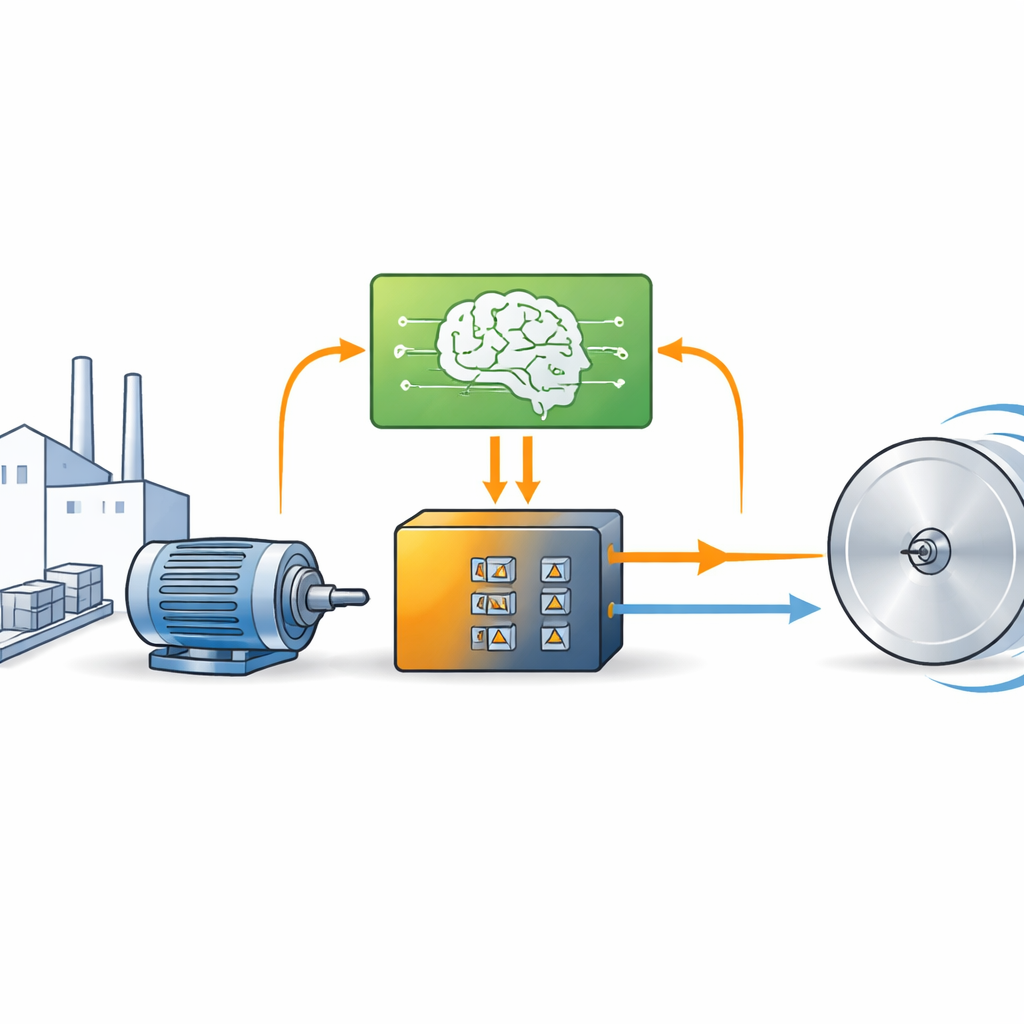
Electric motors are everywhere—from factory conveyor belts to wind turbines—quietly converting electricity into motion. Keeping them running efficiently usually requires delicate sensors to track their internal speed and magnetic fields, but those sensors can fail in harsh industrial environments. This paper explores a way to run powerful industrial motors accurately without such sensors, using only electrical measurements and clever mathematics packed into the control software.
Why Ditch the Hardware Sensors?
Industrial induction motors are popular because they are robust, inexpensive, and can operate over a wide range of speeds. Traditionally, engineers rely on hardware sensors attached to the motor shaft or to the magnetic circuit to measure speed and magnetic flux. These devices, however, are vulnerable to dust, vibration, heat, and electromagnetic interference, and they add cost and maintenance. A growing trend is therefore to build “sensorless” drives, where the control system estimates the motor’s internal state from the easily measured electrical currents at its terminals. Achieving this reliably is a challenge: if the internal model of the motor is even slightly inaccurate, performance can suffer, causing extra losses, torque ripple, or unstable behavior.
Turning Equations Into a Digital Twin
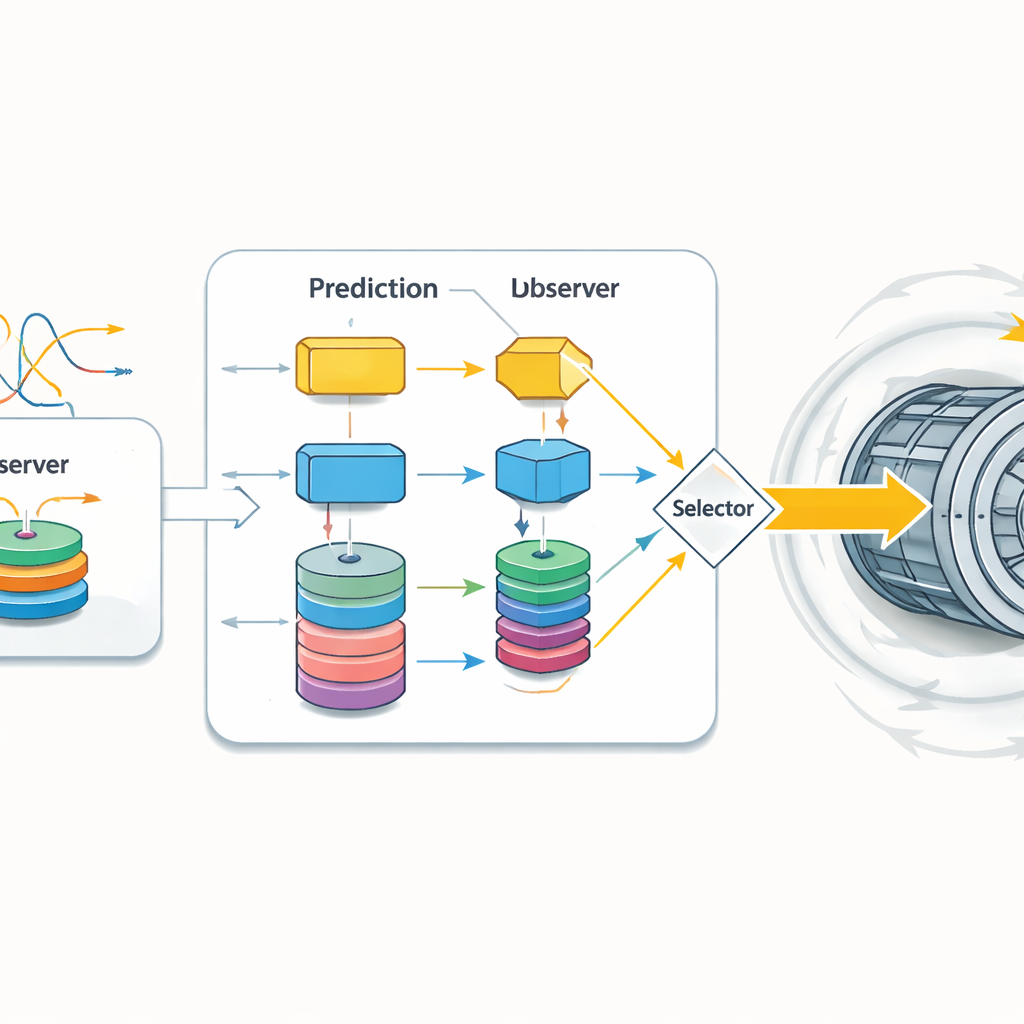
The authors focus on a class of techniques called model predictive control, which uses a digital “twin” of the motor to forecast what will happen if different voltage commands are applied. From these forecasts, the controller chooses the option that should give the desired torque and magnetic flux in the next instant. To keep track of the unmeasured internal quantities, they use a full-order adaptive observer, a mathematical structure that continuously refines its estimates of current, magnetic flux, and speed based on the mismatch between prediction and measurement. The central innovation is to rewrite the motor model using only stator current and stator magnetic flux as state variables, removing the rotor flux from the equations. This reduces the number of quantities that must be tracked, simplifying the observer and tightening the link between what is modeled and what actually matters for torque control.
Sharper Discrete-Time Models for Digital Control
Because real controllers operate in discrete time steps, continuous motor equations must be approximated as step-by-step update rules. Most drives rely on the simple Euler method, which is easy to compute but can become inaccurate if the sampling rate is not extremely high. The authors investigate more precise alternatives based on Taylor series and Runge–Kutta methods, which represent how the motor state evolves over a sampling interval using higher-order information. They derive second- and higher-order versions of these discrete-time models consistently for both the observer and the predictive controller. Although these methods require more computations per step, they promise much better numerical accuracy at practical sampling rates, potentially improving both the estimation of hidden variables and the quality of control decisions.
Putting the Algorithms to a Real-Time Test
To see how these ideas perform in practice, the researchers built a hardware-in-the-loop setup. A real-time simulator emulated a 4-kilowatt induction motor and its power electronics, while the sensorless control algorithms ran on a separate processor core, just as they would in an actual industrial drive. This allowed rapid, repeatable experiments with different model variants. They compared the traditional observer and controller against their reformulated versions, and also pitted Euler, Taylor, and Runge–Kutta discretizations against each other. They evaluated not just how closely torque, speed, and flux followed their targets, but also how quickly the system settled after speed changes, how large the torque ripple was, and how much processor time each method consumed.
What the Results Mean for Real Machines
The tests showed that simply improving the observer’s accuracy—without changing the basic predictive control strategy—already yields noticeably better sensorless performance. The reformulated framework, which avoids explicit rotor flux estimation, matched or exceeded the conventional scheme in steady-state behavior and reached the desired speed faster, despite relying on fewer state variables. Among the discrete-time methods, the Taylor-based approach stood out: it delivered the smallest speed and flux errors and the quickest dynamic response, at a moderate increase in computational cost and only a slight rise in torque ripple. Higher-order Runge–Kutta methods, while theoretically more refined, offered little practical benefit because they cannot fully exploit future input information in this control setting. Overall, the study suggests that carefully designed, higher-accuracy digital models can make rugged sensorless induction motor drives both simpler and more precise—an appealing combination for demanding industrial applications.
Citation: Herrera-Hernández, R., Reusser, C., Carvajal, R. et al. Reformulated predictive torque and flux control with a full-order adaptive observer and accurate discrete-time models for sensorless induction machine drives. Sci Rep 16, 12757 (2026). https://doi.org/10.1038/s41598-026-41944-y
Keywords: sensorless motor control, induction machine drives, model predictive control, adaptive observers, discrete time modeling