Clear Sky Science · en
Religiosity spirituality and nonreligious spiritual practices linked to anxiety and depressive symptoms
Why inner beliefs and everyday rituals matter
Many young adults experiment with meditation, manifestation, tarot, or traditional worship to find comfort and direction in life. This study asked a simple but pressing question: how are these different spiritual paths linked to feeling anxious or depressed? Focusing on 1,240 young people in Poland, the researchers compared Catholics, atheists, and those who mix or replace religion with nonreligious spiritual practices to see which patterns of belief and practice go hand in hand with better—or worse—mental health.
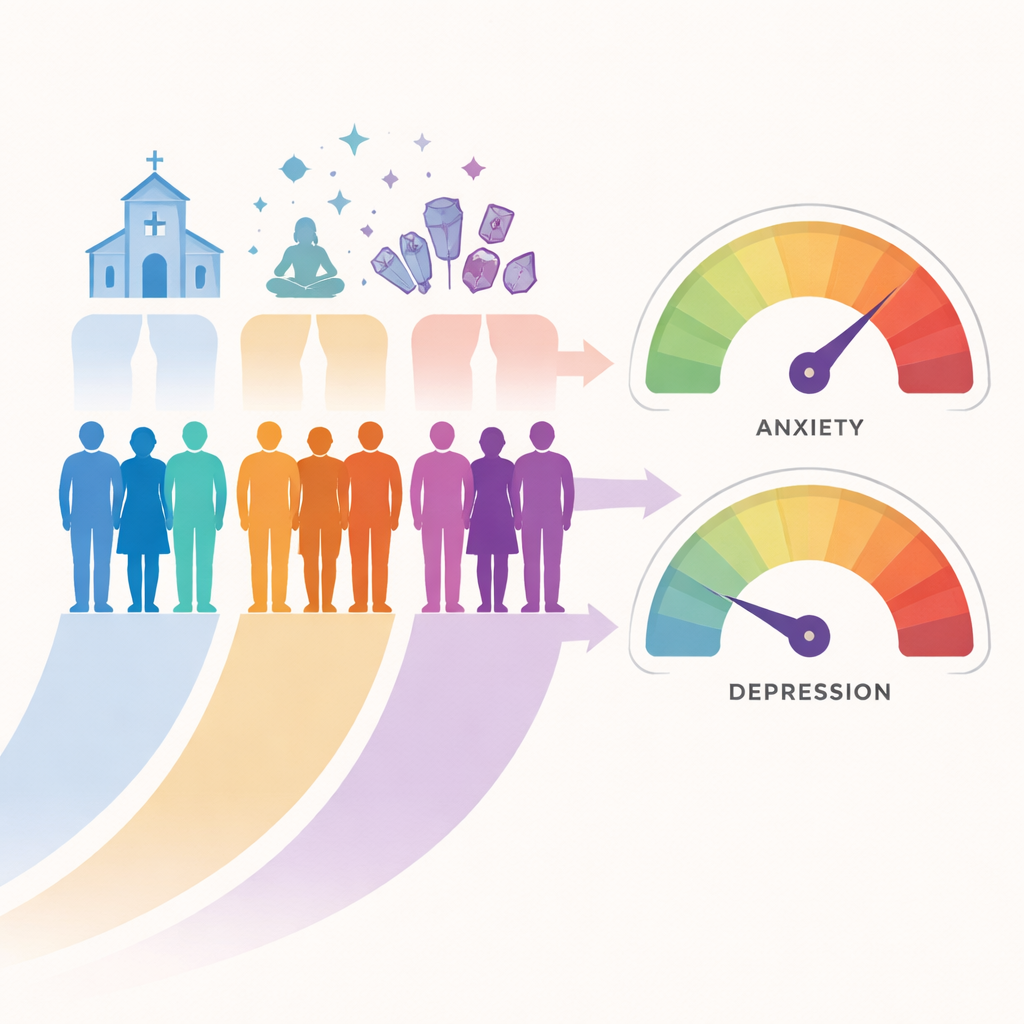
Different paths of belief among young adults
The researchers divided participants into four groups: Catholics who do not use nonreligious spiritual practices, Catholics who also engage in such practices, atheists who avoid spiritual practices, and atheists who still turn to things like astrology, tarot, crystals, manifestation, or non-institutional meditation. Nearly half of all respondents used at least one nonreligious spiritual practice, and many used several. These practices often emphasized personal experience and self-guidance rather than organized rituals, reflecting a wider social shift away from formal religion and toward highly individualized spiritual “mix and match” approaches.
How spirituality was measured
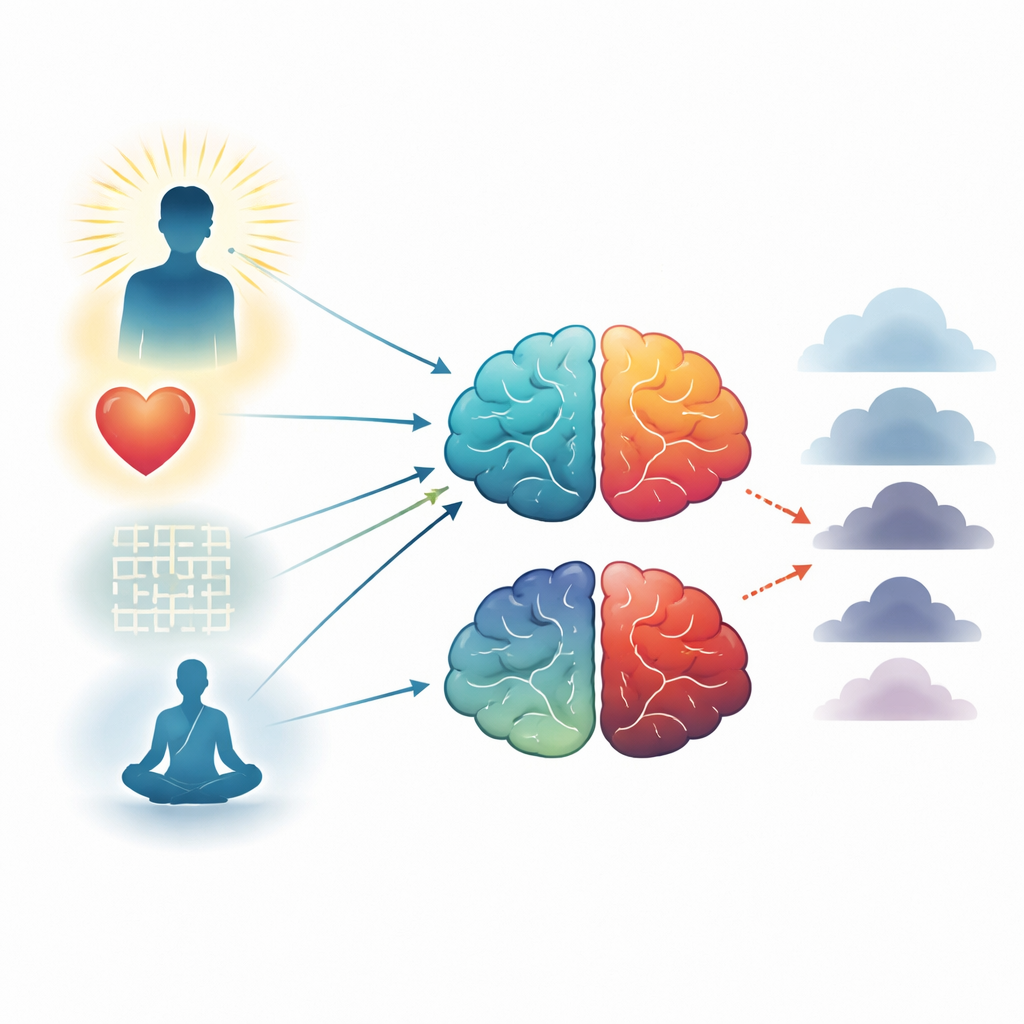
To move beyond simple labels like “religious” or “atheist,” the study used a detailed spirituality questionnaire. It captured four main dimensions: a felt connection with a higher power; self-discipline and everyday virtues such as moderation and kindness; reflective or meditative activities aimed at understanding life; and a sense of love directed toward, or received from, something greater. Another short survey measured symptoms of anxiety and depression. Because the data did not follow a normal distribution, the researchers used non‑parametric statistical methods, comparing the four groups and examining how the spiritual dimensions linked up with mental health scores.
Spirituality, sadness, and low mood
Across all 1,240 young adults, higher overall spirituality was tied to fewer depressive symptoms. In particular, feeling close to a higher power, living according to inner values and self-control, and experiencing a form of “divine love” were all associated with less depression. These links appeared regardless of whether a person was formally religious or not, suggesting that what matters most for low mood is not official membership in a church, but whether a person feels guided, connected, and supported by something that gives life meaning and direction.
Spirituality and anxiety: a more tangled picture
Anxiety told a very different story. While depression scores did not differ much between the four groups, anxiety scores did. The highest anxiety levels were found among both Catholics and atheists who used nonreligious spiritual practices. In Catholics and atheists without such practices, more meditation and reflection were linked to higher anxiety, hinting that intense self-focus can sometimes stir up worry rather than calm it. Among Catholics who also practiced nonreligious spirituality, however, a stronger sense of closeness to a higher power and of loving connection helped counter anxiety. For atheists who used nonreligious spiritual practices, greater emphasis on discipline and everyday virtues was tied to lower anxiety, even without belief in a deity.
Mixed practices and inner tension
The group that both identified as Catholic and engaged in alternative spiritual practices stood out: they showed the highest overall anxiety, even though certain aspects of their faith seemed to protect them. One possible explanation is inner conflict. Combining church-based beliefs with practices that some religious communities view skeptically may create tension and uncertainty about what to trust. For atheists who rely heavily on nonreligious spiritual practices, elevated anxiety might reflect ongoing searching and experimentation, where practices are used in response to distress but do not always resolve it.
What this means for everyday life
For a layperson, the takeaway is twofold. First, having a sense of meaning, moral direction, and loving connection—whether framed in religious or nonreligious terms—tends to go along with fewer symptoms of depression. Second, anxiety is more sensitive to how beliefs and practices are organized. Spiritual habits can soothe or amplify worry depending on whether they fit comfortably with a person’s broader view of the world. The study cannot prove cause and effect, but it suggests that when supporting young adults’ mental health, it may help to look not only at whether they are religious or not, but at how their various practices form a coherent—or conflicting—inner landscape.
Citation: Główczyński, P., Dębski, P. & Badura-Brzoza, K. Religiosity spirituality and nonreligious spiritual practices linked to anxiety and depressive symptoms. Sci Rep 16, 11479 (2026). https://doi.org/10.1038/s41598-026-41882-9
Keywords: spirituality and mental health, young adults, nonreligious spiritual practices, anxiety and depression, religiosity