Clear Sky Science · en
Predictability comparison of central corneal thickness reduction in myopic eyes with or without astigmatism undergoing FS-LASIK with two profiles of MEL 90
Why this matters for people considering laser eye surgery
For anyone thinking about LASIK to correct nearsightedness, one of the biggest safety questions is how much of the cornea—the eye’s clear front window—is actually removed by the laser. If too much tissue is taken away, the cornea can become structurally weaker. This study looks at how accurately a modern laser system predicts tissue removal when using two popular ways of shaping the cornea, and what that means for safety in people with different degrees of myopia.
Two ways to reshape the eye
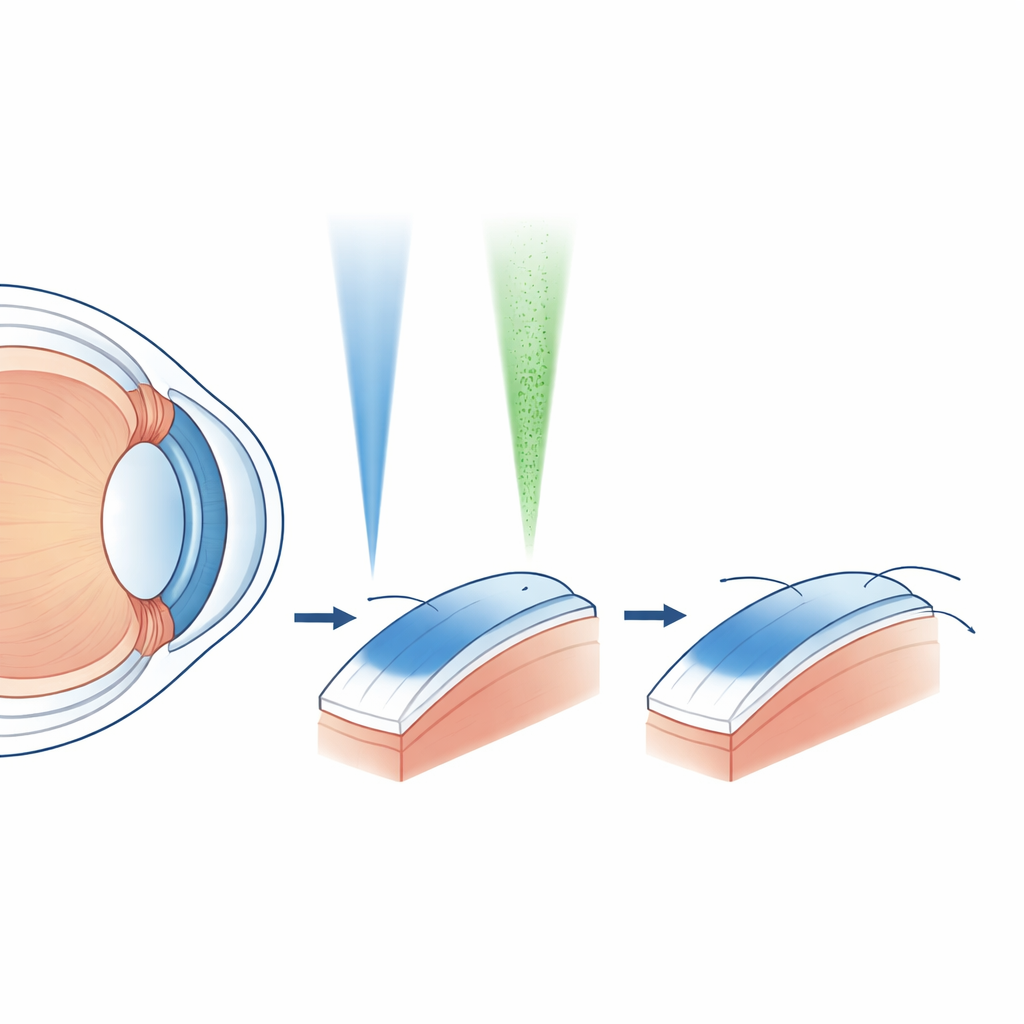
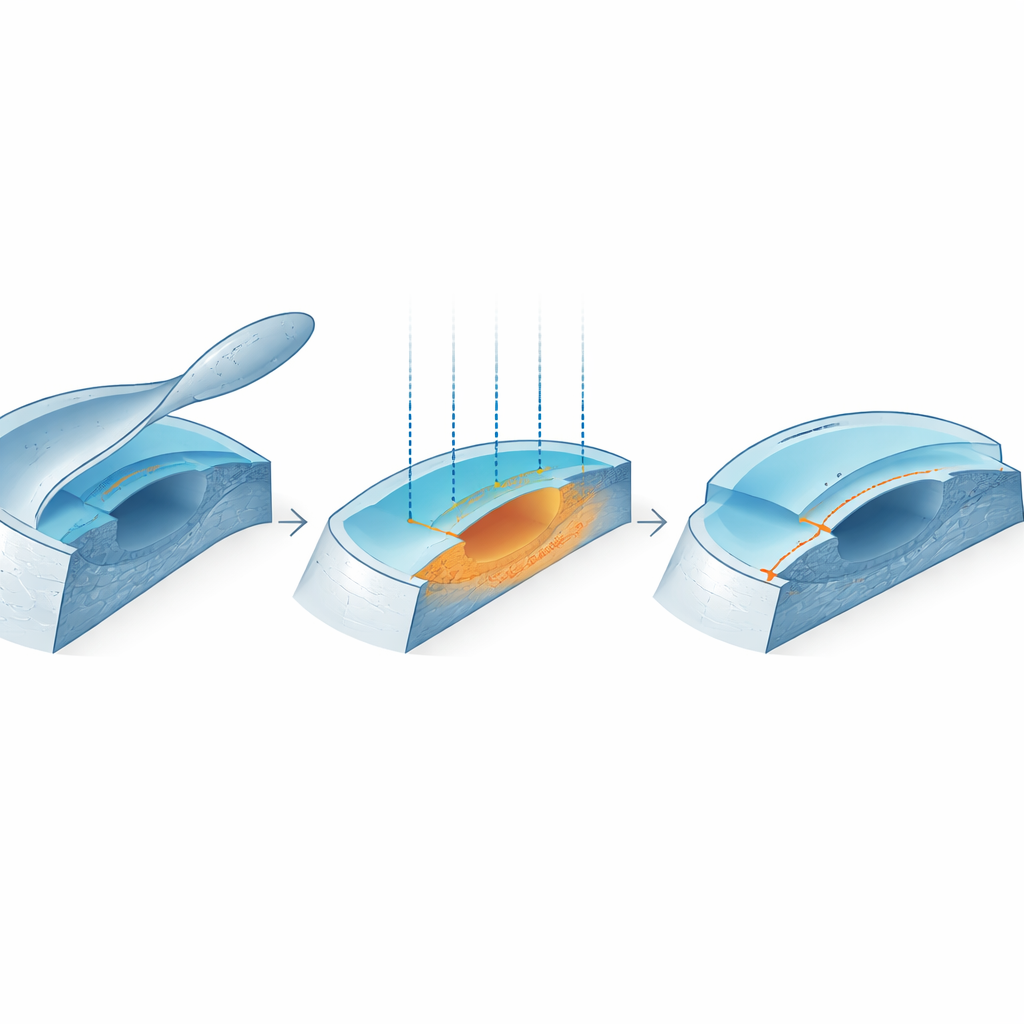
Modern LASIK for nearsightedness and astigmatism reshapes the cornea by removing a very thin layer from its inner surface. On the MEL 90 laser platform, surgeons can choose between two profiles. One, called Triple-A, is designed to give a smooth, natural curvature while trying to save as much tissue as possible. The other, called topography-guided (TG), takes a more customized approach, aiming to iron out tiny surface irregularities that can cause glare, halos, and trouble with night vision. Both profiles are already known to give good vision, but it has been unclear whether one truly saves more corneal tissue than the other and how well the machine’s predictions match what actually happens.
How the study was carried out
The researchers enrolled 82 adults with myopia, many of whom also had regular astigmatism. Each person had femtosecond LASIK (FS-LASIK) in both eyes: one eye was treated with the Triple-A profile and the other with the TG profile, assigned at random. Before surgery and then at one day, one week, one month, and three months afterward, the team measured vision, prescription, and central corneal thickness using a precise imaging system called Pentacam. The laser software also provided a planned amount of tissue removal for each eye. By comparing the planned reduction in corneal thickness with the actual change measured afterward, the investigators could judge how well the system predicted tissue loss in each profile and in different levels of myopia.
What actually happened to corneal thickness
Despite similar starting prescriptions between the two eyes, the TG profile always showed a smaller planned tissue removal than Triple-A. However, real measurements told a different story. Three months after surgery, both profiles had removed more corneal tissue than the laser had predicted. On average, the underestimate was about 5 micrometers for Triple-A and about 14 micrometers for TG—roughly three times larger in the TG eyes. When patients were divided into low, moderate, and high myopia, the differences were most striking in moderate myopia. In this group, the TG profile both predicted less thinning and actually produced more thinning than Triple-A. In high myopia, the plans still underestimated tissue removal in both profiles, but the final amount of tissue removed ended up similar between them.
Why stronger prescriptions matter more
When the team looked more closely at the data, they found that the higher the amount of vision correction needed, the bigger the gap between planned and actual thinning. In other words, as surgeons aim to correct stronger prescriptions, the laser tends to remove more tissue than expected, especially with the TG profile. The study suggests several reasons for this, including longer laser time and greater drying of the cornea during deeper ablations, as well as the slower treatment speed of the TG setting. These factors can make each laser pulse slightly more effective than the software assumes, leading to extra tissue removal. Even so, all patients in the study achieved excellent vision and no serious complications over the three-month follow-up.
What this means for patients and surgeons
For people with moderate to high myopia, this study shows that the MEL 90 laser, whether using the Triple-A or TG profile, tends to remove more central corneal tissue than its planning software predicts. Although the TG profile appears more “tissue-saving” on paper, it did not spare tissue in practice and even removed more tissue than Triple-A in moderate myopia. For patients, this does not mean LASIK is unsafe, but it underscores the importance of careful screening and generous safety margins for remaining corneal thickness. For surgeons, the findings highlight the need to adjust planning strategies—especially when using topography-guided treatments in stronger prescriptions—to ensure that enough corneal structure is preserved for long-term stability.
Citation: Jiang, X., Zhang, Z., Mao, W. et al. Predictability comparison of central corneal thickness reduction in myopic eyes with or without astigmatism undergoing FS-LASIK with two profiles of MEL 90. Sci Rep 16, 12560 (2026). https://doi.org/10.1038/s41598-026-41492-5
Keywords: LASIK safety, corneal thickness, myopia surgery, topography-guided LASIK, refractive laser profiles