Clear Sky Science · en
Infrared ship target detection algorithm PEW_YOLOv8 in complex environments
Watching Ships in the Dark
Modern shipping lanes are crowded and busy, and many vessels now rely on infrared cameras to keep watch at night and in bad weather. But turning those fuzzy heat images into reliable warnings is harder than it sounds: distant boats can be tiny smudges, sea fog blurs the scene, and bright lights or waves can trick the software. This paper introduces PEW_YOLOv8, a new computer-vision method designed to spot ships in infrared videos more accurately, even when the view is murky or cluttered.
Why Spotting Ships Is So Tricky
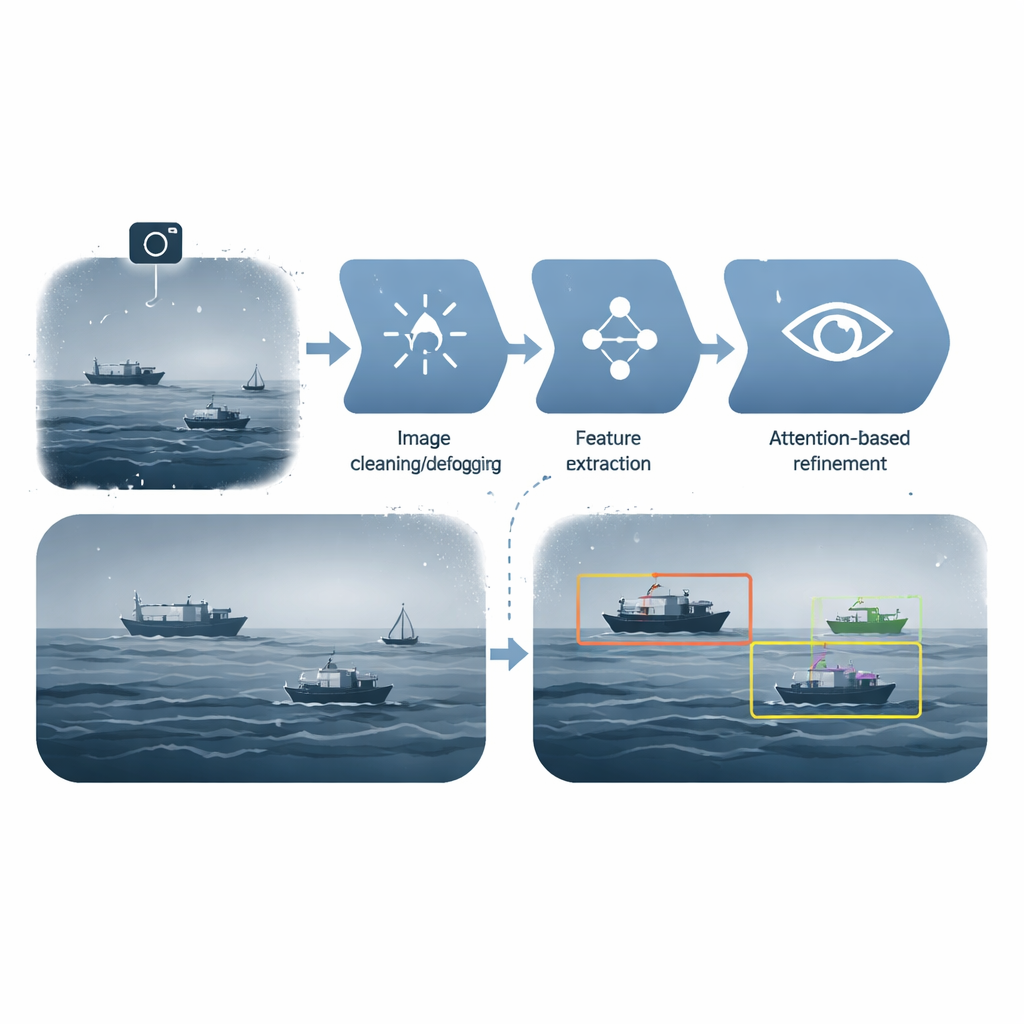
Infrared ship detection aims to automatically find vessels in images based on their heat signatures rather than visible light. This is attractive because infrared cameras work day and night and in many harsh conditions. However, the images they produce are often low in detail and contrast. Moist sea air can cause fogging and blur, making ships appear smeared or washed out. Small and distant boats may occupy only a handful of pixels, so standard algorithms overlook them. When waves, docks, or city lights create busy backgrounds, older systems can confuse these patterns with real targets, raising false alarms or missing threats altogether.
Building on Fast Vision Tools
The authors start from YOLOv8, a widely used deep-learning system that can identify many kinds of objects in real time. YOLOv8 is fast, but in raw infrared ship images it still struggles with noisy scenes, overlapping targets, and tiny vessels. To address this, the researchers introduce four key upgrades that together form PEW_YOLOv8. Each upgrade focuses on a different weak spot in the original pipeline: cleaning the input image, extracting richer details, smartly combining information across scales, and judging detection boxes more carefully when ships overlap or their outlines are fuzzy.
Cleaning the View and Finding Fine Details
The first upgrade is a defogging module called FFA-Net. Before the main detector ever looks at the image, FFA-Net enhances contrast and restores lost details by paying attention both to whole channels of information and to individual pixels. In effect, it clears the haze so that the downstream network has sharper data to work with. Next comes a redesigned "backbone" for feature extraction, known as PGIG-Backbone. This structure guides how information flows and how the network’s internal signals are updated. By carefully managing these gradients and fusing signals from multiple paths, it becomes better at representing small, low-resolution ship targets that standard designs tend to overlook.
Letting the Network Focus and Judge Better
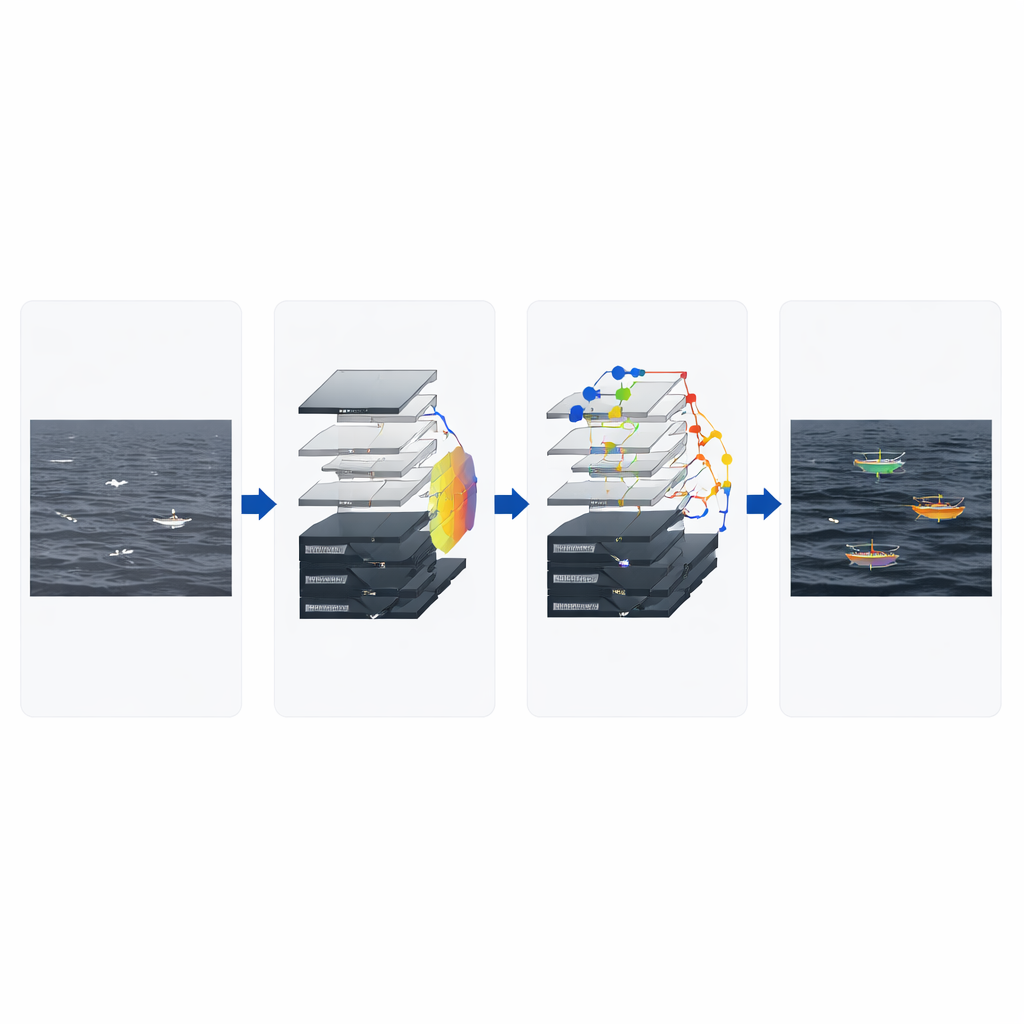
Beyond clearer images and a stronger backbone, PEW_YOLOv8 adds an efficient multi-scale attention module in the middle of the network. This component weighs different regions and layers of the feature maps, boosting patterns that look like ships while toning down background clutter such as waves or docks. Finally, the authors replace the usual way of scoring bounding boxes with a method called Wise-IoU v3. Instead of being overly influenced by a few problematic examples, this loss function adjusts how strongly it learns from various cases, which helps the system handle overlapping vessels and unclear borders without becoming unstable.
What the Tests Show
The team evaluates their method on an industrial infrared ship dataset containing 9,400 images from real coastal defense scenes, including open sea, ports, and coastal waters, and seven types of ships from canoes to large container vessels. They compare PEW_YOLOv8 against the original YOLOv8 and several other popular detectors. Each added module—defogging, the improved backbone, the attention mechanism, and the new loss function—raises accuracy by a measurable amount. When combined, these changes lift the main detection score to 92.2 percent, an improvement of nearly four percentage points over the base YOLOv8, while keeping the processing speed suitable for real-time monitoring.
Clearer Warnings on the Open Sea
In simple terms, this work shows how carefully tailored upgrades can turn noisy infrared ship images into much more reliable automatic alerts. By first cleaning the picture, then extracting richer details, focusing on likely ship regions, and making smarter decisions about overlapping targets, PEW_YOLOv8 sees more vessels and makes fewer mistakes than earlier systems. With further refinement for heavily crowded scenes and even faster processing, approaches like this could help make maritime traffic safer, especially at night and in rough conditions where human eyes and traditional cameras are most likely to fail.
Citation: Dong, T., Zhu, M. & Tang, G. Infrared ship target detection algorithm PEW_YOLOv8 in complex environments. Sci Rep 16, 10240 (2026). https://doi.org/10.1038/s41598-026-40574-8
Keywords: infrared ship detection, maritime surveillance, object detection, deep learning, YOLOv8