Clear Sky Science · en
Long-term adaptation pathways for Venice and its lagoon under sea-level rise
A City Caught Between Land and Sea
Venice is famous for its canals, art, and fragile beauty—and for the floods that increasingly disrupt daily life. This study asks a stark question: as seas continue to rise for centuries, how long can Venice stay where it is, and what forms of protection are still possible? The authors explore not just engineering projects, but the values at stake: historic buildings, the living lagoon, tourism and port activity, and the safety and well-being of residents. By tracing how options narrow as waters climb, they offer a roadmap of difficult choices ahead for Venice and, by extension, many coastal cities worldwide.
Why Rising Seas Threaten Venice’s Future
Over the last 150 years, Venice has faced ever more frequent flooding, driven by a combination of global sea-level rise and local land sinking. Extreme floods have clustered in recent decades. A system of mobile gates, known as MoSE, now closes the lagoon’s three inlets during storm surges, greatly reducing immediate flood risk. Yet this solution relies on the ability to keep the lagoon mostly open to the sea most of the time. As average sea level rises—potentially by around 0.8 meters by 2100 under high emissions, and several meters more by 2300—these gates would need to close more often and for longer, undermining navigation, the health of the lagoon’s ecosystems, and port operations. Venice thus stands at the front line of a slow-moving but relentless threat.
Four Big Choices for a Sinking City
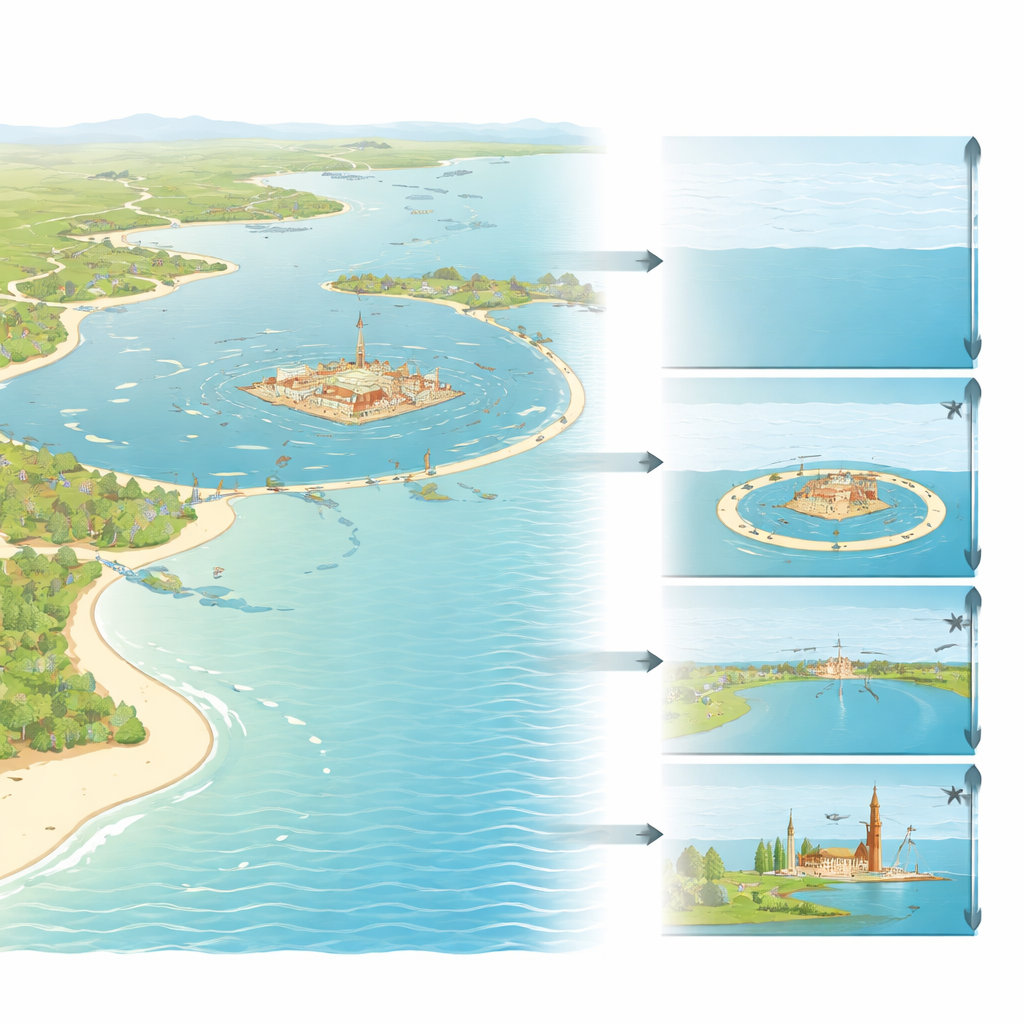
The authors group Venice’s long-term options into four main strategies. The first, an “open lagoon,” builds on the current approach: keep MoSE, fine-tune its use, and add local measures such as raising pavements, protecting ground floors, and even gently lifting parts of the city by injecting seawater deep underground. This path can preserve the lagoon environment and the historic city for some decades, but only up to a certain sea-level threshold. Beyond that point, closures become too frequent and risky, and the lagoon starts to degrade. A second strategy, “ring-diking,” imagines encircling the historic city and some nearby islands with high earthen walls, isolating them from a lagoon that remains open to the sea. This better protects people and buildings at higher sea levels, while allowing the lagoon’s ecology to evolve more naturally, but it would visually and culturally separate Venice from the waters that have shaped it.
Closing the Lagoon or Letting Go
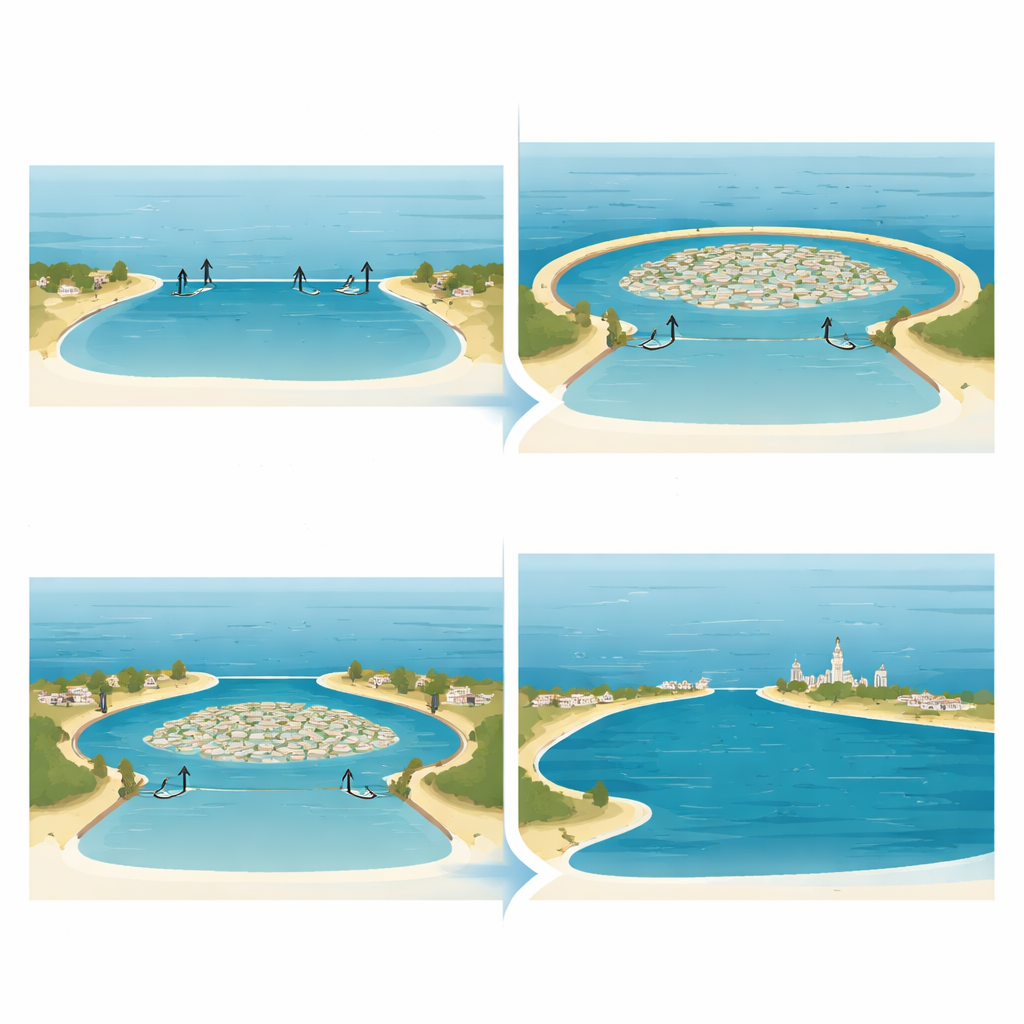
A third option, the “closed lagoon,” would convert the entire lagoon into a large coastal lake sealed off from the sea by permanent dams and raised shore defenses. Inside this protected bowl, water levels could be tightly controlled even under very high seas outside, offering a long-lasting shield for buildings and urban life. The trade-off is severe: the lagoon’s tidal ecosystems, and many traditional activities tied to them, would be irreversibly transformed. This solution also demands enormous upfront investments, constant pumping, and major changes to port access. The final and most drastic path is “retreat,” in which residents gradually or abruptly abandon the city. In its least painful form, selected monuments might be carefully dismantled and rebuilt on higher ground, creating new cultural sites inland while the old city slowly deteriorates under water. This would preserve fragments of Venice’s heritage but at the cost of losing the living city, its lagoon culture, and much of its economy.
Pathways, Tipping Points, and Shrinking Choices
Rather than picking a single “best” answer, the study lays out adaptation pathways: sequences of strategies that follow one another over time. Each pathway is punctuated by adaptation tipping points—moments when a given approach can no longer meet its goals, whether because the sea has risen too far, the risk of failure grows unacceptable, or the required costs and social changes become too great. Today Venice is in an “incremental” phase, extending the life of the open-lagoon strategy with MoSE and local adjustments. As relative sea level climbs somewhere beyond roughly three-quarters of a meter, the city will likely be forced into a more transformative phase, turning to ring-dikes or a closed lagoon. Under extreme scenarios, retreat from the site becomes the only physically viable choice in the longer run. The timing of these shifts depends heavily on global greenhouse-gas emissions and the behavior of the Antarctic ice sheet.
What This Means for Venice—and for the World
The authors conclude that Venice can be defended for a long time, but not forever, and not without sacrifice. Each strategy protects a different bundle of values: some favor monuments and urban life, others the lagoon environment or financial feasibility. No option avoids all losses under high sea-level rise. By mapping these trade-offs and the narrowing “solution space,” the study helps decision-makers confront what they most want to save and how much change they are willing to accept. Venice, they argue, is a preview of choices that many low-lying coasts will face: whether to keep adapting in place, radically redesign defenses, or eventually retreat. Rapid global emission cuts could still delay or soften the hardest decisions—but the need to plan for a rising sea is already here.
Citation: Lionello, P., Di Fant, V., Pasquier, U. et al. Long-term adaptation pathways for Venice and its lagoon under sea-level rise. Sci Rep 16, 9438 (2026). https://doi.org/10.1038/s41598-026-39108-z
Keywords: Venice, sea-level rise, climate adaptation, coastal cities, flood protection