Clear Sky Science · en
Orangutans and chimpanzees show evidence of inferring when a hidden breadstick is intact or broken
How apes think about what they cannot see
Imagine watching two breadsticks partly hidden under little covers. You can see their ends, but not the middle. With a quick push, one breadstick moves as a single piece, while the other shifts oddly, as if it were snapped in two. Could you work out which one is whole, and grab the better snack? This study asks whether orangutans and chimpanzees can solve that kind of everyday mystery: using subtle clues to figure out the hidden state of things they cannot directly see.
Why hidden clues matter
Humans constantly draw conclusions from incomplete information. We hear a thud in the next room and guess what fell; we see one cup lifted and know the prize must be under the other. Scientists have long tested such “reasoning by exclusion” in animals using cup-and-treat games, but those tasks can be explained by simple habits like “avoid the empty cup” rather than true reasoning. The authors of this paper wanted a cleaner test, one where both choices always contained something, and success required noticing how parts of an object move together or come apart.
Breadsticks in place of tools
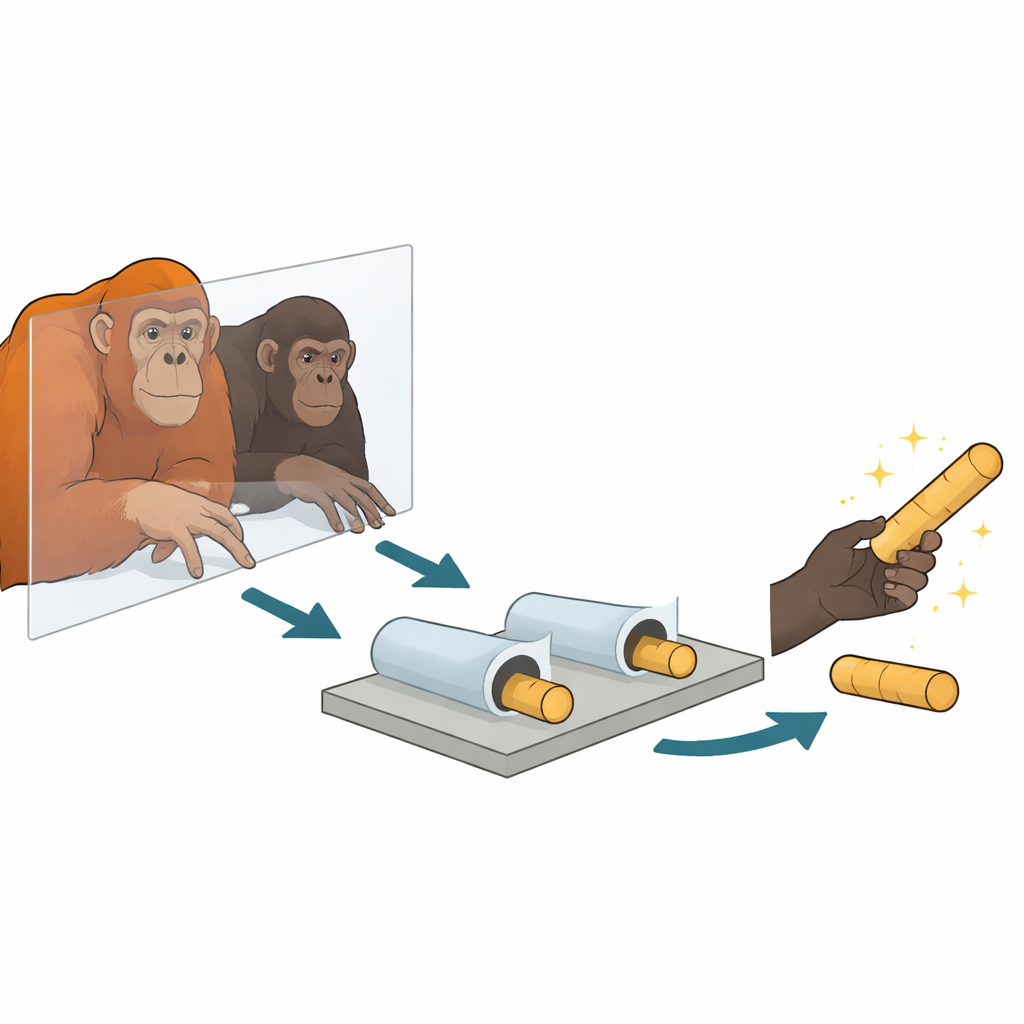
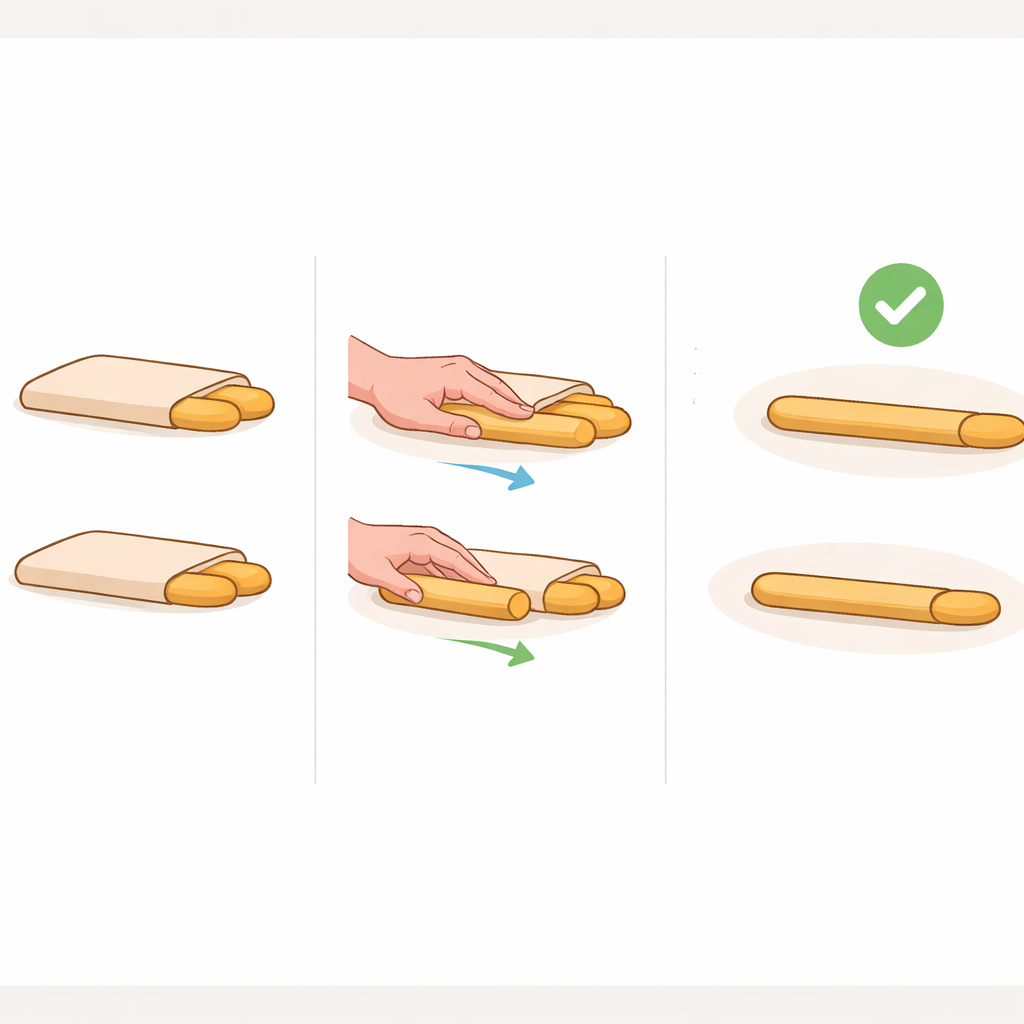
Past work tried to probe great apes’ understanding of hidden tool properties—whether a stick behind a box was intact or broken. Those results were mixed, possibly because apes had to juggle two things at once: the tool and a separate, out-of-reach reward. Here, the researchers simplified the problem. The breadstick itself was both tool and reward: if it was intact, the ape got the whole thing; if it was broken, they got less or even nothing. The middle part of each breadstick was hidden under a curved cover, with the ends sticking out so the two options looked identical. By sliding or pushing one end, the experimenter created different movement patterns—both ends moving together for a whole breadstick, or one end lagging behind for a broken one—offering a purely visual clue to what was going on under the cover.
Stepwise training in a thinking game
At first, twelve apes (seven chimpanzees and five orangutans) simply learned that a whole breadstick was better than a broken one when both were fully visible. Once they reliably preferred the intact stick, the real thinking tests began. In the early versions, apes watched both hidden breadsticks being slid before choosing. Only a few individuals picked the intact piece more often than chance, leading the team to suspect that memory load, split attention, or weak motivation (since even a broken stick was still a treat) might be holding the others back. To probe this, the researchers removed delays before choice, reduced how many sticks moved, or let apes bend down and peek inside the covers for extra information. They also changed the reward rules so that choosing a broken breadstick sometimes yielded nothing at all.
Learning the hidden mechanism
The turning point came when apes were shown the “secret machinery” behind the trick. In one phase, they watched uncovered whole and broken breadsticks as the experimenter moved them, making the connection between intactness and how the ends moved together or not. After this experience, many more individuals started succeeding when the breadsticks were hidden again and only the motion of the ends gave the clue. The team then introduced new twists: pushing inner ends instead of sliding outer ends; briefly uncovering just the broken breadstick; and, most powerfully, using a three-piece broken breadstick whose small middle segment could be removed and shown like a puzzle piece. In transfer tests where movement cues and the floating middle piece sometimes pointed in conflicting ways, several apes still picked the intact breadstick at high rates, suggesting they were weighing the physical possibilities rather than following a simple “avoid this cue” rule.
What this reveals about ape minds
By the end of ten experiments, most orangutans and several chimpanzees were using indirect clues to judge whether a partly hidden breadstick was whole or broken, even in novel situations they had never seen before. Their success could not easily be explained by always avoiding a certain side, always following the experimenter’s hand, or merely shunning the piece that looked smaller. Instead, the results point toward a flexible ability to reason about unseen properties of objects: to link what they see—a particular kind of movement or a briefly revealed fragment—to what must be true under the cover. The sample was small, and not every individual succeeded, but the work offers fresh evidence that our close relatives can, under the right conditions and with relevant experience, think about hidden causes in ways that echo the building blocks of human reasoning.
Citation: Schubiger, M.N., Fichtel, C. & Mulcahy, N.J. Orangutans and chimpanzees show evidence of inferring when a hidden breadstick is intact or broken. Sci Rep 16, 11305 (2026). https://doi.org/10.1038/s41598-026-38796-x
Keywords: ape cognition, inferential reasoning, problem solving, object permanence, primate experiments