Clear Sky Science · en
Exploring the association between mental imagery, sensory sensitivity, and autistic traits in autistic and non-autistic adults
Why our inner pictures matter
When you picture a sunset or remember the feel of sand between your fingers, those inner experiences are called mental images. Some people see and feel them almost like real life; others have little or no inner imagery, a pattern known as aphantasia. At the same time, many autistic people report that everyday sounds, lights, or textures can feel overwhelming or oddly faint. This study asks a simple but important question: are these two things—how vivid our inner pictures are and how strongly we react to real-world sensations—actually linked, especially in autistic people?

Three threads of experience
The researchers focused on three related but distinct traits in adults: mental imagery vividness, sensitivity to sights, sounds and touch, and autistic characteristics. Previous work had suggested that people with fewer autistic traits often have richer mental imagery, and that autistic traits tend to go hand-in-hand with stronger sensory reactions. That pattern would imply that vivid inner images and strong real-world sensitivity should pull in opposite directions. Yet another recent study had hinted at the opposite—that the more vivid people’s imagery, the more sensitive they were to sensory input—possibly because both might share a highly excitable sensory brain.
Listening to many minds
To probe these contradictions, the team surveyed 595 adults in the United Kingdom, half of whom were autistic and half non-autistic. Participants completed standard questionnaires about how clearly they could picture scenes or imagine touch, how often they found everyday sensations too strong or too weak, and how strongly they showed a range of autistic traits. This large, mixed group allowed the researchers to look not just at diagnostic labels, but at how these traits varied across people on a smooth spectrum.
Surprising separations
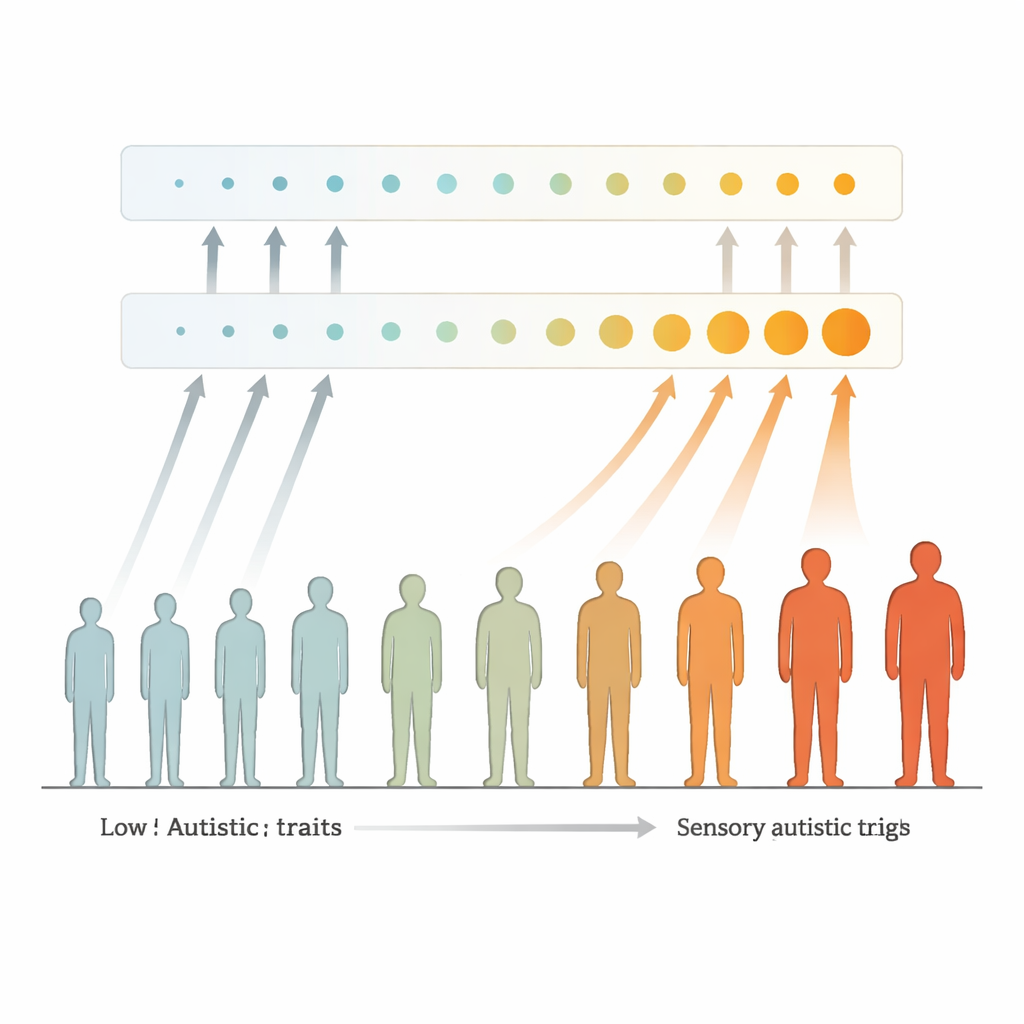
When the data were analysed, some expectations were confirmed. People with higher autistic trait scores typically reported stronger sensory sensitivities. They were also, on average, more likely to report less vivid visual and tactile imagery, and autistic participants showed a higher rate of scores consistent with aphantasia than non-autistic participants. However, the crucial link between mental imagery and sensory sensitivity themselves was strikingly weak. Visual imagery showed only a tiny negative relationship with sensory sensitivity, and touch imagery showed none at all. When the researchers used statistical models that took autistic traits into account, they could force a small positive link to appear between imagery and sensitivity, but this explained less than one percent of the differences between people—so small as to be practically negligible.
No shared wiring after all?
The findings challenge the idea that vivid inner images and strong sensory reactions share the same underlying brain mechanism, such as generally heightened excitability in sensory brain areas. Instead, the results suggest that these are largely independent features of human experience. Mental imagery draws heavily on top-down processes—our brain constructing experiences from within—whereas sensory sensitivity reflects how the nervous system responds to incoming sights, sounds, and touches. Autistic traits relate to both, but in different ways, rather than by tying imagery and sensitivity tightly together.
What this means for everyday life and care
For autistic people and clinicians, the study carries two main messages. First, low or absent mental imagery appears somewhat more common in autism, but it is not simply another face of sensory sensitivity. Second, because many psychological therapies and mindfulness practices ask people to work with vivid inner pictures, therapists may need to consider that some autistic clients—and some non-autistic ones—find such imagery hard to generate. Overall, the research shows that how we see and feel the world inside our heads, and how we react to the world outside, are related to autism in overlapping but distinct ways, rather than being driven by a single shared cause.
Citation: Taylor, R., Sumner, P., Singh, K.D. et al. Exploring the association between mental imagery, sensory sensitivity, and autistic traits in autistic and non-autistic adults. Sci Rep 16, 11018 (2026). https://doi.org/10.1038/s41598-026-38574-9
Keywords: mental imagery, aphantasia, autism, sensory sensitivity, questionnaire study