Clear Sky Science · en
Seasonal and diel acoustic activity of sei whales (Balaenoptera borealis) in the New York Bight
Listening for Giants Near New York
The busy waters off New York and New Jersey are not just shipping lanes and future wind farms—they are also seasonal highways for endangered sei whales. Because these sleek, little‑known giants are hard to spot at the surface, scientists turned to listening instead of looking. By eavesdropping on whale calls over several years, they set out to learn when sei whales pass through the New York Bight, how their calling changes over the day and seasons, and how their movements might intersect with intense human activity.
Whales in a Crowded Sea
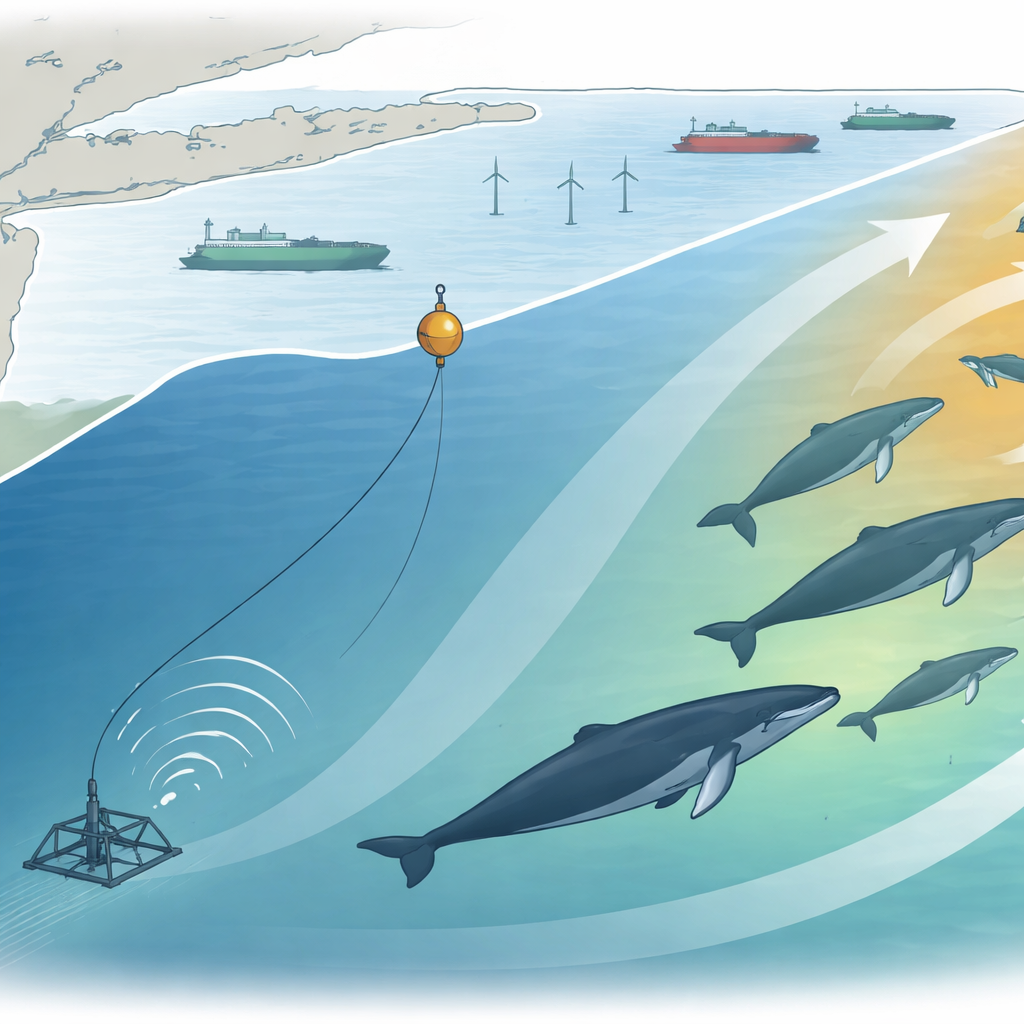
The New York Bight hosts some of the densest ship traffic on the U.S. East Coast, along with commercial fishing and expanding offshore wind development. All of this raises the risk of ship strikes, entanglement, and noise disturbance for large whales. Sei whales are especially worrisome: they are endangered, travel fast, and tend to stay offshore, making them difficult to see and protect. Previous surveys suggested that sei whales visit this region mainly in spring, but visual sightings near shore were rare. To fill the gaps, the authors deployed a sophisticated listening buoy on the mid‑shelf, about 40 kilometers off New York Harbor, to record underwater sounds almost continuously from 2017 through 2020.
Tracking Whales by Their Voices
Sei whales produce a distinctive low‑frequency “downsweep” call that slides from higher to lower pitch over about a second and a half. The team used automated detectors to flag possible downsweeps in the recordings, then manually checked each one to avoid confusing them with similar sounds from humpback whales. For every week of the study, they counted how many days whales were heard (acoustic presence) and how many calls were recorded (vocal activity). They then compared these patterns with satellite‑derived sea surface temperature and chlorophyll‑a, a pigment that hints at how much plant‑like plankton is in the water and, indirectly, how much food might be available for whales higher up the food web.
Spring Peaks and Shifting Seas
The acoustic record revealed a strikingly regular pattern. Sei whale calls occurred in almost every month except the coldest winter weeks, but about 95 percent of all calls were concentrated between March and May. Presence and vocal activity were usually low in summer and early winter, with a smaller bump in late summer and autumn. The clearest environmental link was with sea surface temperature. Whale calling surged when waters warmed to about 5–9 degrees Celsius in late winter and early spring, then dropped sharply once temperatures climbed past roughly 9 degrees. In 2018, when waters stayed cooler for longer—likely tied to a La Niña climate pattern—both whale presence and calling remained elevated several weeks later than in other years, suggesting that cooler, late spring conditions delayed the whales’ departure or drew more animals into the area.
Daytime Voices, Nighttime Feeding
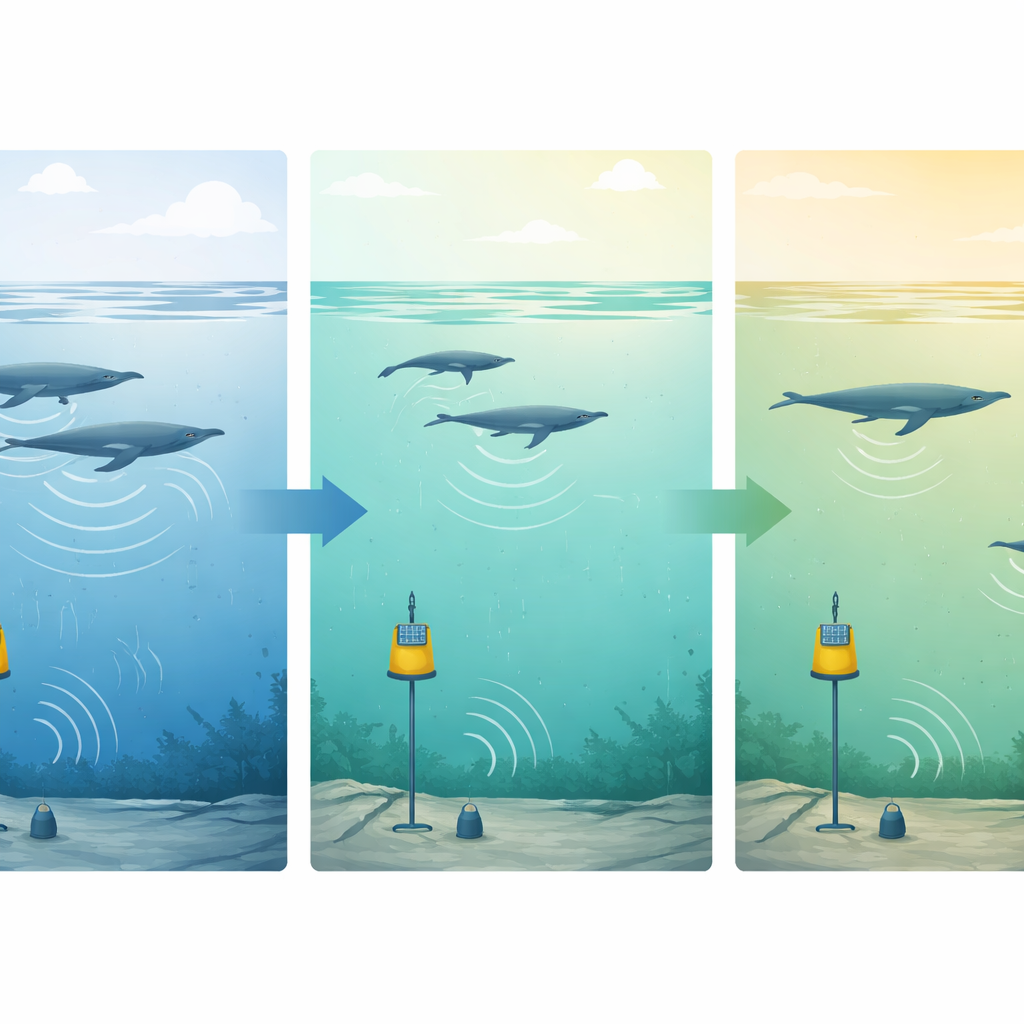
By sorting calls into daytime, nighttime, and twilight hours, the researchers uncovered strong daily rhythms. Sei whales called more often and were detected on more days during daylight than at night or during dawn and dusk, especially in spring. This fits with the idea that whales may feed more actively at night, when their tiny crustacean prey rise closer to the surface, and call more during the day for social reasons or to keep in touch while migrating. In autumn, patterns flipped in some weeks, with more calling at night, hinting that whales may be exploiting different prey or simply passing through more quickly on their way south.
What This Means for Whales and People
Together, these findings show that the New York Bight is a reliable spring stopover—and perhaps a feeding area—for sei whales, tightly linked to cool seasonal waters rather than to simple surface measures of productivity like chlorophyll. Because whales are present and often quiet at night, yet spend more time near the surface then, they may be especially vulnerable to fast‑moving ships they cannot hear or avoid in time. The study provides rare baseline information on when and how sei whales use this crowded coastal corridor. That knowledge can help managers time slow‑down zones, refine real‑time acoustic alerts, and design future offshore projects so that the seasonal passage of these endangered giants is heard, and protected, rather than overlooked.
Citation: Papadopoulos, M.R., Rekdahl, M.L., King-Nolan, C.D. et al. Seasonal and diel acoustic activity of sei whales (Balaenoptera borealis) in the New York Bight. Sci Rep 16, 11119 (2026). https://doi.org/10.1038/s41598-025-33863-1
Keywords: sei whales, New York Bight, passive acoustic monitoring, marine conservation, ship strike risk