Clear Sky Science · en
Mapping regional disparities in discounted grocery products
Why wasting less food in stores matters
Every time a grocery store slaps a discount sticker on food that is about to expire, it is a small clue about where our food system is leaking. Those leaks add up: food waste is responsible for a large share of global greenhouse gas emissions. This study looks inside one of Denmark’s biggest supermarket chains to see which types of foods most often end up on near-expiry sale, and how that pattern changes between big cities and rural towns. Understanding these hidden patterns can help design smarter, more local ways to cut waste, improve diets, and lower the climate impact of what we buy.
Looking at discounts across a whole country
The researchers analyzed 153 days of data from more than 500 Netto discount supermarkets operated by Denmark’s largest retail group. Using an open online feed that lists products nearing their expiration date, they tracked when and where items such as meat, dairy, bread, and ready-made meals were discounted. They combined this with detailed maps of the road network to measure distances between stores and with public databases that rate foods for both nutrition and environmental impact. This gave them a nationwide view of how often different foods end up on sale because they are close to spoiling, not because of planned marketing campaigns.
City centers, suburbs, and countryside behave differently
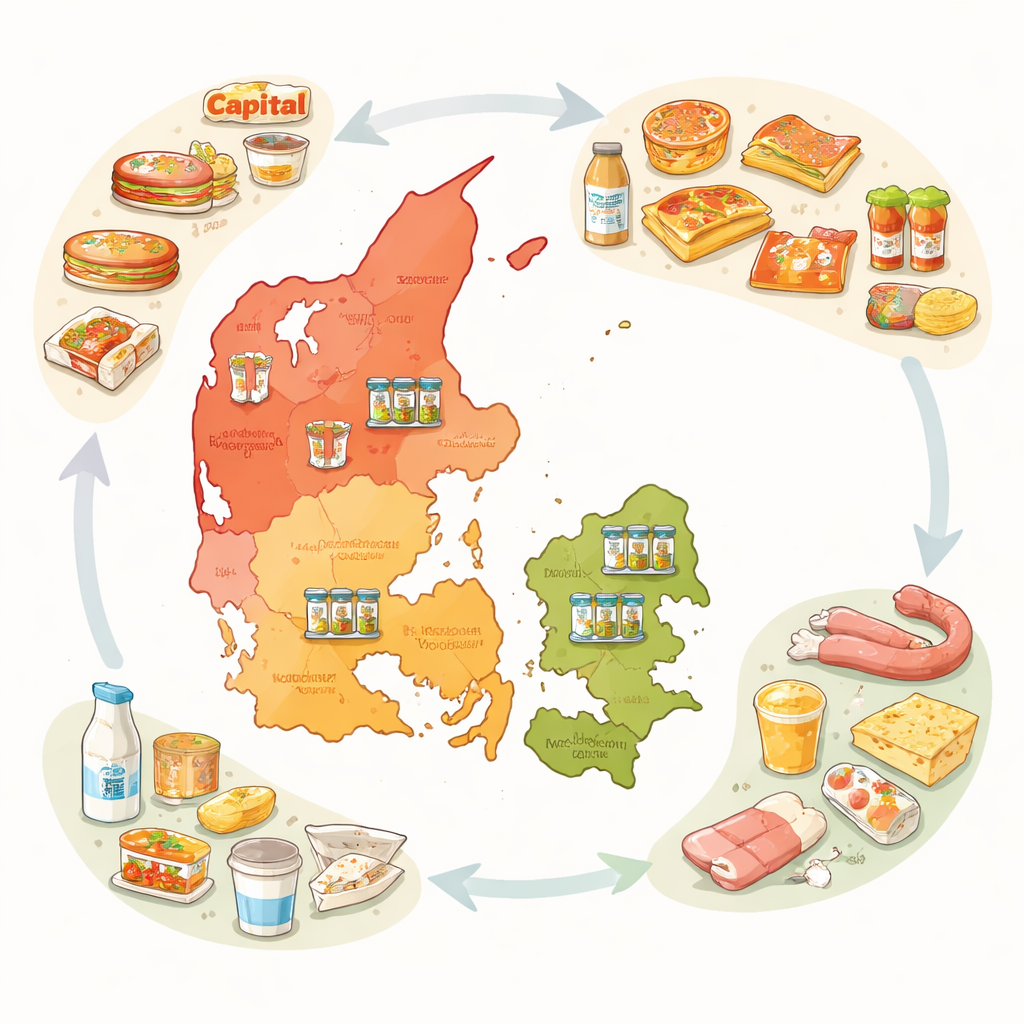
By clustering stores based on how close they are along real roads, the team revealed a clear geographic structure. Dense urban cores form tight clusters, while rural stores are more isolated. When they compared this map to patterns of discounted products, they found that nearby stores tend to have similar mixes of items on sale, but those similarities fade and even reverse over longer distances. Using network tools that link stores to the products they discount most often, the authors uncovered three main communities: a capital region centered on Copenhagen, a group of other metropolitan areas, and a broad countryside group. These communities are not defined by administrative borders alone, but by how stores actually behave.
What ends up on sale where
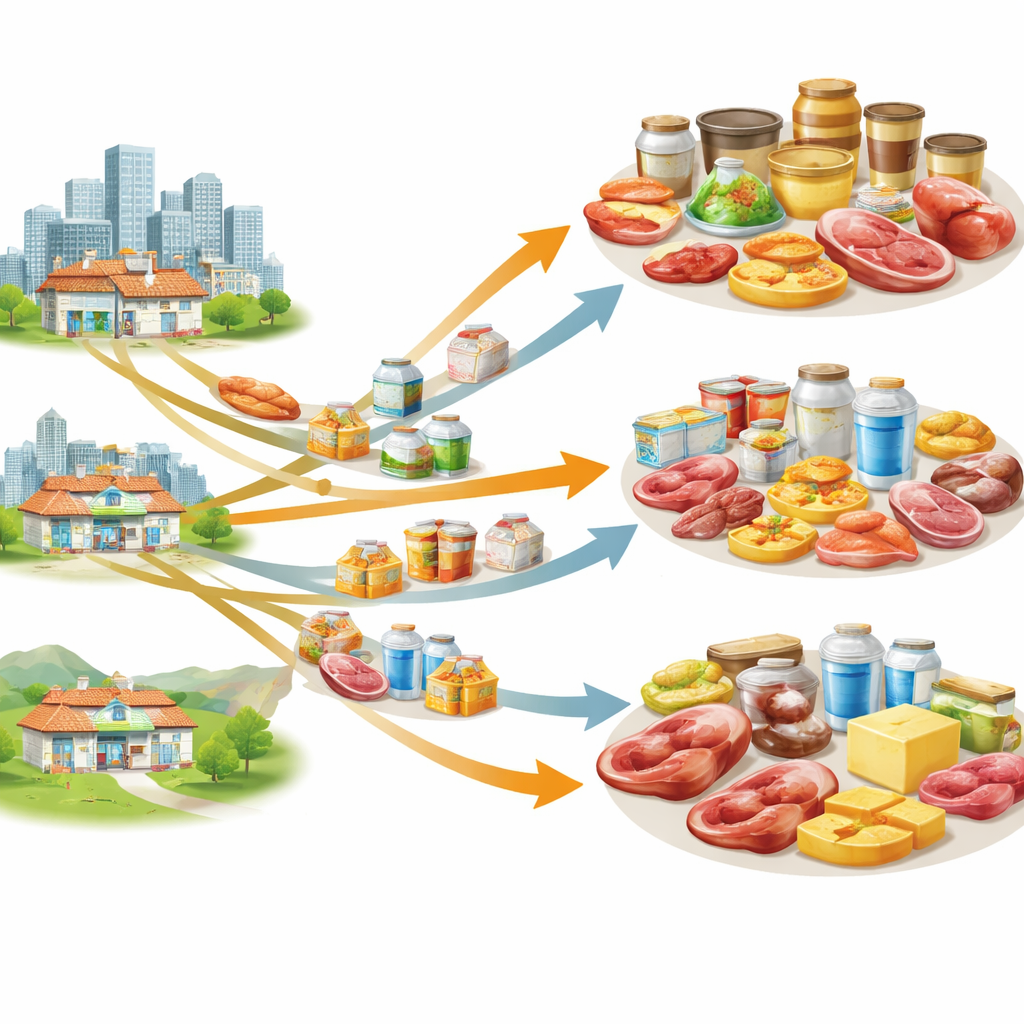
The three store communities show strikingly different discount profiles. In the countryside, meat products are heavily overrepresented among near-expiry discounts: some types of meat, such as pork, appear up to about twice as often per person as in metropolitan areas, and chicken discounts are essentially absent from the city-group but common in rural stores. Dairy products like butter also go on sale more frequently in rural areas. In contrast, the capital region and other metropolitan centers lean toward ready-to-eat and convenience items. Discounted cold coffee drinks, snack-style desserts, crackers, tapas and pasta dishes are much more common there, reflecting faster-paced, on-the-go lifestyles and different stocking choices by retailers.
Health and planet impacts of these patterns
To understand what these discounts mean for health and climate, the authors matched individual products to widely used nutrition and environmental ratings wherever possible. Across all regions, mid-range nutrition scores dominate, and the healthiest items are rarely the ones most often discounted. Rural areas show the highest share of nutritionally poorer options among discounted foods, suggesting that residents are more often exposed to cheap but less healthy near-expiry items. On the environmental side, rural stores appear to discount somewhat more climate-favorable products according to available scores, while city regions lean toward foods with higher impacts. However, because meat is known to have a large environmental footprint and many meat products lacked environmental labels, the true climate toll of rural discounts is likely underestimated.
Why local retail patterns matter for cutting waste
The study concludes that food waste in supermarkets is not a uniform problem with a one-size-fits-all solution. Instead, it is tightly linked to geography, store networks, and local habits. Rural stores struggle more with surplus meat and butter, while city stores are more prone to wasting convenience foods. That means policies and store strategies to cut waste—such as how much to order, how quickly to discount, or what package sizes to stock—should be tailored to each region’s typical problems. By aligning waste-reduction efforts with local retail realities, it is possible to reduce discarded food, improve diets, and lower greenhouse gas emissions more effectively than with national rules that ignore these fine-grained differences.
Citation: Desiderio, A., Galdeman, A., Bäuerlein, F. et al. Mapping regional disparities in discounted grocery products. npj Sci Food 10, 112 (2026). https://doi.org/10.1038/s41538-026-00764-0
Keywords: food waste, grocery retail, discounted food, regional differences, Denmark