Clear Sky Science · en
An ENIGMA Consortium study of the relationship between white matter microstructure and positive and negative symptom severity in patients with schizophrenia
Why Brain Wiring Matters in Schizophrenia
Schizophrenia is often described in terms of vivid hallucinations, disturbing beliefs, and emotional withdrawal, but underneath these experiences lies the brain’s physical wiring. This study brings together brain scans from over a thousand people worldwide to ask a simple question with big implications: how do changes in the brain’s internal “communication cables” relate to how severe a person’s symptoms are? The answers offer fresh support for viewing schizophrenia not just as a problem with isolated brain regions, but as a disorder of how those regions are connected.
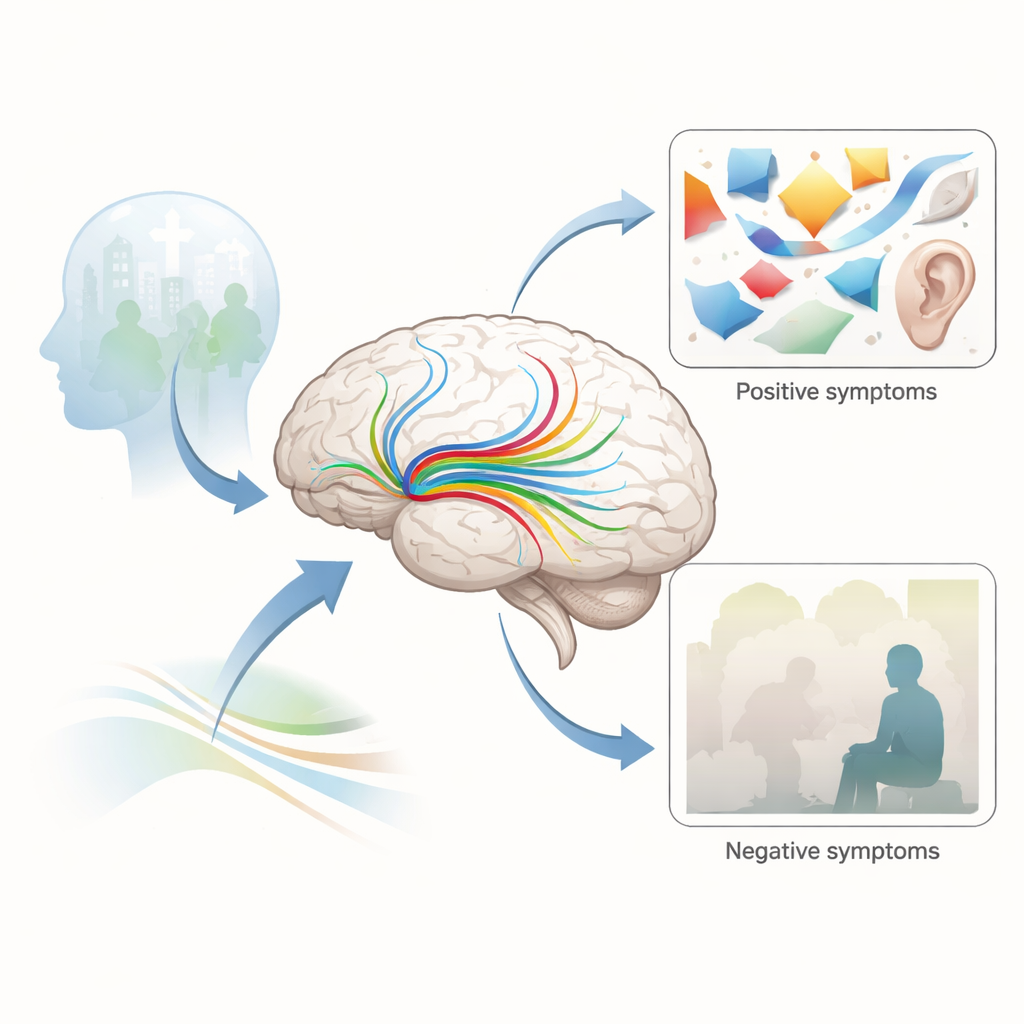
Two Types of Symptoms, One Connected Brain
People with schizophrenia commonly experience two broad groups of symptoms. Positive symptoms add experiences that should not be there, such as hearing voices or holding fixed false beliefs. Negative symptoms reflect the loss of normal functions, including blunted emotion, lack of motivation, and social withdrawal. Earlier research linked these symptoms mainly to changes in the brain’s gray matter—the outer layers where nerve cells sit. But nerve cells communicate along long, cable-like fibers known as white matter. If schizophrenia is also a disorder of communication, it makes sense to look closely at how the condition of these cables is related to what people actually feel and do.
A Global Effort to Map Brain Cables
To tackle this, researchers from 19 centers in Europe, Asia, Australia, and North America pooled diffusion MRI scans from 1,025 people with schizophrenia. This type of scan tracks how water moves along nerve fibers, producing a measure called fractional anisotropy, or FA, which reflects how orderly and intact white matter is. Rather than focusing on dozens of individual tracts separately, the team summarized white matter organization in three ways: a global measure across the whole brain, a set of pathways running through temporal regions (important for hearing and language), and a set through frontal regions (important for planning, emotion, and motivation). They then asked how each of these measures related to people’s positive and negative symptom scores.
How Brain Wiring Relates to Hallucinations and Delusions
The researchers found that people with more severe positive symptoms tended to have slightly lower FA both across the brain and in temporal pathways. In other words, the more disrupted the brain’s wiring—especially in regions involved in sound and language—the stronger the hallucinations and delusions. Follow-up analyses showed that the global measure of white matter integrity captured unique information beyond the temporal pathways alone. This pattern fits with the idea that positive symptoms may arise when communication across many brain areas becomes less efficient or less coordinated, not just when one specific pathway is damaged.
Subtle Wiring Changes and Long-Term Difficulties
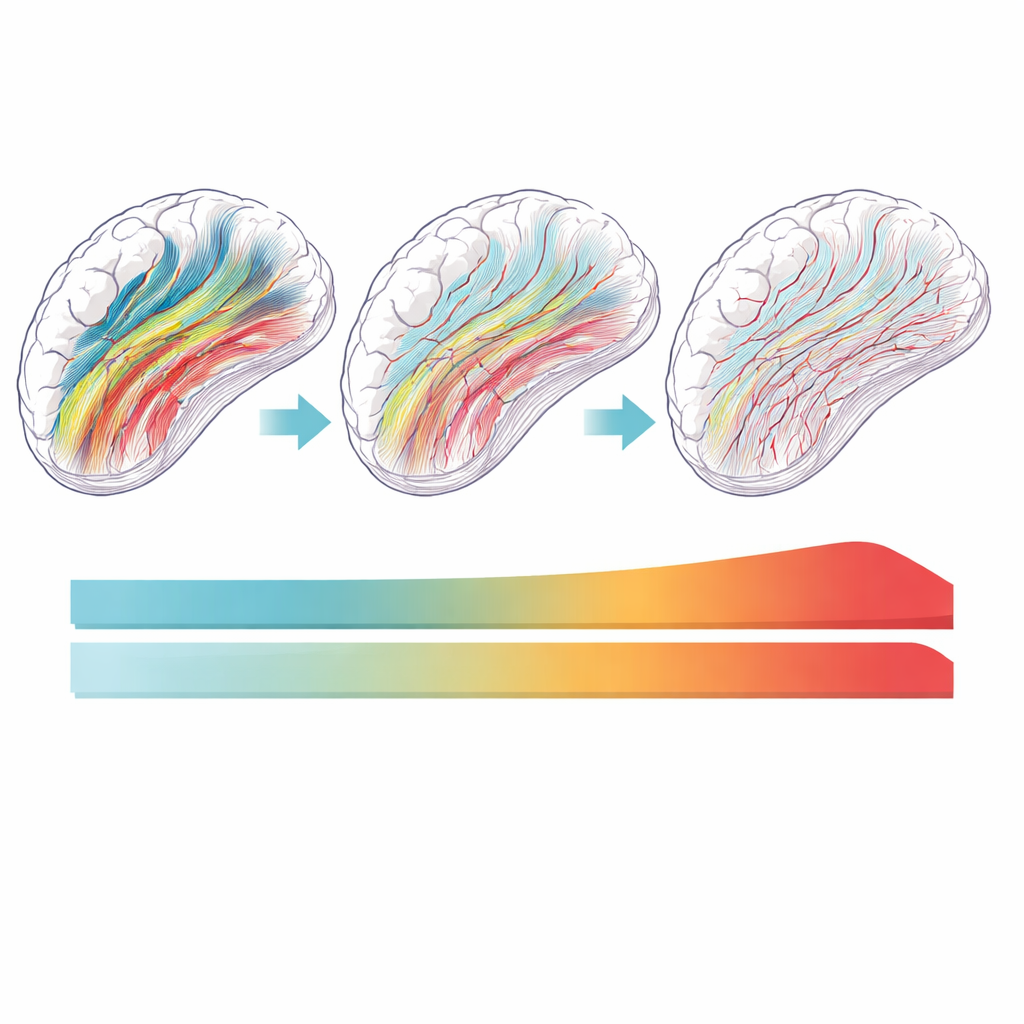
The picture for negative symptoms was more complex. At first glance, there was no clear link between these symptoms and either frontal or global white matter in the full sample. However, when the scientists examined why results varied from site to site, one factor stood out: how long people had been ill. In places where participants had been living with schizophrenia for longer, stronger links emerged between poorer white matter organization and more severe negative symptoms. When the team removed one site that strongly differed in illness duration and other characteristics, clearer patterns appeared: higher negative symptom severity was associated with lower FA in both frontal pathways and across the brain. This suggests that long-term changes in brain wiring may be especially relevant for the enduring motivational and emotional difficulties seen in schizophrenia.
What This Means for Understanding Schizophrenia
Putting everything together, this large, carefully harmonized study shows that small but reliable changes in the brain’s wiring are tied to how severe both positive and negative symptoms are, especially when illness has lasted many years. The findings reinforce a view of schizophrenia as a condition of disturbed brain connectivity: the communication lines that link gray matter regions are subtly compromised, and this disruption relates to the intensity of people’s experiences and day-to-day challenges. While these results do not yet translate directly into new treatments, they point researchers toward interventions that might protect or restore white matter health and highlight the importance of studying brain changes over time, not just at a single point in an illness.
Citation: Warren, A., Holleran, L., Agartz, I. et al. An ENIGMA Consortium study of the relationship between white matter microstructure and positive and negative symptom severity in patients with schizophrenia. Schizophr 12, 38 (2026). https://doi.org/10.1038/s41537-026-00728-z
Keywords: schizophrenia, white matter, brain connectivity, diffusion MRI, symptom severity