Clear Sky Science · en
EU-ETS emergency reserve price curbs coal use and shields consumers during natural gas price shocks
Why this matters for everyday life
When natural gas prices suddenly soar, household electricity bills spike and governments scramble to respond. This study looks at what happened in Europe when gas prices exploded after Russia invaded Ukraine and asks a simple question with big consequences: is there a smarter way to protect consumers without backsliding on climate goals?
What happens when gas gets very expensive
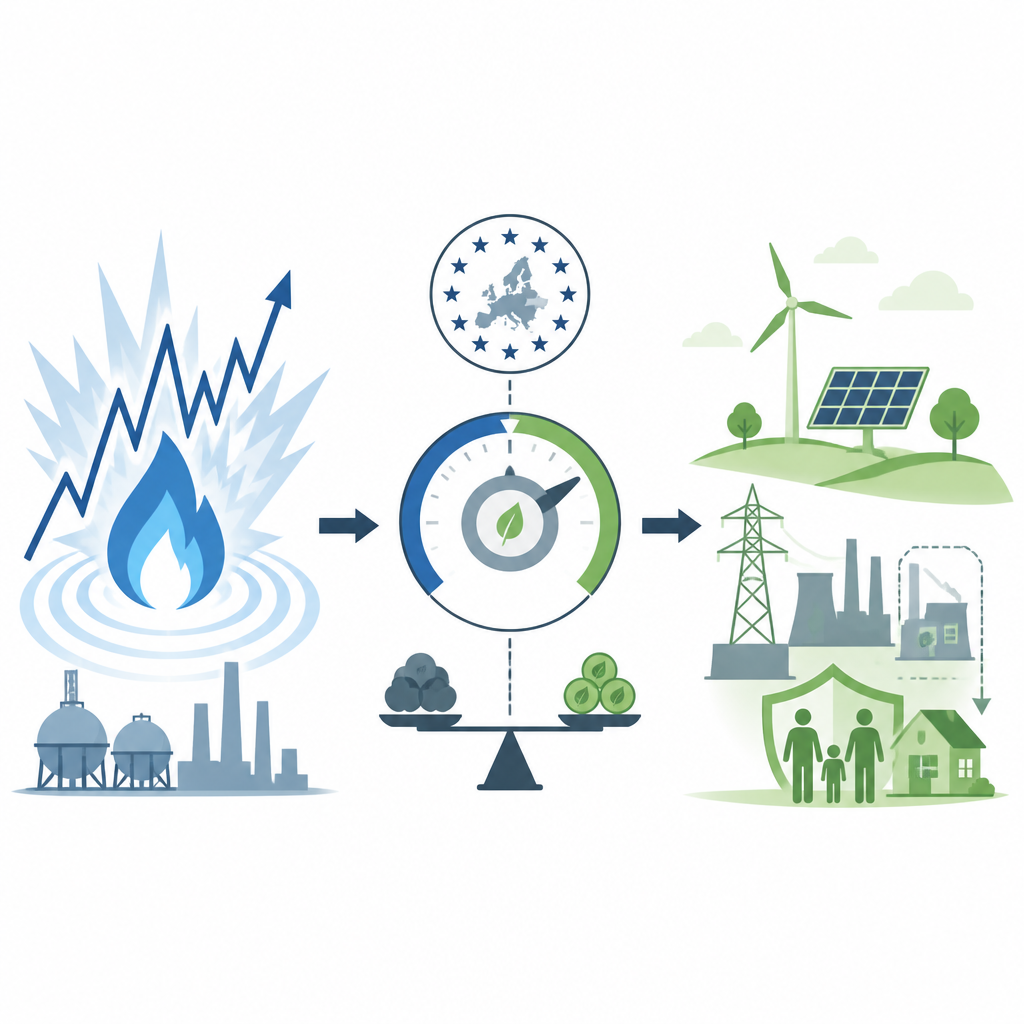
The researchers begin by charting how Europe’s power system reacted to the historic gas price surge of 2021–2022. As gas became far more costly, many power plants switched from burning gas to burning coal, which is cheaper but much more polluting. Across 13 European Union countries that still used both fuels, coal power rose sharply and carbon emissions jumped by about one fifth above what they would have been under pre-crisis fuel prices. At the same time, wholesale electricity prices climbed dramatically, feeding through to higher costs for households and businesses.
How European countries juggled coal, gas, and prices
The response was not the same everywhere. In coal-heavy countries such as Poland and Czechia, generators leaned on coal plants to replace expensive gas, which kept electricity prices somewhat lower but pushed emissions up. In nations with more renewable power and less coal, like Spain and Finland, there was less room to switch fuels. There, high gas prices flowed more directly into high electricity prices. By comparing these patterns hour by hour, the authors show a clear trade-off: using coal capacity to cushion price shocks tends to worsen emissions, while systems that are cleaner on paper can still be very exposed to fuel price swings.
Why the gas price cap falls short
In late 2022 the European Union introduced a cap on wholesale gas prices, hoping to tame extreme spikes. The team use their data to simulate how that cap would have worked if it had been active during the worst of the crisis. They find that it would have cut power-sector emissions only modestly, mainly in a few large countries. The cap does limit the shift from gas to coal, which is good for the climate, but it also makes electricity cheaper overall. Lower prices encourage people to use more electricity, which pushes emissions back up. These two effects largely cancel out, so the environmental benefit of the gas cap remains small.
A different safety valve inside carbon markets
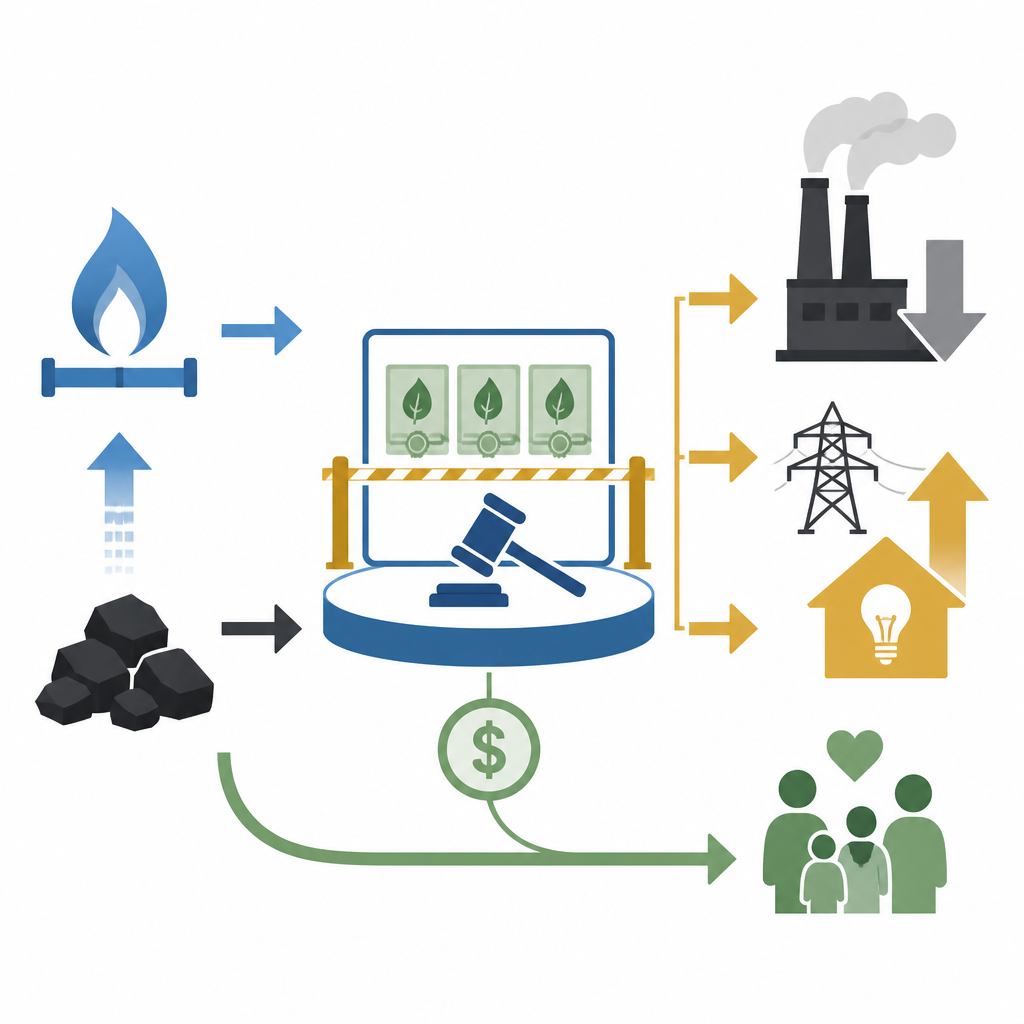
Instead of trying to hold gas prices down, the authors propose a rule-based “emergency reserve price” inside the European carbon trading system. When gas prices shoot far above normal levels, this mechanism would automatically add a small extra charge to the price of emitting carbon, set so that gas does not suddenly become far more expensive than coal. Their calculations suggest that an increase of only about 12 euros per tonne of carbon in 2022 would have more than doubled the emissions cuts achieved by the gas cap. Because higher carbon prices also slightly raise electricity prices, they reduce demand, reinforcing the shift away from coal rather than offsetting it.
Turning carbon revenues into consumer relief
A key concern is that any policy that raises power prices will hurt households. The study tackles this by counting the extra money governments would collect from selling emission permits at the higher emergency price. Across the 13 countries, these revenues would have far exceeded the added costs to consumers from higher electricity prices. In fact, recycling only a small share of the money back to households would be enough to fully offset their higher bills, with substantial funds left over for further support or investment in clean energy. This stands in contrast to a gas cap, which lowers prices but does not generate new public revenue.
What this means for future energy shocks
In plain terms, the authors conclude that Europe’s carbon market can be equipped with an automatic safety feature that both limits the temptation to burn more coal during gas crises and offers better protection to consumers than a gas price cap. By tying the response to clear rules instead of ad hoc decisions, such an emergency reserve price could help keep climate policy on track even when fossil fuel markets are in turmoil, and would become less important over time as coal is phased out and renewables expand.
Citation: Bento, A.M., Koch, N. & Marmarelis, Z.E. EU-ETS emergency reserve price curbs coal use and shields consumers during natural gas price shocks. Nat Commun 17, 4637 (2026). https://doi.org/10.1038/s41467-026-73559-2
Keywords: natural gas price spikes, EU emissions trading system, coal to gas switching, electricity prices, carbon pricing policy