Clear Sky Science · en
Bullying victimization and brain development: a longitudinal structural magnetic resonance imaging study from adolescence to early adulthood
Why bullying leaves more than emotional scars
Bullying is often seen as a painful schoolyard problem that fades with time, but for many young people it is a chronic stress that shapes how they think, feel, and relate to others well into adulthood. This study asks a stark question: does being bullied during the teenage years leave a fingerprint on the developing brain itself, and do those brain changes look different for young women and men?

Following teenagers and their brains over time
The researchers drew on the IMAGEN project, a large European study that has followed over two thousand young people from around age 14 into their early twenties. At three key ages, roughly 14, 19, and 22, participants had detailed brain scans and completed surveys about how often they were bullied over the previous six months. Bullying covered a range of harmful peer behaviors, including name calling, exclusion, and physical aggression. With repeated scans, the team could track how different brain regions grew or shrank over time, rather than taking just a single snapshot.
Where bullying tracks with brain growth
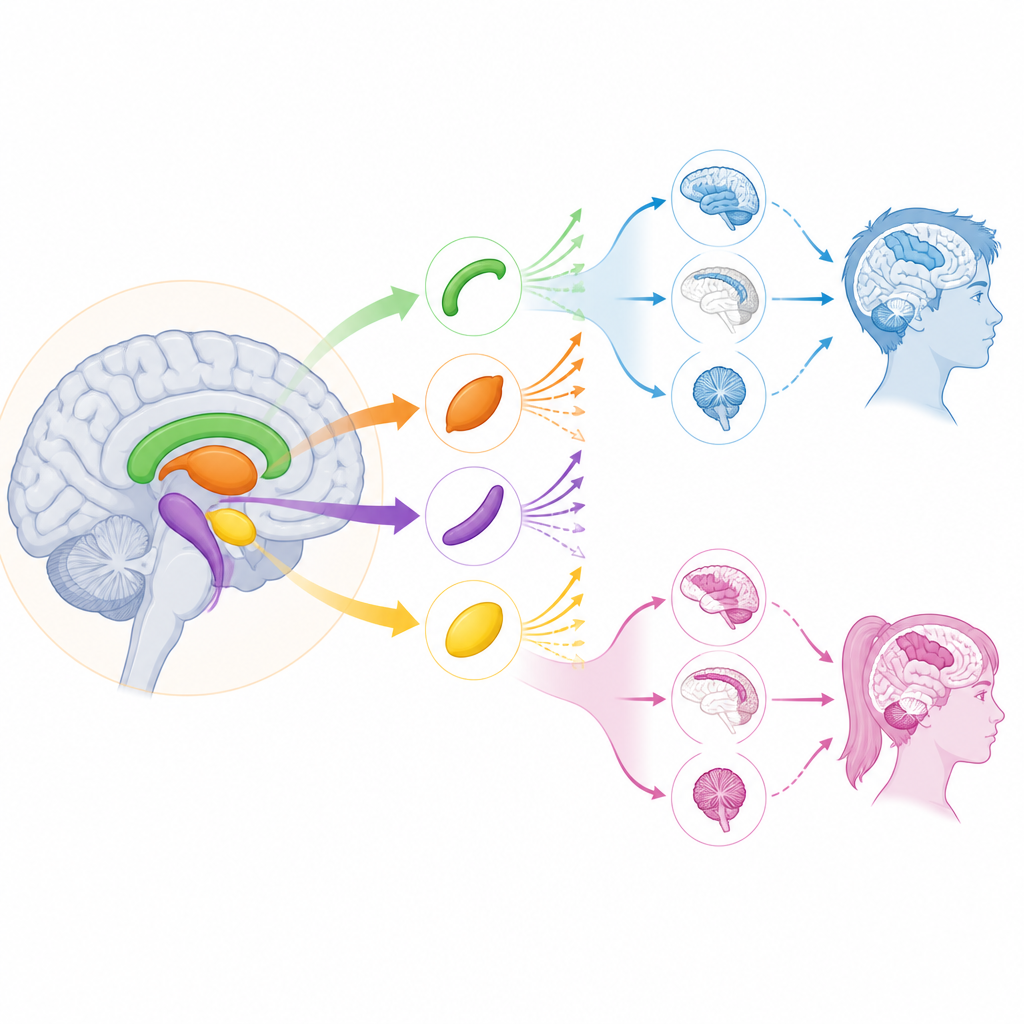
Using advanced statistical models, the study linked levels of reported bullying to changes in the size of 88 brain regions. A clear pattern emerged. Teens who reported more bullying tended to show faster growth in several deep brain areas tied to emotion, learning, and habits. These included structures like the amygdala and hippocampus, which help detect threat and store emotional memories, and parts of the basal ganglia that are involved in forming automatic responses and motivated behavior. At the same time, bullying was linked to slower growth or even loss of volume in regions involved in thinking, sensing, and coordination, such as parts of the outer cortex, the insula, and the cerebellum.
What these brain changes may mean in everyday life
The pattern of larger emotional and habit circuits alongside thinner control and sensory regions fits with what many bullied teens report: feeling on edge, stuck in unhelpful patterns, and struggling to read social situations. A more reactive amygdala and hippocampus could make emotional memories of bullying especially vivid and easy to trigger. Changes in the striatum may encourage rigid, threat-focused habits that once helped the teen cope but later get in the way of flexible, healthy behavior. Reduced volume in areas like the insula, visual regions, and cerebellum may contribute to misreading others’ intentions or feeling clumsy and out of sync in social settings, which can in turn invite further rejection.
Different paths for young women and men
When the team looked at sex differences, they found that bullying did not shape all brains in the same way. For females, higher bullying exposure was more strongly tied to growth in limbic and related areas, including regions supporting emotional memory and internal bodily awareness. For males, bullying was more linked to changes in regions that support movement, spatial awareness, and detecting important cues in the environment. These differences echo the fact that girls are more often targeted with social exclusion and rumor spreading, while boys more often face direct physical or verbal attacks, suggesting that the type of bullying may “tune” different brain systems over time.
What this means for young people and their support networks
Although the study cannot prove that bullying alone causes these brain differences, it shows that frequent victimization is closely tied to how key brain systems mature during the sensitive years from mid-teens to early adulthood. The findings reinforce the idea that bullying is not just a temporary social difficulty but a serious and sustained stressor that can influence circuits involved in stress, emotion, and social understanding. For parents, teachers, clinicians, and policy makers, this work adds biological weight to calls for early, effective anti-bullying efforts and for support that helps young people rebuild a sense of safety, connection, and flexible thinking as their brains continue to develop.
Citation: Connaughton, M., Mitchell, O., Cullen, E. et al. Bullying victimization and brain development: a longitudinal structural magnetic resonance imaging study from adolescence to early adulthood. Transl Psychiatry 16, 256 (2026). https://doi.org/10.1038/s41398-026-04010-9
Keywords: bullying victimization, adolescent brain development, stress and emotion, peer relationships, MRI study