Clear Sky Science · en
XRF examination of the overpainting of fascist symbols in a painting by Erich Mercker
Hidden stories beneath the paint
At first glance, an old cityscape by German painter Erich Mercker shows a peaceful Munich square with a blue and white Bavarian flag. Yet using modern X-ray tools, researchers uncovered a very different picture buried beneath the surface: a scene filled with Nazi symbols that had been carefully covered up after the Second World War. This study explains how science can peel back layers of paint to reveal how artists – and societies – tried to rewrite their own past. 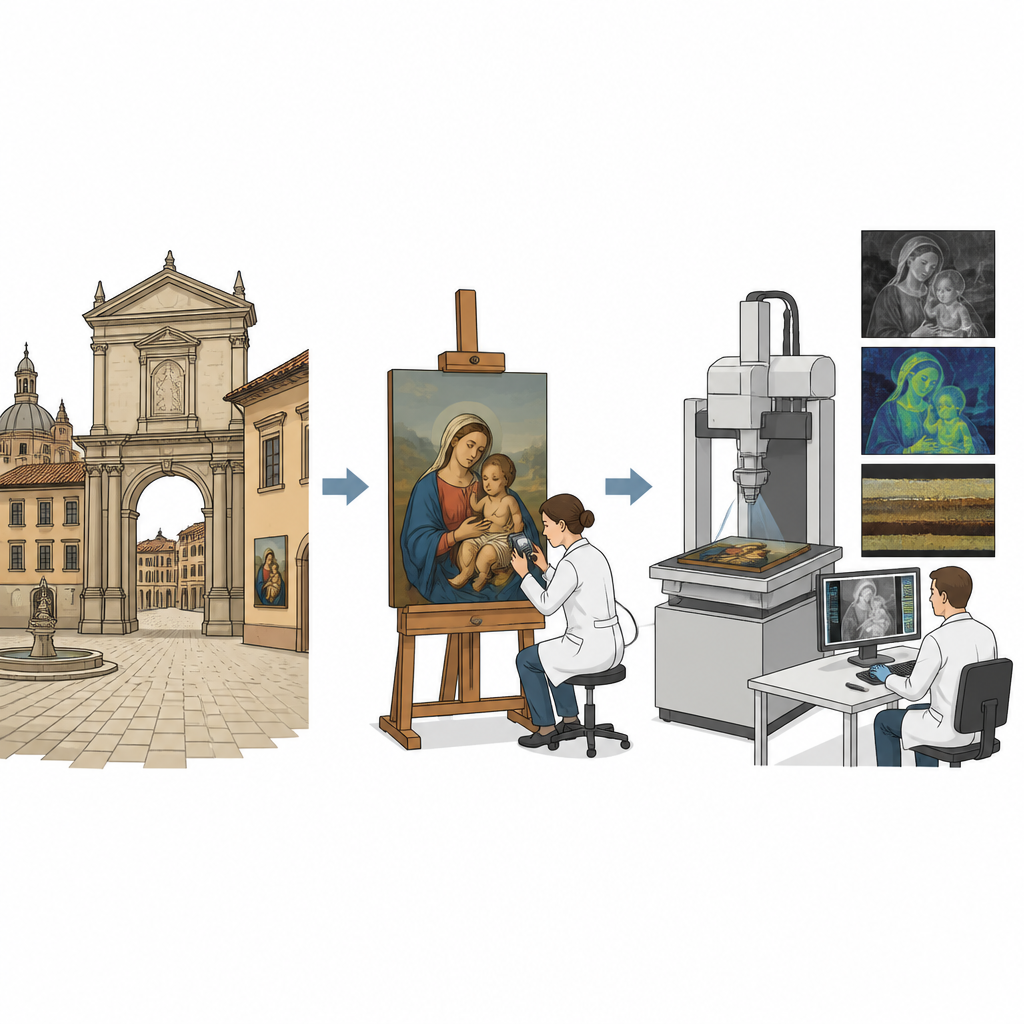
The painter and his changing times
Erich Mercker was a successful German painter best known for landscapes and industrial scenes. During the Nazi years, his detailed views of factories, bridges, and city squares were popular with officials and private collectors, and he sold many works to the state. One recurring subject was the Odeonsplatz in Munich, where a monument honored Nazi supporters killed in the failed Beer Hall Putsch of 1923. Before 1945 Mercker painted this square with clear party symbols, including soldiers, wreaths, and the familiar red flag.
A painting that did not match history
The painting studied here, later titled with neutral place names, once hung in a private home as a wedding gift in 1966. It shows the same Munich square, but now with a Bavarian flag and no soldiers, wreaths, or Nazi banners. Strangely, the monument itself is still visible even though it was demolished right after Germany’s defeat in 1945. On the back, a faint inscription appears to spell out the old title linked to the Nazi memorial, and a number code suggests the work was originally finished in November 1934. Together these clues hinted that the “harmless” city view might once have looked very different.
Using X-rays to look under the surface
To test this idea, the team used X-ray fluorescence (XRF), a method that maps the elements in paint without damaging the artwork. Because X-rays can reach below the top layer, they can reveal colors and shapes that are no longer visible. The researchers focused on four key areas: the flag, the monument, the wall where wreaths once hung, and the standing figures in the foreground. They also studied old paint tubes from Mercker’s studio to understand what pigments he used and to see whether the same materials appear in both the visible painting and any hidden layers. 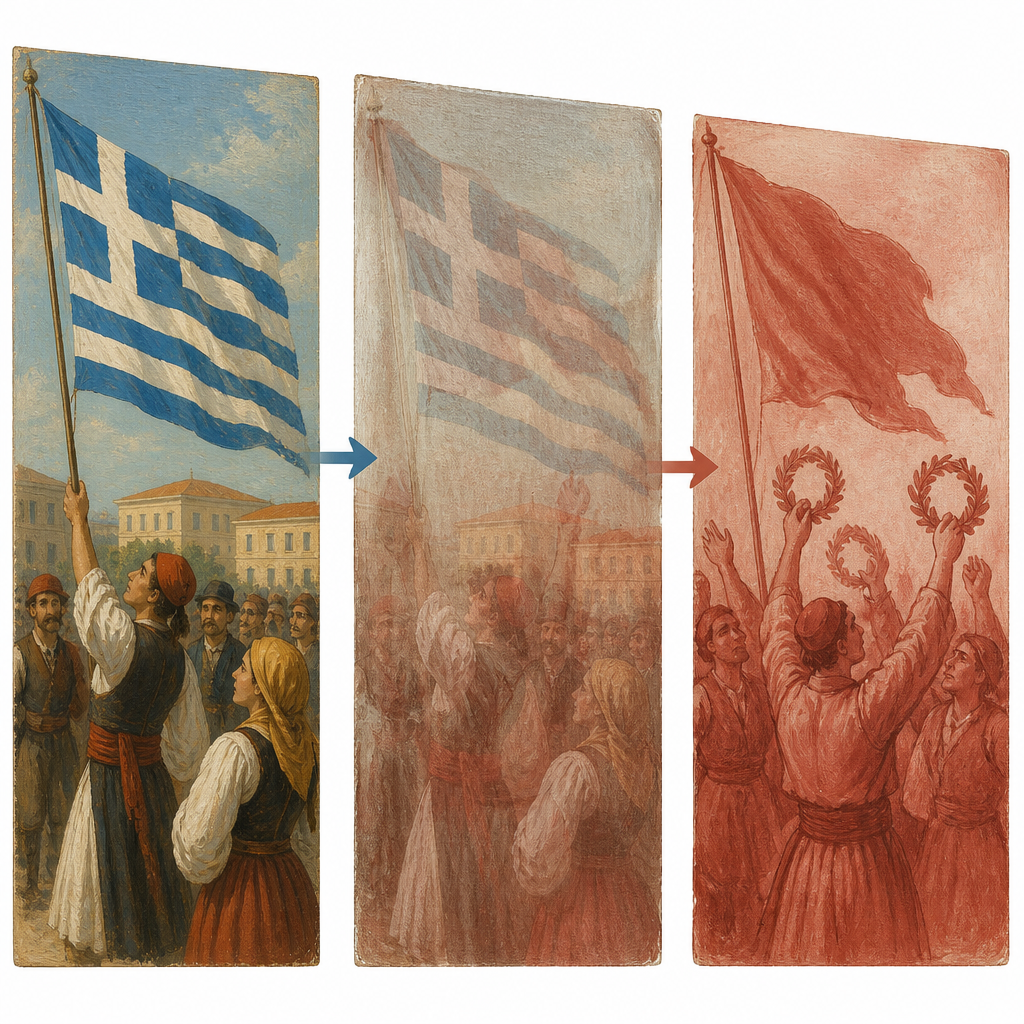
What the hidden layers showed
The flag area turned out to be especially revealing. XRF maps showed that beneath the blue and white flag lies a broad band of red paint made from cadmium-based pigment, matching the typical Nazi flag. The red layer stretches across the whole flag shape, with a slightly different elemental pattern in the center where a white circle and black symbol would have been. Elsewhere in the scene, X-ray maps exposed wreaths, ribbons, groups of soldiers, and raised arms that had been covered with paint rich in titanium white, a pigment not used in untouched parts of the work. The pigments and extenders in these overpainted passages closely match those in Mercker’s own paint tubes, suggesting that the same hand likely both created and revised the picture.
Art, memory, and what gets erased
By combining science with historical research, the authors conclude that this painting began life in 1934 as a clear tribute to a Nazi memorial and was later altered to hide its most obvious symbols. The revision did not fully correct the scene to match the postwar city; instead, it softened the political message just enough for the painting to circulate again in everyday life. This quiet act of repainting illustrates how, after 1945, many people tried to move on by covering over uncomfortable traces rather than confronting them openly. The study shows how modern imaging tools can recover these buried stories and help us understand how societies deal with difficult parts of their past.
Citation: Mantouvalou, I., Na’es, M., Wagener, Y. et al. XRF examination of the overpainting of fascist symbols in a painting by Erich Mercker. npj Herit. Sci. 14, 300 (2026). https://doi.org/10.1038/s40494-026-02577-6
Keywords: Erich Mercker, X-ray fluorescence, overpainting, Nazi-era art, heritage science