Clear Sky Science · en
Acquisition and use of animal resources during the Longshan period in the northern Guanzhong region of China
Animals, People, and a Changing World
Long before written history in China, how people raised and hunted animals shaped what they ate, how they lived, and even how early societies formed. This study looks at one such tipping point about 4,000 years ago in the Guanzhong region of northern China. By carefully examining thousands of animal bones from a large village called Xiaweiluo, the researchers show how local families balanced pigs, cattle, sheep, dogs, and wild game as the climate cooled and new livestock arrived from distant lands.
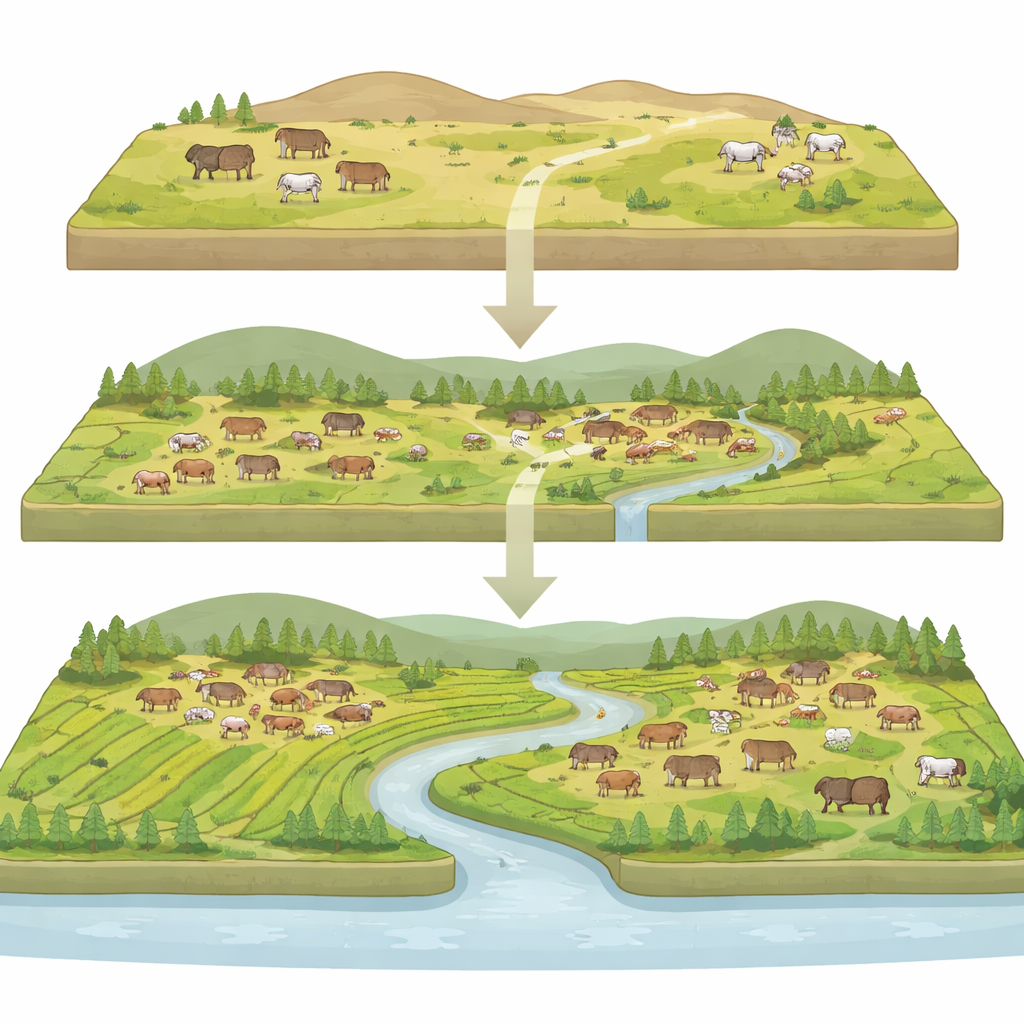
A Village Between Two Ways of Life
Xiaweiluo sat on a broad loess tableland between two very different landscapes: to the north, a dry plateau where herding cattle and sheep took hold early; to the south, river-fed plains where crop farming dominated. This middle zone acted as a natural corridor linking steppe herders and farmers in the Yellow River valley. Archaeologists had already shown that cattle, sheep, and goats entered China from the Eurasian steppe and moved southward, but it was unclear how people in this in-between region adjusted their daily lives as these newcomers arrived. Xiaweiluo, a large, well-preserved Longshan-period settlement full of houses, pits, kilns, and burials, offered an ideal window into these choices.
What the Bones Reveal About Daily Life
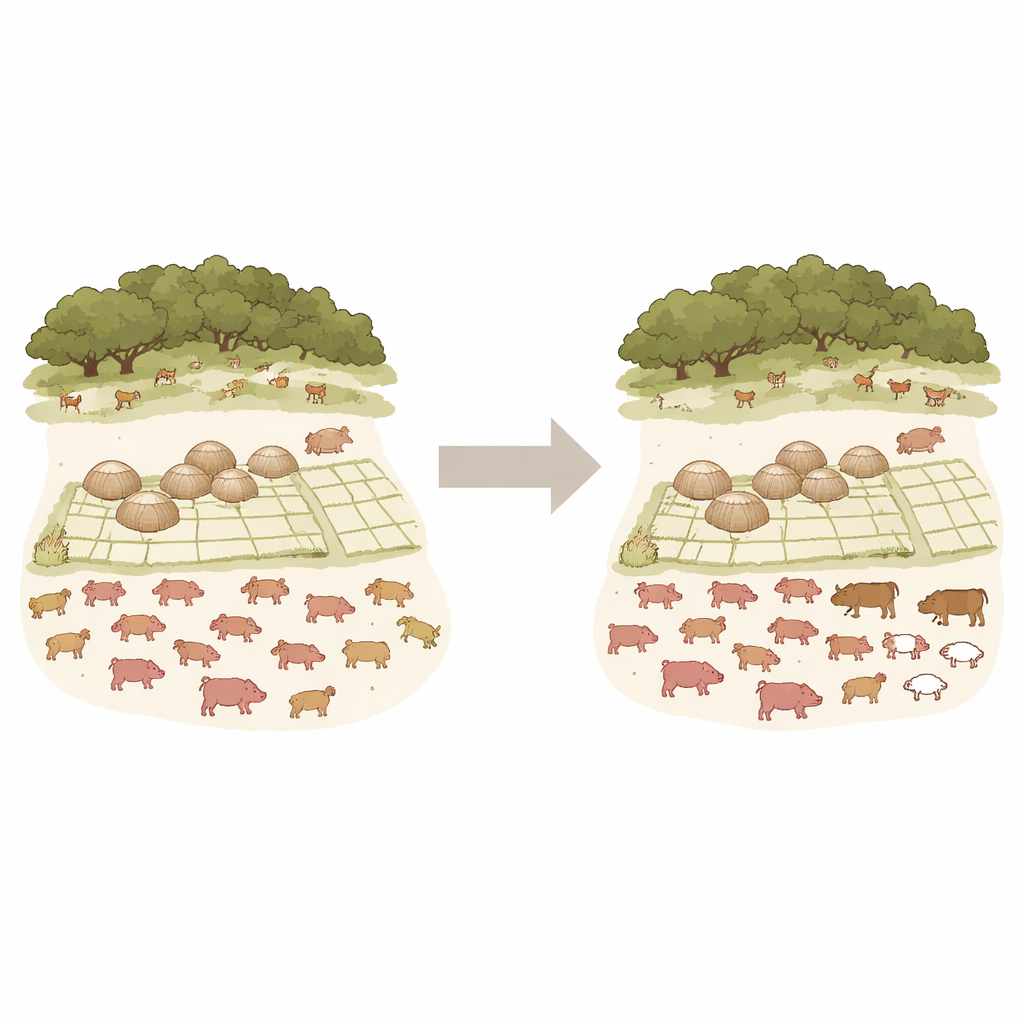
The team reanalyzed 1,578 animal remains from early and late phases of the Longshan period at Xiaweiluo. They identified each bone by species, age, and traces of human use such as cut marks or burning. Most of the meat clearly came from domestic animals: pigs were by far the most common, with a supporting role for dogs and small numbers of cattle and sheep or goats. Wild animals—including deer, hare, and smaller creatures—were present throughout, but mainly as a supplement rather than the main course. Many pig jaws could be aged from tooth wear, showing that most pigs were slaughtered before two years of age, just when they offered the best return in meat for the effort invested in raising them. This pattern points to a village economy in which households bred pigs mainly to feed themselves, not for large-scale trade.
New Animals, Old Habits
One of the most striking findings is timing. Using measurements, bone shape, and ancient DNA, the researchers confirmed that a rare large ankle bone belonged to domestic cattle, and a leg bone to domestic sheep. Radiocarbon dates show these animals appeared at Xiaweiluo relatively late—after cattle and sheep were already well established further north on the Shaanxi Plateau. Even then, they remained few in number. Over time, pigs became even more dominant in the bone counts, while dogs declined, and cattle and sheep or goats appeared only in small amounts. Wild animals continued to be hunted but never disappeared. In other words, Xiaweiluo adopted new livestock cautiously, weaving them into an existing, pig-centered system instead of replacing it.
Different Paths Across the Region
By comparing Xiaweiluo with other sites to the north and south, the study reveals a patchwork of animal strategies across late Neolithic northern China. On the dry Northern Shaanxi Plateau, open grazing land favored herds of cattle and sheep or goats, helping create one of the earliest pastoral economies in the region. In the wetter Southern Guanzhong plains, dense populations and expanding rice and millet farming pushed communities to reduce their reliance on pigs—which depended heavily on grain feed—and to lean more on cattle and sheep that could graze on wild plants. In contrast, Northern Guanzhong, including Xiaweiluo, had relatively low population pressure and plenty of land suitable for both fields and hunting, allowing families to stick with pigs while adding only a few new animals on the side.
What This Means for the Story of Early China
For a non-specialist, the key message is that there was no single "Neolithic way" of raising animals in northern China. Even neighboring regions facing the same broad climate shift around 4,000 years ago responded differently, depending on their landscapes, crops, and social pressures. Xiaweiluo shows how a community in a crossroads zone could maintain a traditional, pig-based farming system while selectively adopting cattle and sheep brought in from afar. This mix of old and new practices—shaped by local environments as much as by outside influences—helped create the varied economic foundations on which early Chinese civilization was built.
Citation: Gan, R., Qin, Y., Huang, Z. et al. Acquisition and use of animal resources during the Longshan period in the northern Guanzhong region of China. npj Herit. Sci. 14, 217 (2026). https://doi.org/10.1038/s40494-026-02455-1
Keywords: Longshan period, animal husbandry, Neolithic China, Guanzhong region, zooarchaeology