Clear Sky Science · en
Fear of failure, procrastination, and academic performance in higher education
Why putting things off matters for students
Many university students know the uneasy mix of crowded desks, looming deadlines, and a nagging fear of letting others down. This study looks closely at how messy study habits, the tendency to delay schoolwork, and fear of failure interact for more than two thousand students in Indonesian universities. Its findings help explain why some students fall into unproductive cycles of delay and worry, and what campuses can do to support healthier study patterns and better learning.
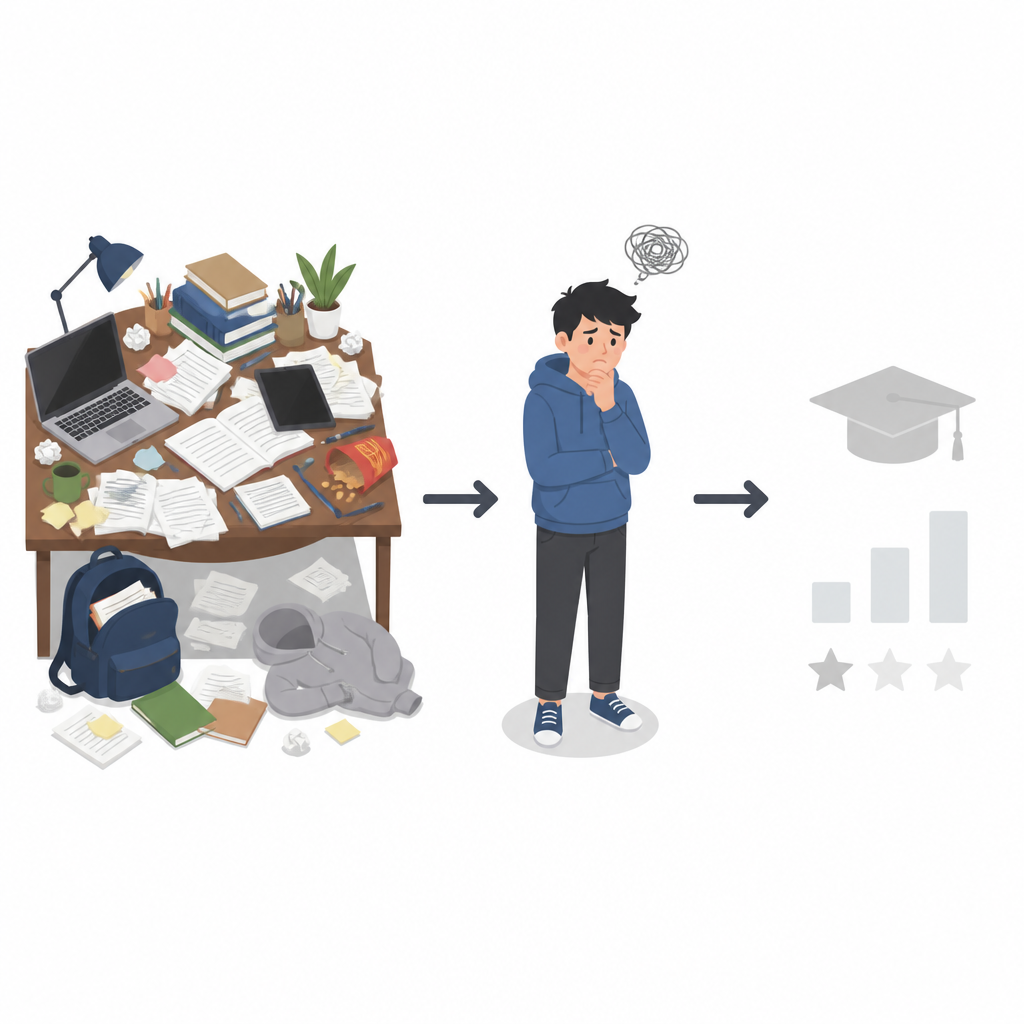
Messy routines and the habit of delay
The researchers focus on three everyday patterns. First is disorganization: having trouble planning what to study, deciding where to start, or keeping materials and time in order. Second is academic procrastination, where students intentionally put off tasks even though they expect bad outcomes. Third is fear of failure, a strong worry about doing badly and disappointing important people. Drawing on Social Cognitive Theory, the team proposes that scattered routines feed procrastination, procrastination chips away at performance, and fear of failure shapes how strongly disorganization turns into delay.
What the study did with thousands of students
From August 2024 to April 2025, the team surveyed 2111 diploma, bachelor, master, and doctoral students across East and Central Java. Students answered established questionnaires about how organized their study habits were, how often they delayed tasks, how much they feared failing, and how they viewed their own academic performance. Using a statistical method called structural equation modeling, the researchers tested whether disorganization leads to more procrastination, whether procrastination is linked to weaker performance, whether procrastination carries part of the impact of disorganization, and whether fear of failure changes these links.
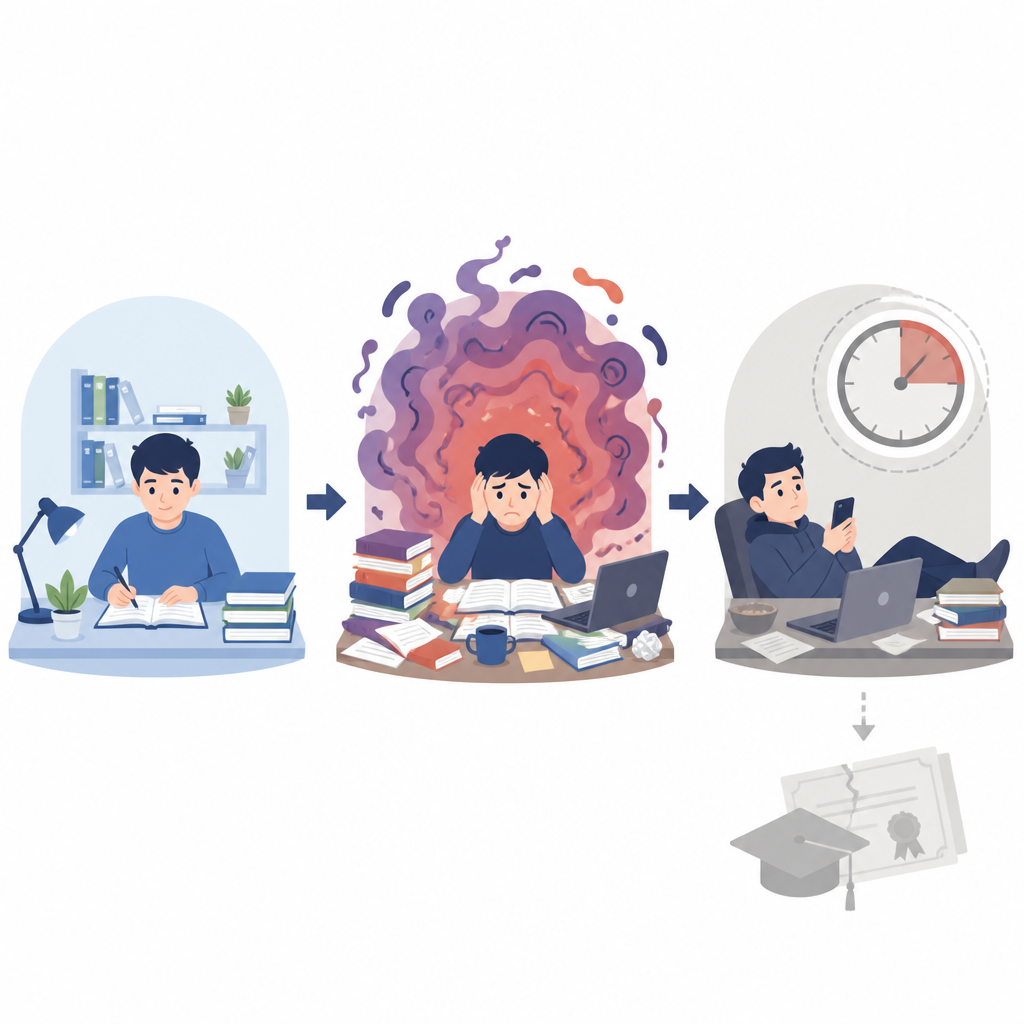
How clutter, delay, and fear work together
The results show clear patterns. Students who were more disorganized were more likely to procrastinate. In turn, students who procrastinated more tended to rate their academic performance slightly lower. Procrastination partly explained how messy routines were connected to weaker outcomes, suggesting that poor planning does not hurt grades directly so much as it encourages last minute work and missed chances to learn deeply. At the same time, the model predicted students' procrastination quite well but explained only a small share of differences in performance, which is shaped by many other factors such as prior knowledge, teaching quality, and mental health.
When fear is already high
The most surprising finding involves fear of failure. The team expected that students who were both disorganized and highly fearful would procrastinate the most. Instead, fear of failure actually softened the link between disorganization and delay. Among students with low fear, becoming more disorganized clearly went hand in hand with more procrastination. Among students with high fear, procrastination levels were already high and barely changed as disorganization increased, suggesting a ceiling effect. In these anxious students, delay seems driven less by messy routines than by constant worry about being judged or falling short, especially in socially demanding environments like dorms and student organizations.
What this means for students and campuses
For a lay reader, the message is straightforward: cluttered study habits make it easier to slide into delay, and delay tends to nibble away at how confident students feel about their academic progress. But for students who are already very afraid of failing, simply learning time management may not be enough; their procrastination is powered by fear as much as by disorganization. The authors argue that universities should pair practical supports such as planning and time management training with programs that build emotional resilience and reduce shame around setbacks. By tackling both messy routines and fear of failure, higher education can better help students turn enrollment into real learning and stronger futures.
Citation: Aldhi, I.F., Suhariadi, F., Rahmawati, E. et al. Fear of failure, procrastination, and academic performance in higher education. Humanit Soc Sci Commun 13, 731 (2026). https://doi.org/10.1057/s41599-026-07088-0
Keywords: academic procrastination, fear of failure, student performance, time management, higher education