Clear Sky Science · en
From structure to substance: public participation as a scaffolding technology in citizen assemblies
Why this matters for everyday democracy
Across the world, governments are inviting small groups of ordinary people to advise on big questions like climate change. This article looks closely at one such citizens climate assembly in Aarhus, Denmark, and asks a simple but powerful question: how does the way these events are set up quietly shape who speaks, what gets said, and what counts as a good contribution? The answers matter for anyone who cares about fair, meaningful public input in political decisions.
Temporary structures that guide how people speak
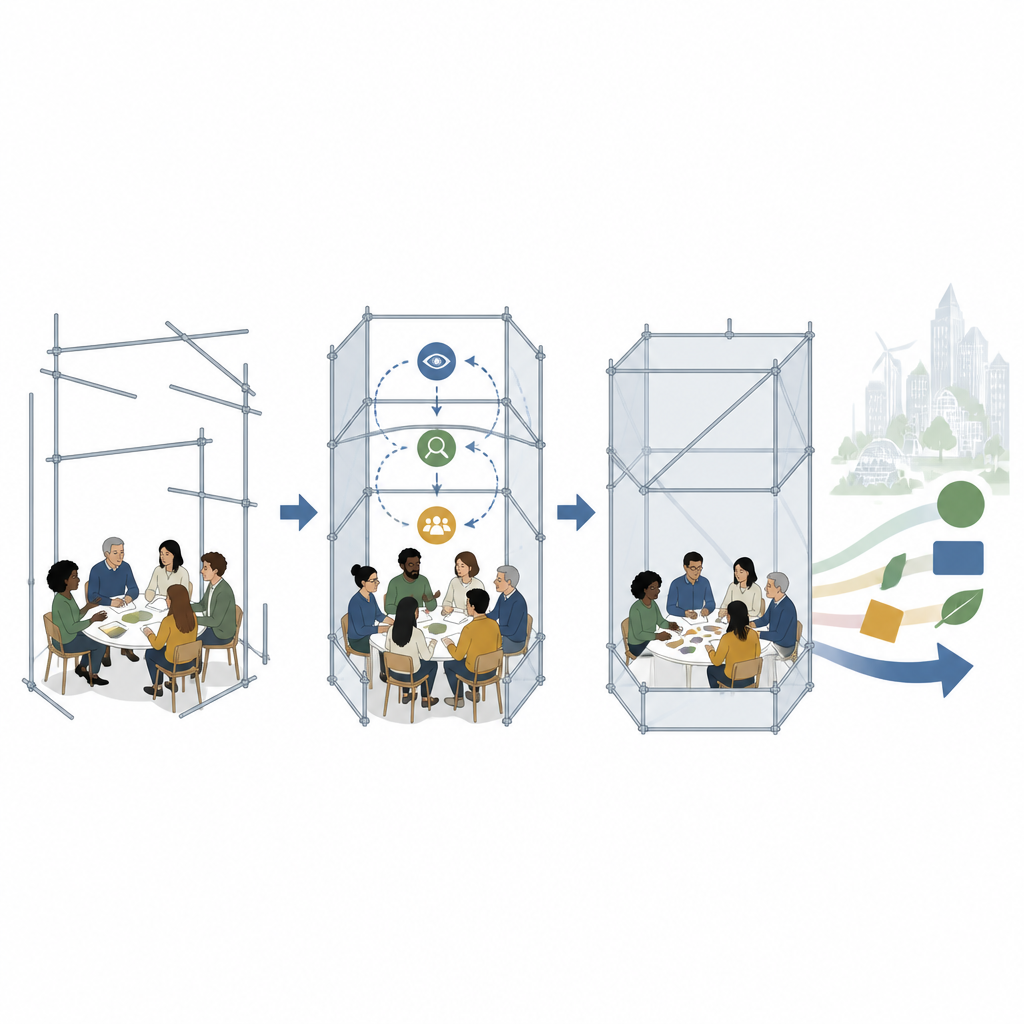
The authors suggest we think of participation events as a kind of scaffold: a temporary structure that supports people while they do a difficult task. In building work, scaffolding lets workers reach high places for a while. In the same spirit, the rules, tools, and formats of a citizens assembly support people as they learn, talk, and make recommendations. Drawing on ideas from education and social theory, the article argues that such scaffolds both enable and limit citizens. They give people cues about what kind of talk is welcome, how formal they should be, and whether personal experience counts as much as expert style arguments.

A Danish climate assembly under the microscope
The case at the heart of the study is the Aarhus Climate Assembly, held in 2022–2023. A group of residents was selected to meet over several months, learn about local climate issues, and produce advice for the city council. The process was designed and run by specialist participation professionals, drawing on a growing market of expert methods for public engagement. The researchers observed meetings, ran focus groups, collected surveys, and interviewed both organisers and participants. This allowed them to see not just the official script, but also the small tensions, doubts, and workarounds that emerged as people tried to follow it.
One method, many mixed feelings
A central scaffold in the assembly was a method called OVA, short for observation, assessment, and recommendation. Citizens were asked to move through these three steps in order: first describe the situation as an objective problem, then discuss how they understood it, and finally suggest solutions. Some participants liked this clear structure, especially those used to academic or data driven work. They felt it kept discussions focused and helped turn talk into concrete proposals in the limited time available. Others, however, found OVA confusing or restrictive. Many only fully grasped it near the end of the process. Several felt pushed toward a more expert like way of speaking, which made some members feel out of place and may have contributed to people dropping out over time.
Unclear purpose, uneasy roles
The second key finding concerns purpose. What, exactly, were the citizens recommendations supposed to do? Were they meant to invent new climate solutions, sort through existing options, signal what trade offs people accept, or simply confirm that current plans have public backing? Organisers, facilitators, and citizens gave different answers to these questions. Some facilitators were unsure whether they should stay neutral or actively correct citizens with climate facts. Public messages sometimes spoke of bold new ideas, while internal documents stressed support for existing policies. This confusion about purpose made it harder for people to know what counted as a valuable contribution and how their work would be used by politicians.
What this tells us about better citizen input
In closing, the authors argue that citizens assemblies are not neutral windows onto public opinion. They are carefully built environments whose scaffolding shapes how people learn, speak, and decide together. When methods like OVA and the overall goals of an assembly are not clearly aligned or well explained, citizens can feel constrained, confused, or even used. Seeing participation as both structured and structuring helps shift attention away from judging whether an ideal model has been reached, and toward examining how real people experience these processes in practice. For anyone designing or taking part in future assemblies, the lesson is clear: the rules and purposes of participation need to be as thoughtfully debated as the policies they are meant to inform.
Citation: Illemann Jæger, S., Goñi, J. From structure to substance: public participation as a scaffolding technology in citizen assemblies. Humanit Soc Sci Commun 13, 630 (2026). https://doi.org/10.1057/s41599-026-06965-y
Keywords: citizens assembly, public participation, climate policy, deliberative democracy, scaffolding