From endless scrolling to constant notifications, our digital lives feel natural, even inevitable. But this article argues that today’s form of “digital capitalism” does more than sell us products or harvest our clicks—it quietly reshapes how we relate to others and how we understand ourselves. Drawing on the philosophy of Byung-Chul Han and Marxist thought, the paper explores how smartphones, platforms, and data-driven systems flatten differences, trap us in a hall of mirrors, and create deep tensions in attempts to resist this trend.
The Vanishing Sense of Other People
At the heart of the article is a simple yet unsettling claim: we become ourselves through encounters with truly different others. For Han, the “Other” is not just another user or profile, but a person or presence that resists our control, surprises us, and can even unsettle or hurt us. This strangeness provides the contrast that lets an “authentic self” take shape. The paper shows how Han weaves together ideas from Heidegger, Husserl and Hegel: we only find who we really are by moving through shared worlds, through work, and through resistance and tension with others. The author explains that this relation of difference and mediation is the backbone of Han’s entire critique of the digital age.
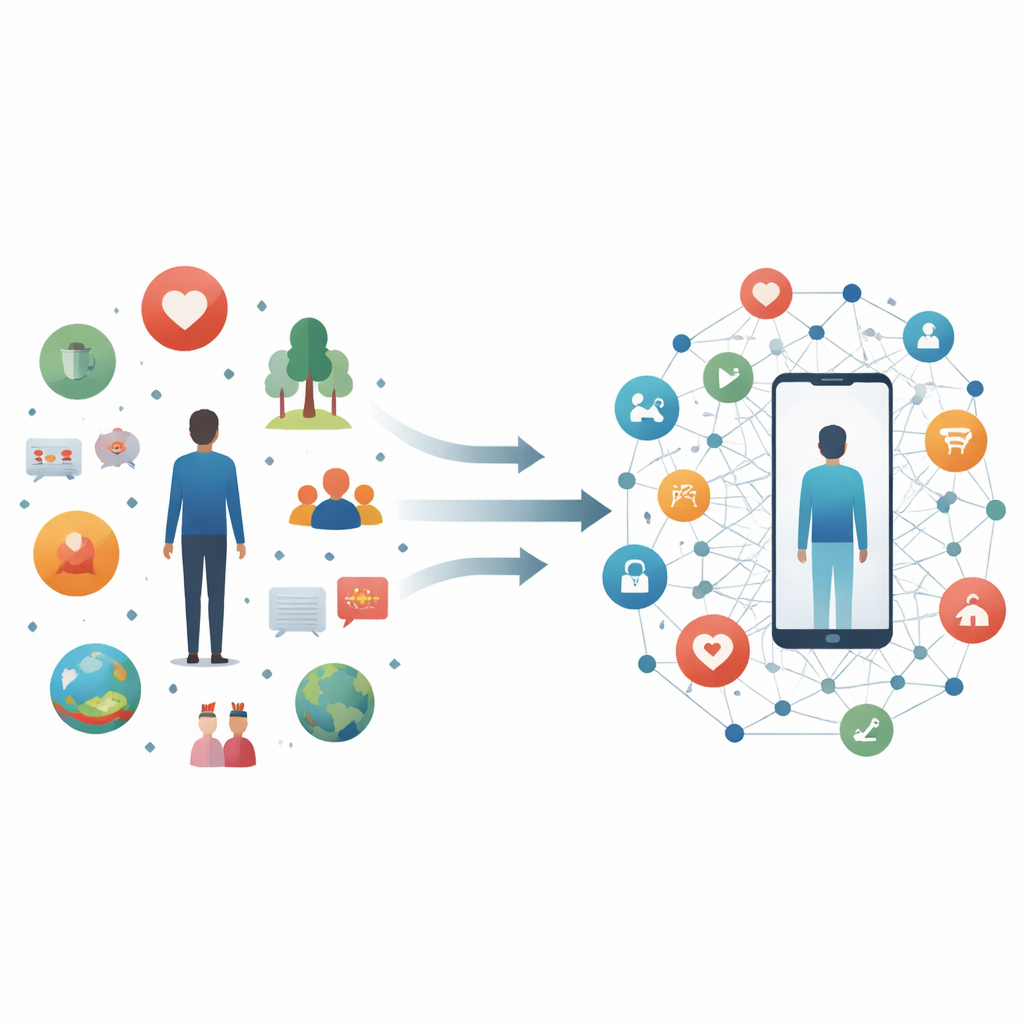
How Digital Capitalism Turns Difference Into Sameness Figure 1.
The article then examines how contemporary digital capitalism systematically erodes this difference. Smartphones become everyday altars of a new kind of power, promising zero distance and instant access. Screens flood us with ultra-clear, ever-available images and algorithmically tailored feeds that match our expectations. At first this looks like personalization and freedom. But by removing distance, surprise and opacity, platforms turn genuinely different others into smooth, predictable content. Our desires, fears and searches become data points, and the messy richness of social life is compressed into a uniform stream that capital can measure, predict and monetize. What feels like connection and choice is, the paper argues, a hidden mechanism of homogenization that turns both others and ourselves into versions of the Same.
Living in a Digital Hall of Mirrors
For individuals, this shift is experienced as a crisis. Without real others to push back or recognize us, we lose stable reference points for who we are. Social media rewards constant self-display and performance, yet this visibility remains shallow. We become both guard and prisoner in a digital panopticon, voluntarily exposing ourselves while trying to cope with a sense of emptiness. The paper uses Han’s language of “shock” to describe this state: we are too active and stimulated to rest, yet too drained to truly live. Even our senses are reshaped: sight is captured by polished images, hearing by relentless alerts, time loses depth and smell, and touch rarely encounters real otherness. Underneath the glitter of constant activity lies a profound numbness and self-exploitation, as our search for meaning and recognition directly fuels capital’s growth.
Contemplation and Storytelling as Forms of Resistance Figure 2.
To counter this, Han proposes two practices: contemplation and narrative. Contemplation is not mere relaxation, but a deliberate pause that interrupts the rush of information and productivity. It reintroduces distance, allows us to endure discomfort and truth, and reopens space for the strange and the negative—that is, for the Other. Narrative, in turn, stitches fragmented moments into meaningful stories shared with others. Unlike raw data, stories rely on memory, selection, and interpretation; they move across time and create continuity between past, present and future. The article explains how, for Han, only by slowing down, lingering, and telling stories can we rebuild the temporal and relational fabric that digital capitalism tears apart, and thereby reopen the path to an authentic self.
The Hidden Paradoxes and a New Way Forward
Yet the author also highlights deep tensions in Han’s proposal. Han criticizes acceleration, but his favored remedy—contemplative “interruption”—can itself look like just another strategy of slowing down, without clear means to change institutions or economic structures. He focuses on individual experience while largely bracketing class, labor and collective struggle, which Marxist theory sees as central to any real transformation. In response, the paper outlines a “Sinicized Marxist” framework that grounds Han’s insights in analyses of platform labor, data-based exploitation and new forms of the working class, and explores possibilities such as digital commons, platform cooperatives and data rights movements. In everyday terms, the article concludes: recognizing how digital systems quietly turn others and ourselves into commodities is only the first step. Recovering real difference, shared stories, and collective action is essential if we hope not just to feel more authentic online, but to change the conditions that keep hollowing that authenticity out.
Citation: He, T. The paradox of retrieval: the Other, the authentic self, and the logical tensions in Byung-Chul Han’s critique of digital capitalism.
Humanit Soc Sci Commun13, 523 (2026). https://doi.org/10.1057/s41599-026-06891-z
Keywords: digital capitalism, Byung-Chul Han, authentic self, social media, Marxist critique