Clear Sky Science · en
The effect of toolpath design on the mechanical strength of additively manufactured glass components
Shaping Glass in New Ways
From skyscraper facades to smartphone screens, glass is everywhere, yet most of it is still made with decades‑old methods that favor flat sheets and simple forms. This paper explores how 3D printing could free glass from those limits, allowing intricate shapes and custom parts—but only if the printed glass is strong and reliable. The authors ask a deceptively simple question: does the path a 3D printer’s nozzle takes, as it lays down molten glass, change how easily that glass will break?
Why Printed Glass Is Hard to Get Right
Printing glass is far more demanding than printing plastic. Glass must be heated to very high temperatures and cools in complex ways, developing internal stresses that can cause cracks. In a process similar to common plastic 3D printing, thin glass rods are fed into a hot nozzle and laid down as soft filaments, building an object layer by layer. That opens exciting possibilities for art, architecture, optics, and even on‑site fabrication in places where shipping is difficult, such as space habitats or underwater stations. But before designers can trust printed glass in real buildings or devices, engineers must understand how strong it really is and what controls that strength.
Testing How Layer Direction Affects Strength
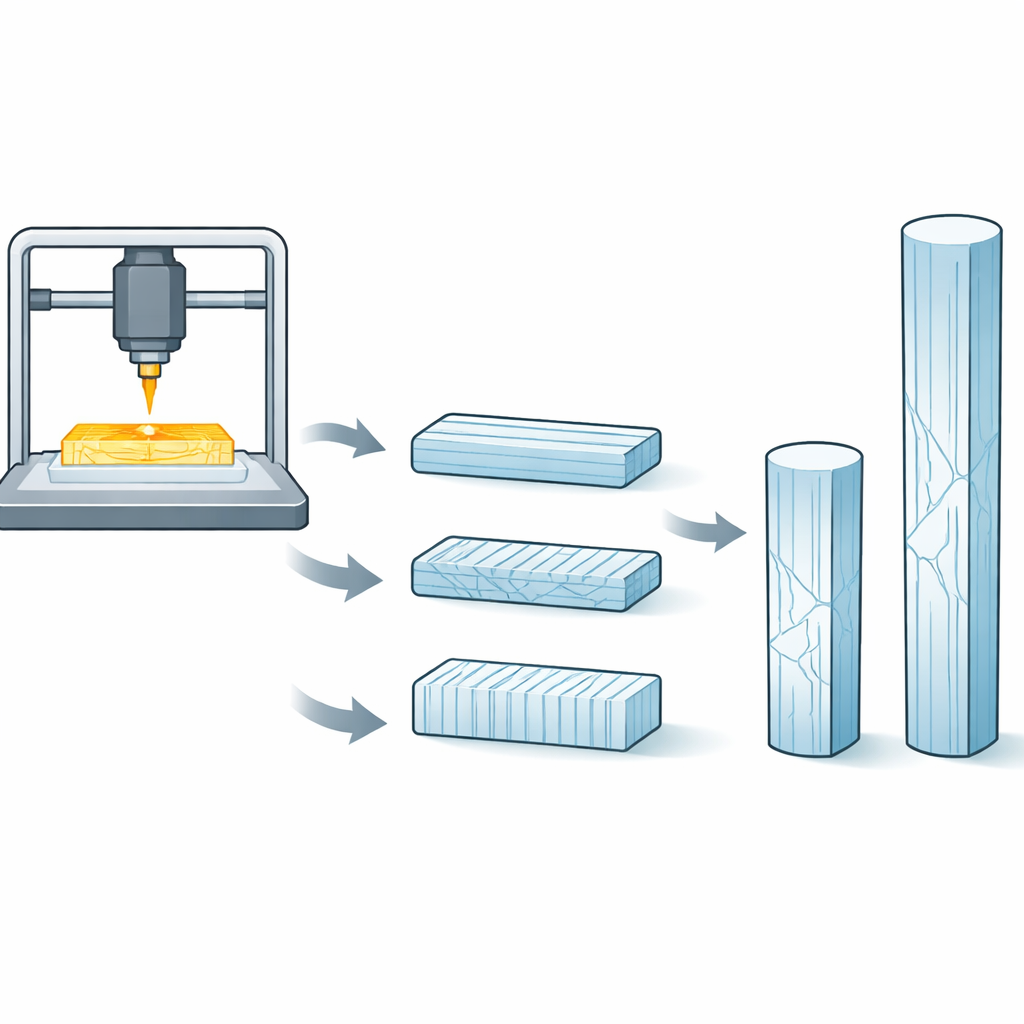
The researchers focused on a fused‑deposition style technique that extrudes molten soda‑lime glass—similar to ordinary window glass—from a custom printer. First, they produced uniform glass rods using an automated pulling machine; these rods served both as feedstock and as a strength baseline. Then they printed standardized “dog‑bone” test pieces, shaped so they would crack in a narrow middle region during bending. Crucially, they varied how each part was filled: layers could run along the length of the piece (0 degrees), across it (90 degrees), or diagonally (45 degrees). All other printing conditions—temperatures, speeds, and layer sizes—were kept the same so that only the internal toolpath pattern changed.
Bending Glass Until It Breaks
To measure strength, the team used a four‑point bending test: each specimen rested on two lower supports while two upper rollers pushed down, creating an even bending zone in the middle. They recorded the force at which each piece fractured and calculated the corresponding stress inside the glass. Surprisingly, samples with layers running across the bend (90 degrees) were the strongest on average, about 40 percent stronger than those with layers running along the bend (0 degrees). Diagonal samples landed in between but with more scatter in the results. When they tested the original glass rods, these turned out to be even stronger than any printed piece—consistent with the idea that larger, more complex shapes are more likely to contain small flaws that trigger failure.
Heat, Voids, and Hidden Weak Spots
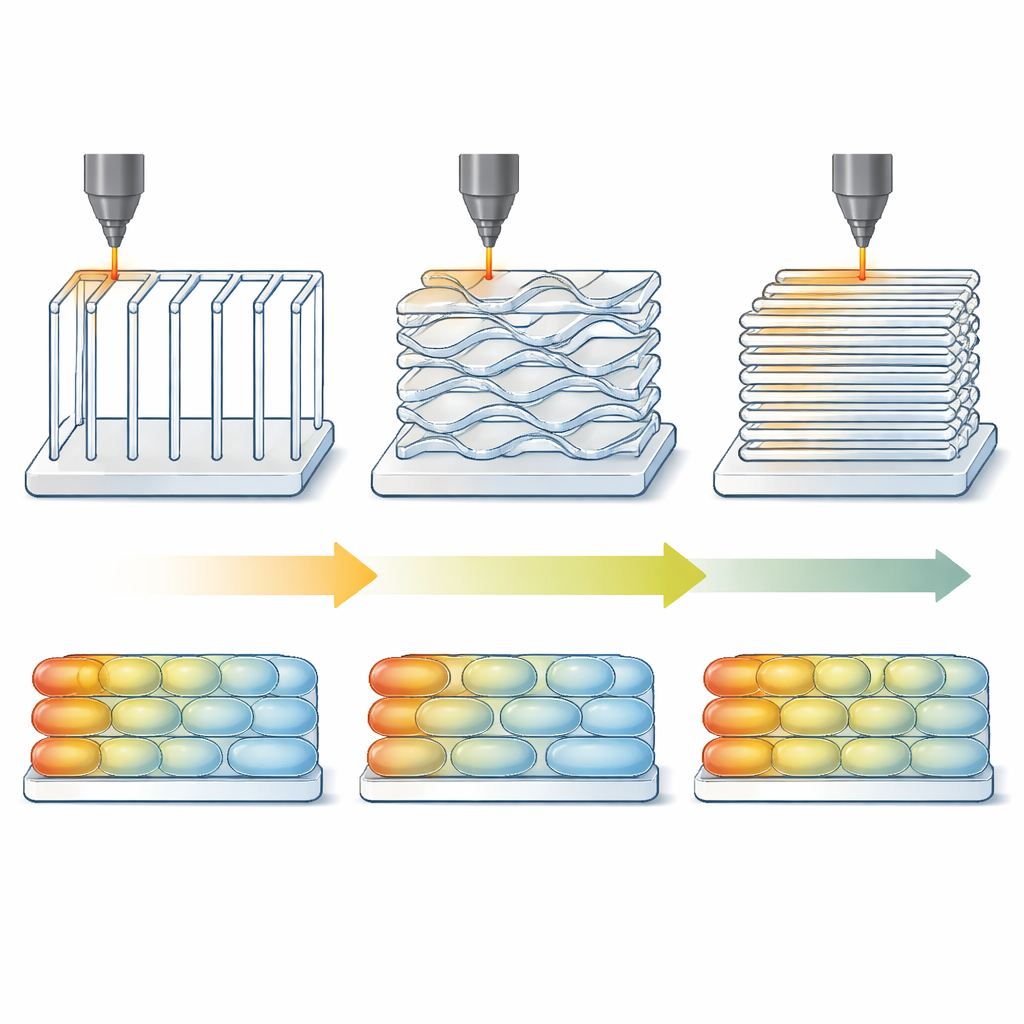
Why would the cross‑layered parts outperform the seemingly more “aligned” ones? Microscopic images of fracture surfaces provided clues. In the strongest 90‑degree samples, the broken surfaces contained relatively few tiny voids—small pockets or gaps between filaments. In weaker 0‑ and 45‑degree samples, voids were more numerous and larger. The authors link this difference to the printer’s travel path. When the nozzle traces many short lines close together, it repeatedly returns to recently deposited filaments that are still warm, helping them fuse tightly. Long, sweeping paths leave earlier segments to cool before the nozzle returns, so bonds between layers are poorer and voids more likely. In effect, toolpath design controls local heat retention, which in turn governs how well the glass layers knit together.
What This Means for Future Glass Designs
The study shows that the strength of 3D‑printed glass is not fixed by the material alone; it can be tuned by how the printer is instructed to move. Carefully chosen, continuous toolpaths that keep glass hot and in close contact can markedly increase reliability, bringing printed parts closer to the performance of conventional glass. The authors suggest that more advanced printing strategies, improved control of pores, and post‑processing steps such as reheating or pre‑stressing could push strengths even higher. Their findings lay groundwork for using printed glass not just as a curiosity, but as a dependable building and design material—from stiffeners on large window panels to intricate lamps and optical components.
Citation: Chhadeh, P.A., Nowak, E., Vlahopoulos, D. et al. The effect of toolpath design on the mechanical strength of additively manufactured glass components. npj Adv. Manuf. 3, 16 (2026). https://doi.org/10.1038/s44334-026-00072-1
Keywords: 3D printed glass, additive manufacturing, toolpath design, glass strength, fused deposition