Clear Sky Science · en
Virtual reconstruction and analysis of the face of DFN3-150 Paradolichopithecus aff. arvernensis specimen from Dafnero, Greece
A Fossil Face and the Story It Tells
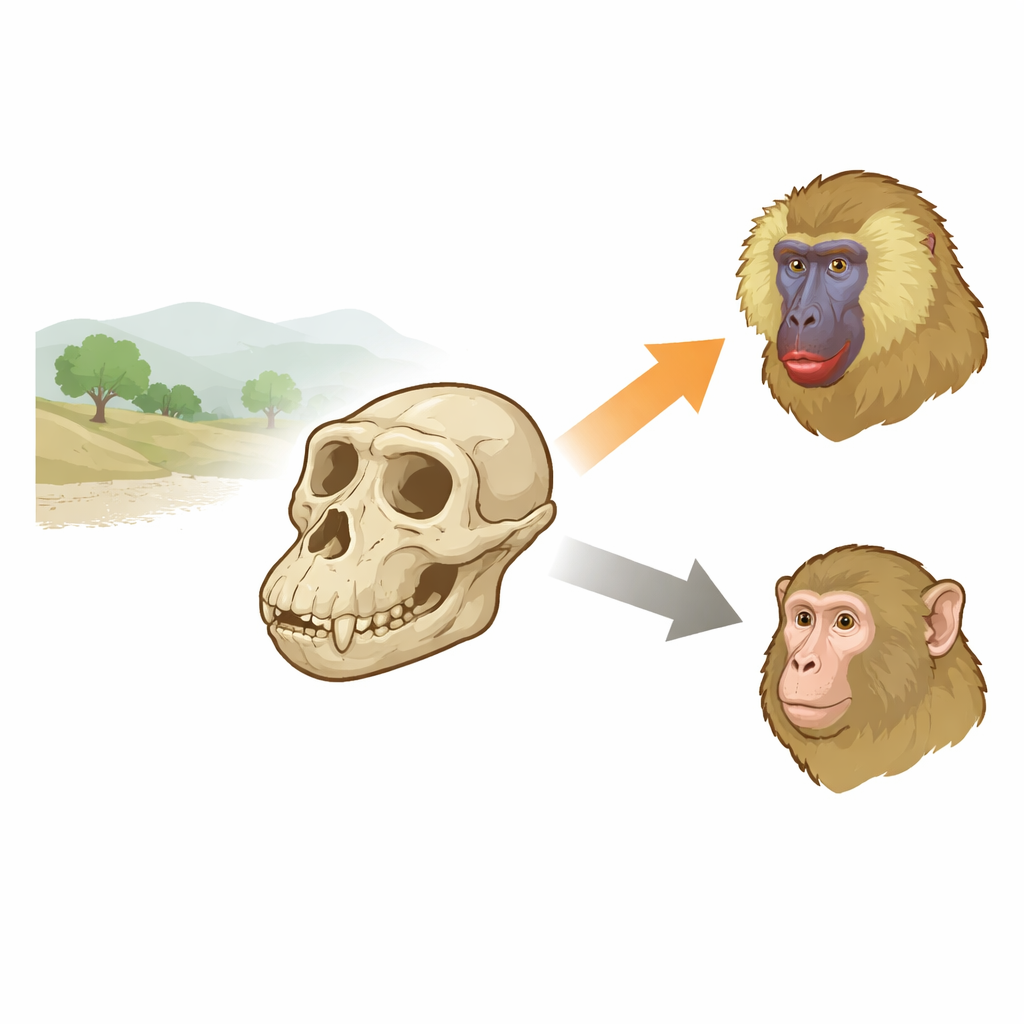
Over two million years ago, a large ground‑dwelling monkey roamed what is now northern Greece. Its skull, crushed and warped by time, has long puzzled scientists asking a simple but important question: was this animal more like today’s macaques or more like baboons? The answer matters because it reshapes how we picture monkey evolution between Africa and Eurasia, and whether baboon relatives were confined to Africa or had deeper roots across the continent divide.
Why This Old Monkey Matters
The fossil in question, called DFN3‑150, belongs to the genus Paradolichopithecus, the largest known group of Old World monkeys from the Eurasian fossil record. These monkeys lived from the middle Pliocene into the Early Pleistocene and spread from Spain to China. For decades, experts have debated whether they were oversized relatives of macaques or closer kin of baboons and their allies. That debate affects a bigger picture: if Paradolichopithecus turns out to be baboon‑like, it challenges the idea that baboons evolved only within Africa and never formed part of a broader Eurasian radiation.
Fixing a Crushed Skull on a Computer
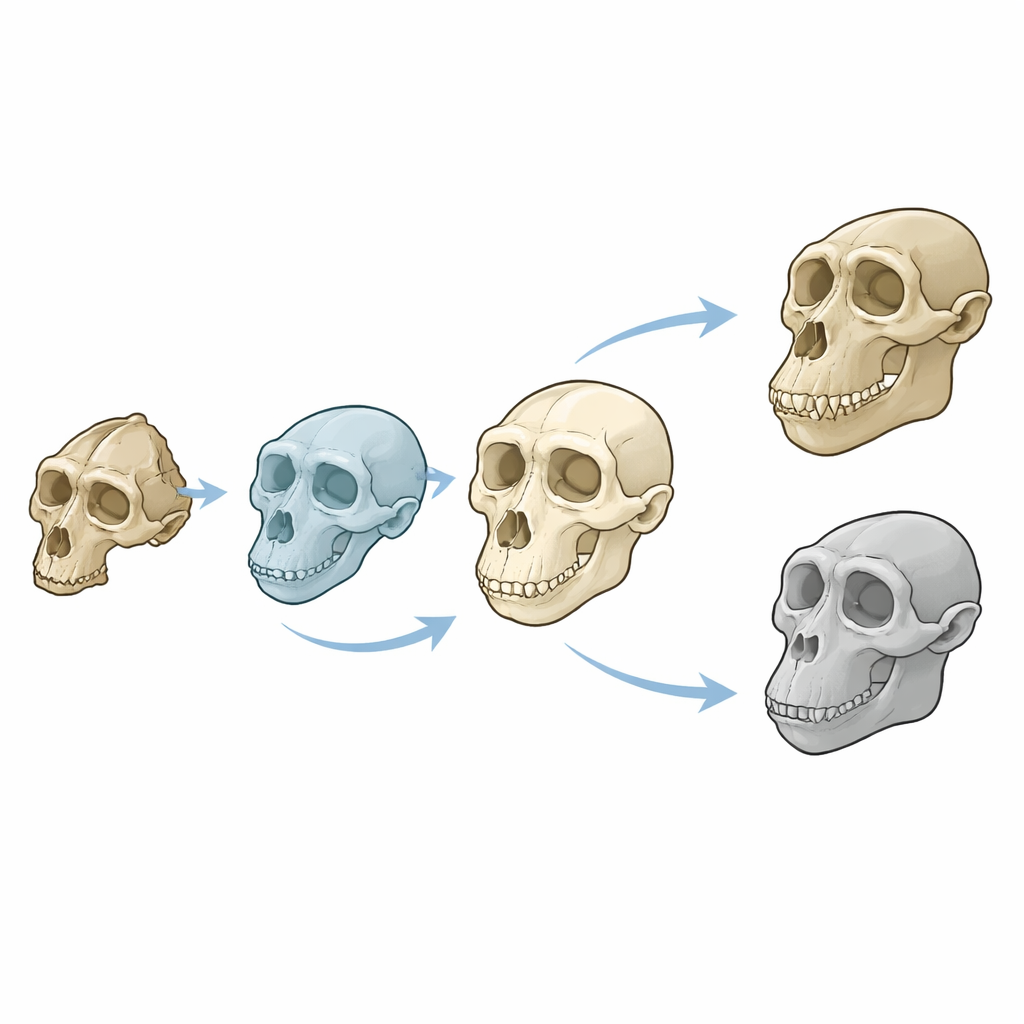
DFN3‑150 is one of the few nearly complete skulls of Paradolichopithecus, but it did not come out of the ground intact. Parts of its face were bent and shifted, especially on the right side, and the bone was filled and surrounded by rock. To recover its original form, the team used high‑resolution micro‑CT scanning to create a detailed three‑dimensional digital model. They then virtually peeled away the sediment and broke the skull into many segments corresponding to bones or fragments. By carefully moving these pieces in 3D space, they produced two slightly different “uncrumpled” versions that correct different aspects of the distortion in the nose and palate.
Two Ways to Rebuild a Face
On top of these manual repairs, the researchers applied two automated restoration strategies. One method, developed by Schlager and colleagues, assumes the skull was originally symmetrical and mathematically “unbends” it to restore that balance. The other, by Amano and colleagues, uses a small set of well‑preserved skulls from closely related living monkeys as a guide, pulling the fossil’s shape back toward the range of forms seen in those reference animals. By combining three starting templates with both protocols, and by testing versions with and without dense surface sampling, the team generated nine different virtual reconstructions of DFN3‑150’s face. Comparing these showed that the choice of method clearly changes details such as how wide the snout is and how tall and round the eye sockets appear.
Reading Evolution in Facial Shapes
To see what these reconstructions say about the fossil’s relationships, the authors used geometric morphometrics—a mathematical way to compare shapes using sets of 3D points on key facial features. They analyzed the nine DFN3‑150 models together with skulls of modern macaques and baboons. Because bigger animals tend to have systematically different skull shapes, they carefully separated the effects of overall size from inherited differences between lineages. Across several statistical tests, and even when size was taken into account, all versions of DFN3‑150 consistently clustered closer to baboons than to macaques in “shape space.” The most conservative and anatomically plausible reconstructions—those produced with the Amano protocol without extra surface points—fell particularly near subadult female baboons used as references.
What This Means for Monkey History
Put in plain terms, once the damaged fossil face is digitally straightened out and compared in a fair, size‑aware way, it looks more like a baboon than a macaque. That does not yet prove that Paradolichopithecus was directly part of the baboon family tree, but it strengthens the idea that these big Eurasian monkeys shared closer roots with baboon‑like forms than with macaques. The study also shows how sensitive such conclusions can be to the details of reconstruction and sampling: different algorithms yield subtly different faces, and the available living comparisons are still limited. As more fossils and modern specimens are added, and as growth and sex differences are modeled more fully, researchers will be able to say with greater confidence whether this ancient Greek monkey marks an early Eurasian chapter in baboon evolution or represents a closely allied side branch.
Citation: Koutalis, S., Röding, C., Merceron, G. et al. Virtual reconstruction and analysis of the face of DFN3-150 Paradolichopithecus aff. arvernensis specimen from Dafnero, Greece. Sci Rep 16, 14703 (2026). https://doi.org/10.1038/s41598-026-51595-8
Keywords: fossil monkeys, baboons, macaques, virtual reconstruction, cranial shape