Clear Sky Science · en
Obstacle-aware inverse kinematics of variable-length continuum robots via teaching–learning-based optimization with experimental validation
Robots That Move Like Elephant Trunks
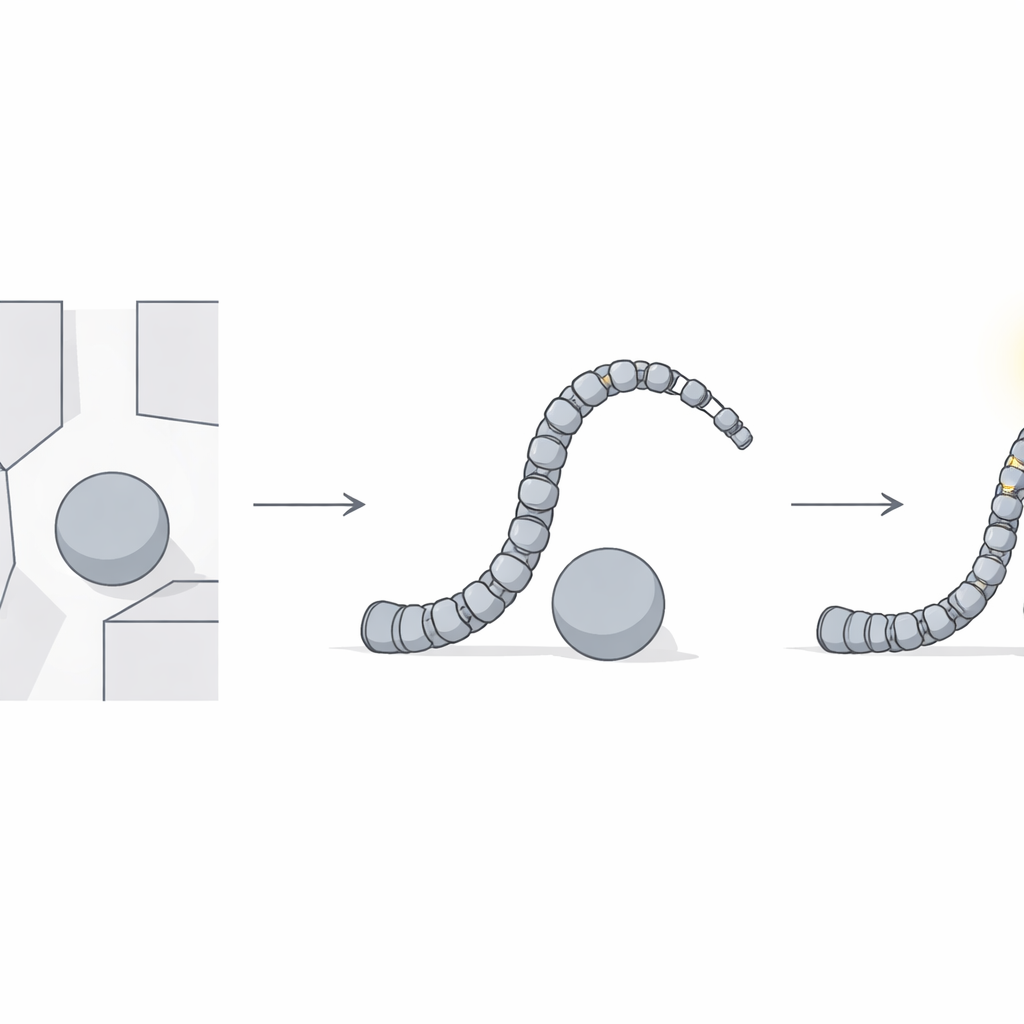
Imagine a robotic arm that can curl, twist, and squeeze through rubble the way an elephant’s trunk snakes between tree branches. Such “continuum robots” are soft, flexible machines designed for work in tight or dangerous places, from collapsed buildings to the inside of the human body. This paper introduces a new way to precisely steer these robots, even as their body length changes and they weave safely around obstacles, bringing this futuristic technology closer to practical use.
Why Flexible Robots Are Hard to Control
Unlike the stiff, jointed arms you might see in a car factory, continuum robots are built around bendable backbones threaded with cables or tubes. They can curve smoothly in many directions and even extend or contract, which gives them great reach and agility. But this flexibility comes at a price: predicting how the tip of the robot will move when you pull on its cables is complicated, and working backward from a desired tip position to the right cable and shape settings is even harder. There are often many ways for the robot to reach the same point, and its motion is highly nonlinear, making traditional step-by-step formulas difficult to apply.
Turning Motion Planning into a Smart Search
To tackle this challenge, the authors treat the robot’s motion planning as a search problem. They first adopt a widely used geometric approximation in which each section of the robot bends like a smooth circular arc. With this model, any specific choice of bending angles, orientations, and section lengths leads to a predicted position of the robot’s tip. The key idea is then to let a computer search over these choices to find the combination that makes the tip land as close as possible to a desired point in space, subject to physical limits on how far sections can bend or extend.
Learning From a Virtual Classroom
The search engine at the heart of this method is called teaching–learning-based optimization. It imagines a classroom of “students,” each representing one candidate way for the robot to bend and stretch. At every round, the best student acts as a “teacher,” nudging the others toward better performance, while pairs of students also learn from each other’s differences. Over many rounds, this virtual class converges on a configuration that very closely hits the target point. A simple trick makes the motion from point to point smooth: when the robot moves along a path, the best solution found for one point is reused as a starting guess for the next, helping the robot avoid sudden jumps in shape.

Keeping a Safe Distance From Obstacles
Operating in cluttered spaces means the robot must not scrape against nearby objects. Instead of checking only the centerline of the robot’s body, the authors model each section as a thickened “capsule” with a real radius, and treat obstacles as solid shapes with their own size. During the search, any candidate shape that would collide with an obstacle is heavily penalized, making it very unlikely to be chosen as a good solution. In computer tests, the robot successfully followed both straight and circular paths while gracefully bending around a fixed obstruction, all while keeping an appropriate safety margin.
Putting the Method to the Test
The team compared their classroom-inspired search with three other popular optimization methods often used in engineering. Across many repeated trials, their approach consistently found extremely precise solutions without needing any hand-tuned control knobs, which the competing methods require. They also pushed the technique to more complex robots with three flexible sections, showing that it scales as designs grow more capable. Finally, they tested the method on a real, trunk-like robot powered by air pressure. Using measurements from sensors that tracked the robot’s motion, they ran their algorithm offline to predict how the internal cables should have moved, and found that the predicted and measured cable lengths matched closely, within a few millimeters.
What This Means for Future Robots
In everyday terms, the study shows that a flexible, trunk-like robot can be guided almost as reliably as a rigid industrial arm, even when it must stretch, curl, and dodge obstacles along the way. By turning the steering problem into a guided search and baking safety margins directly into the objective, the authors provide a practical recipe that works in both simulations and hardware. This lays groundwork for future robots that can safely worm their way through crowded environments—inside machinery, disaster zones, or even the human body—while still moving with the precision that demanding tasks require.
Citation: Ghoul, A., Sattar, A.M., Adoul, M.A. et al. Obstacle-aware inverse kinematics of variable-length continuum robots via teaching–learning-based optimization with experimental validation. Sci Rep 16, 11227 (2026). https://doi.org/10.1038/s41598-026-46132-6
Keywords: continuum robots, soft robotics, obstacle avoidance, motion planning, optimization algorithms