Clear Sky Science · en
Reinforcement drives within- not between-trial motor adaptation
How practice and payoff shape our movements
Everyday actions like reaching for a coffee mug or tossing a ball feel effortless, yet our brains are constantly fine‑tuning these movements. This study asks a deceptively simple question: when we practice, do rewards and punishments help us improve while we are in the middle of a movement, or only from one attempt to the next? The answer reveals how motivation and natural trial‑to‑trial differences in our actions combine to shape how we learn new motor skills.
Two ways the brain learns from movement errors
When we move in a new or altered situation, our brain can learn in at least two ways. One route updates the plan between attempts: after seeing where the last reach went wrong, we subtly change how we aim the next time. The other route adjusts on the fly during a single movement: as visual feedback shows the hand drifting off course, control systems correct the motion mid‑stream. The authors wanted to know whether these two routes are influenced differently by rewards and punishments, and whether the natural variability in people’s early movements helps or hinders learning in each case.
Two joystick games: with and without mid‑course correction
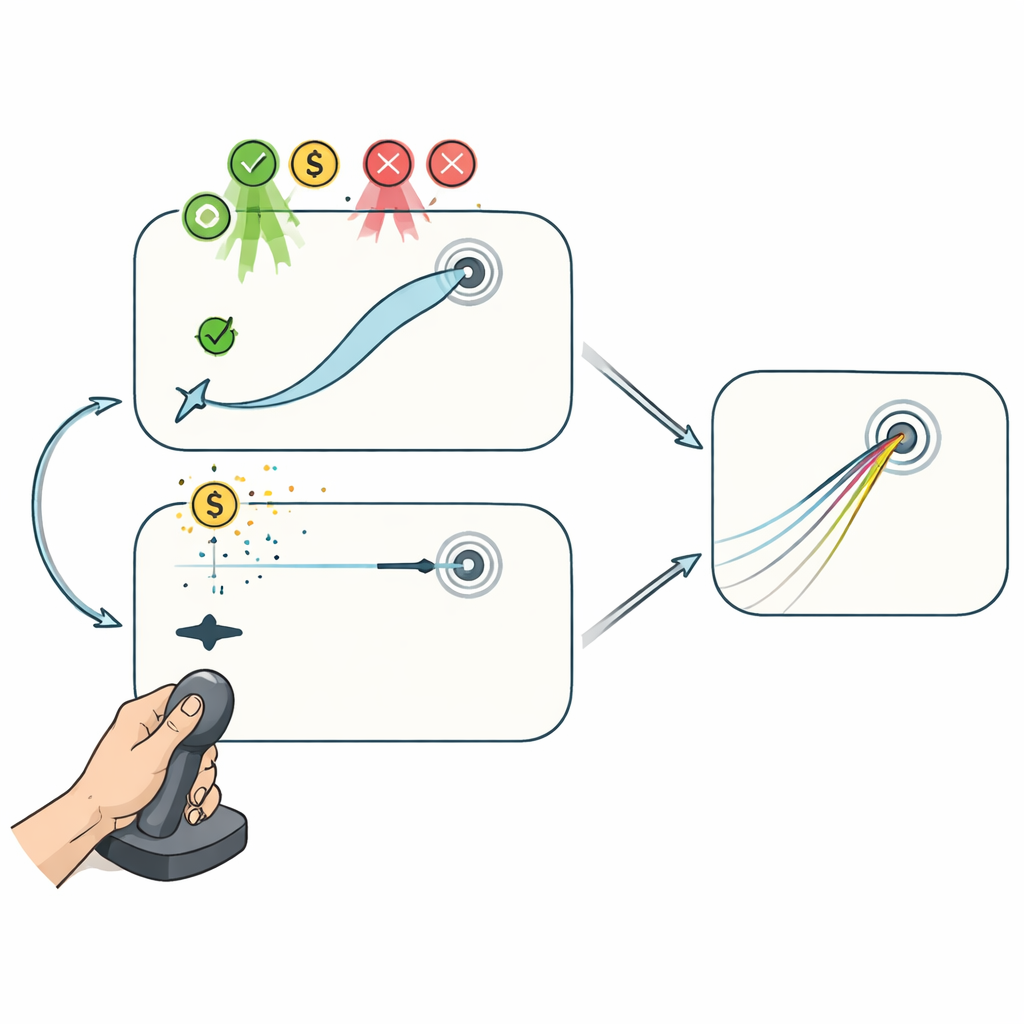
To tease these processes apart, volunteers played two joystick‑based computer tasks while the link between hand movement and cursor was secretly rotated. In the “Reaching” task, the cursor faithfully followed the joystick, allowing players to bend their path mid‑movement to steer toward the target. This setup lets both between‑attempt planning and within‑attempt correction contribute to improvement. In the “Curling” task, by contrast, only the very beginning of the joystick motion mattered: once the cursor passed a short distance, it slid in a straight line that could no longer be influenced, much like a curling stone on ice. Here, performance could improve only by adjusting the initial plan from trial to trial, not by fixing errors on the way.
Motivation boosts mid‑movement correction, not planning alone
Across both games, people gradually compensated for the visual rotation, showing clear signs of motor adaptation, savings when revisiting the perturbation, and retention after a half‑hour break. However, allowing mid‑course corrections made a big difference: in the Reaching game, errors shrank more and learning rates were higher than in the Curling game, even though the overall time course of adaptation was similar. Crucially, rewards and punishments tied to performance improved outcomes only in the Reaching task. Whether participants gained more money for accurate movements or lost money for large errors, their performance surpassed that of a neutral feedback group—but only when they could continuously steer the cursor. When success depended purely on planning a good initial shot, reinforcement had no detectable impact.
Helpful variation when planning, dampened during correction
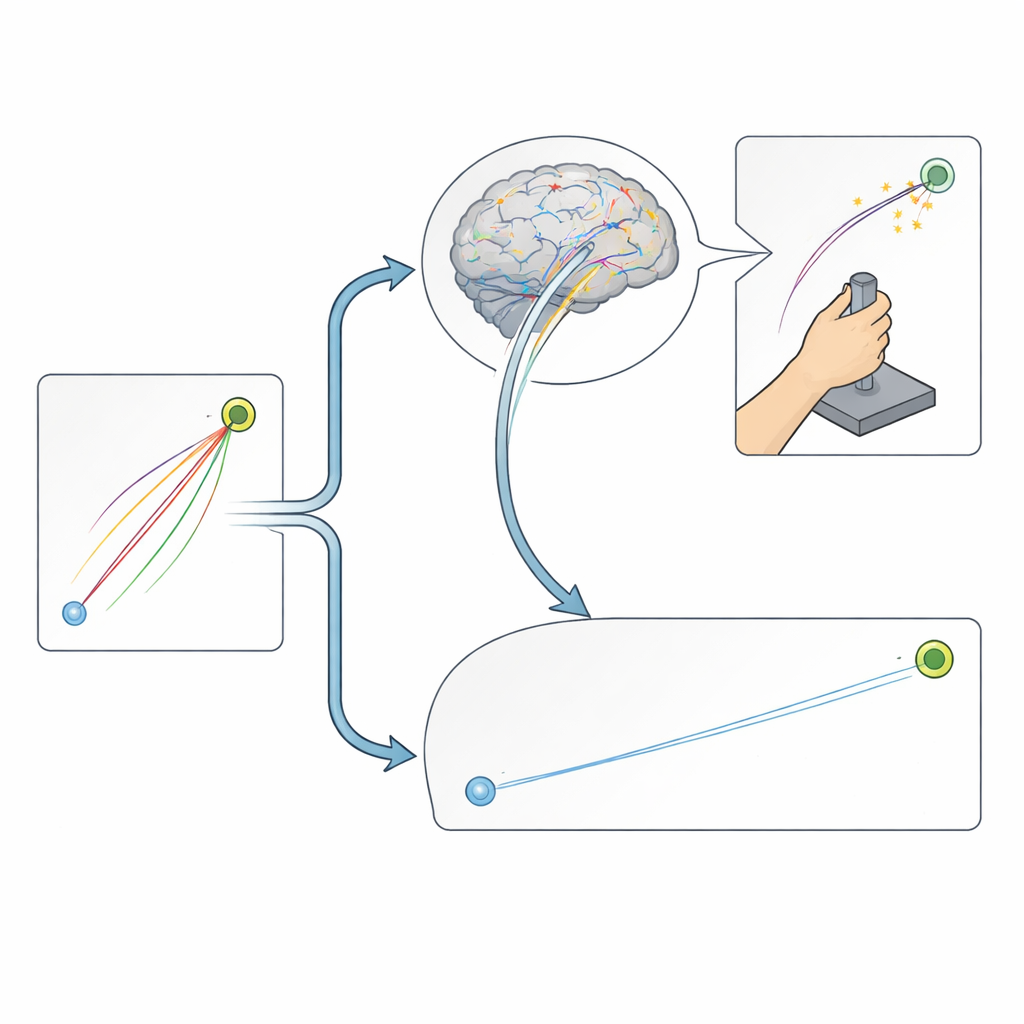
The researchers also examined how much people’s early movements varied in direction when the rotation was first introduced. In the Curling task, participants who showed greater early variability went on to learn more, even after accounting for quick initial improvements. This suggests that, when corrections are impossible, trying out slightly different plans—what the authors call “planning noise”—helps the brain explore and refine better strategies between trials. In the Reaching task, by contrast, early variability mostly reflected rapid error reduction within the first few attempts and did not predict how much people would ultimately adapt. Because ongoing visual feedback lets the system correct errors in real time, the informational value of these early differences appears to be dampened.
Why this matters for training and rehabilitation
Together, these results show that reinforcement mainly strengthens the brain’s ability to correct movements as they unfold, while natural variability in how we start our movements primarily supports learning that happens from one attempt to the next. For everyday training, sports coaching, and rehabilitation, this means that rewards or penalties may be most effective when tasks allow continuous feedback and adjustment, whereas carefully harnessing variation in early attempts could be especially valuable when only the initial movement impulse determines success. By separating these two learning routes, the study helps explain why past research has reported mixed effects of reward and punishment on motor learning, and points toward more targeted ways to design practice that works with, rather than against, our nervous system’s built‑in learning mechanisms.
Citation: Lehnberg, F.M., Paul, T., Wiemer, V.M. et al. Reinforcement drives within- not between-trial motor adaptation. Sci Rep 16, 11605 (2026). https://doi.org/10.1038/s41598-026-45293-8
Keywords: motor learning, reinforcement, movement variability, visuomotor adaptation, motor control