Clear Sky Science · en
Shared leadership relates to civil servants’ voice behavior via psychological capital and organizational identification
Why speaking up at work matters
Civil servants are often the first to spot problems in public services and to imagine better ways of doing things. Yet many stay silent, worried about offending superiors or upsetting colleagues. This study explores when government employees feel able to voice ideas and concerns, and highlights a different way of leading teams—called shared leadership—that seems to make speaking up more likely by strengthening people’s confidence and sense of belonging at work. 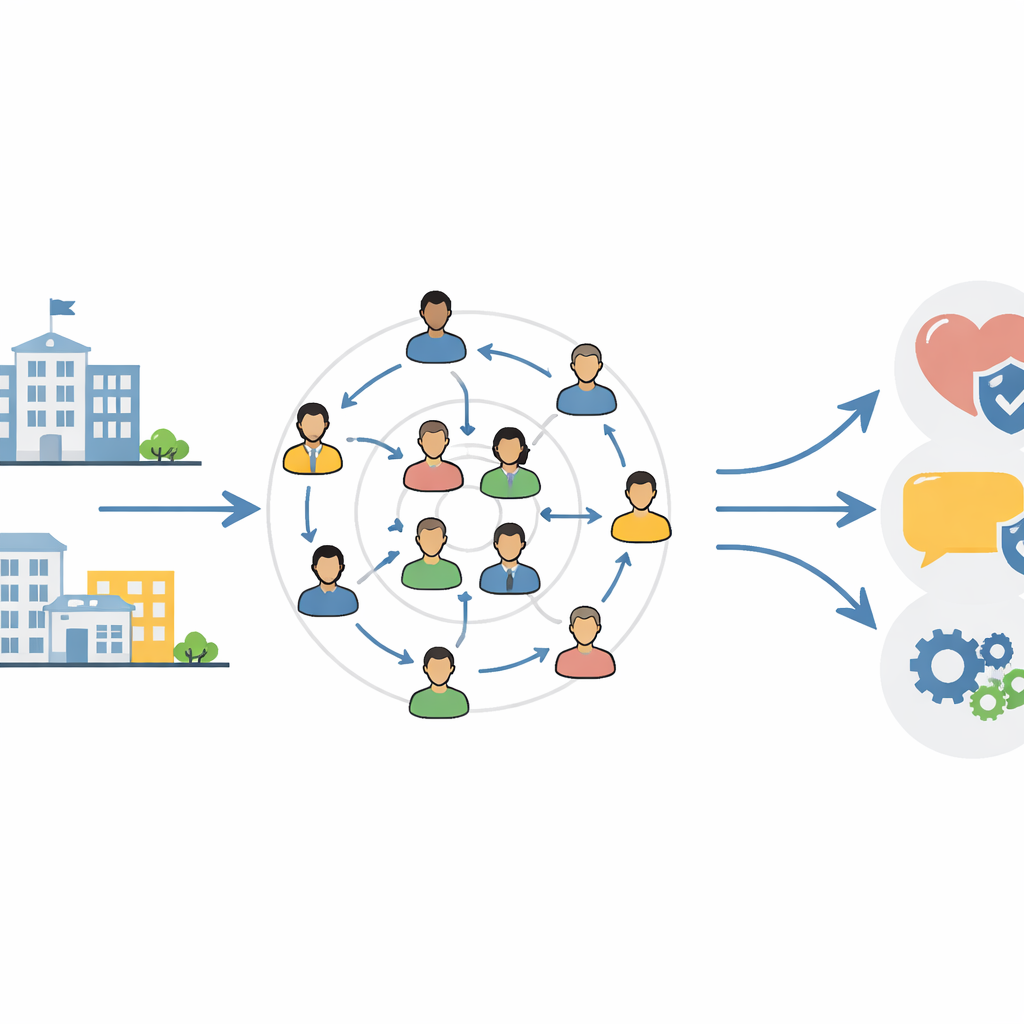
A new way of looking at leadership
Most leadership research focuses on a single boss directing subordinates from the top of a hierarchy. Shared leadership, by contrast, is about influence flowing among team members who jointly guide their work. Rather than one person always deciding, responsibility and initiative are spread across the group. This shift is especially relevant in public agencies, which are usually formal and rule-bound. When decisions are made only at the top, those closest to frontline problems may feel it is not their place to question or suggest improvements, even when they see better options.
Two kinds of speaking up
The researchers distinguish between two ways employees voice themselves. Promotive voice focuses on ideas to improve services or processes—suggesting new tools, streamlining steps, or finding fresh solutions. Prohibitive voice is about warning of risks or pointing out harmful practices, such as waste, safety hazards, or unfair treatment. Both forms help organizations adapt and avoid costly mistakes, but prohibitive voice is often riskier because it can be seen as criticism of existing decisions or powerful people. Understanding what encourages each type of voice is crucial in settings like government, where mistakes can affect many citizens.
The power of confidence and belonging
To explain how shared leadership might foster voice, the authors focus on two inner experiences. One is psychological capital—a bundle of positive states such as confidence, hope, optimism, and resilience that help people tackle challenges. The other is organizational identification, or how strongly employees feel they are part of, and emotionally attached to, their organization. When civil servants feel capable and hopeful, they are more willing to propose changes and take interpersonal risks. When they also feel the organization’s goals are their own, speaking up becomes a way to protect and improve something they care about, rather than simply a risky act of defiance.
What the study found in Chinese government offices
The authors surveyed 440 full-time civil servants in China’s Guangxi province, asking about how leadership is shared in their teams, their levels of psychological capital and organizational identification, and how often they engage in both promotive and prohibitive voice. Using statistical models, they found that shared leadership was linked to higher psychological capital and stronger identification with the organization. In turn, both of these inner resources were linked to more frequent speaking up of both kinds. Shared leadership also had a direct association with voice, but part of its influence clearly ran through employees feeling more confident and more attached to their organization. These patterns held even after accounting for age, gender, education, seniority, and job rank, suggesting the links are fairly robust. 
What this means for public service
For a general reader, the main takeaway is straightforward: when leadership in public agencies is treated as a shared team responsibility rather than a top-down chain of command, civil servants are more likely to feel strong, hopeful, and genuinely part of their organization. In that climate, they are readier to offer bold ideas for improvement and to sound the alarm when they see trouble, even in cautious bureaucratic settings. Although this study is based on one region and cannot prove cause and effect, it points to a practical path for governments that want more honest feedback and innovation: cultivate work environments where influence circulates among colleagues, where people’s psychological resources are nurtured, and where staff feel the organization is truly “theirs.”
Citation: Lyu, H., Duan, N. Shared leadership relates to civil servants’ voice behavior via psychological capital and organizational identification. Sci Rep 16, 14488 (2026). https://doi.org/10.1038/s41598-026-44452-1
Keywords: shared leadership, employee voice, public sector, psychological capital, organizational identification