Clear Sky Science · en
A comparison of transient experiential wellbeing across health enhancing behaviours in the American Time Use Survey
Why everyday activities and feelings matter
We often hear that exercise, volunteering, and social time are “good for us,” but those messages usually focus on long-term health or life satisfaction. This study asks a simpler, more immediate question: how do different common activities actually feel in the moment? Using a large national survey of Americans’ daily lives, the researchers compared people’s real-time emotions during eight types of health-supporting activities, from workouts and walks to arts, reading, worship, and helping others. Their findings reveal that these activities evoke rich mixes of pleasure and discomfort—and that where we are, who we are with, and how meaningful the activity feels can shift that emotional balance.
How the study followed a day in people’s lives
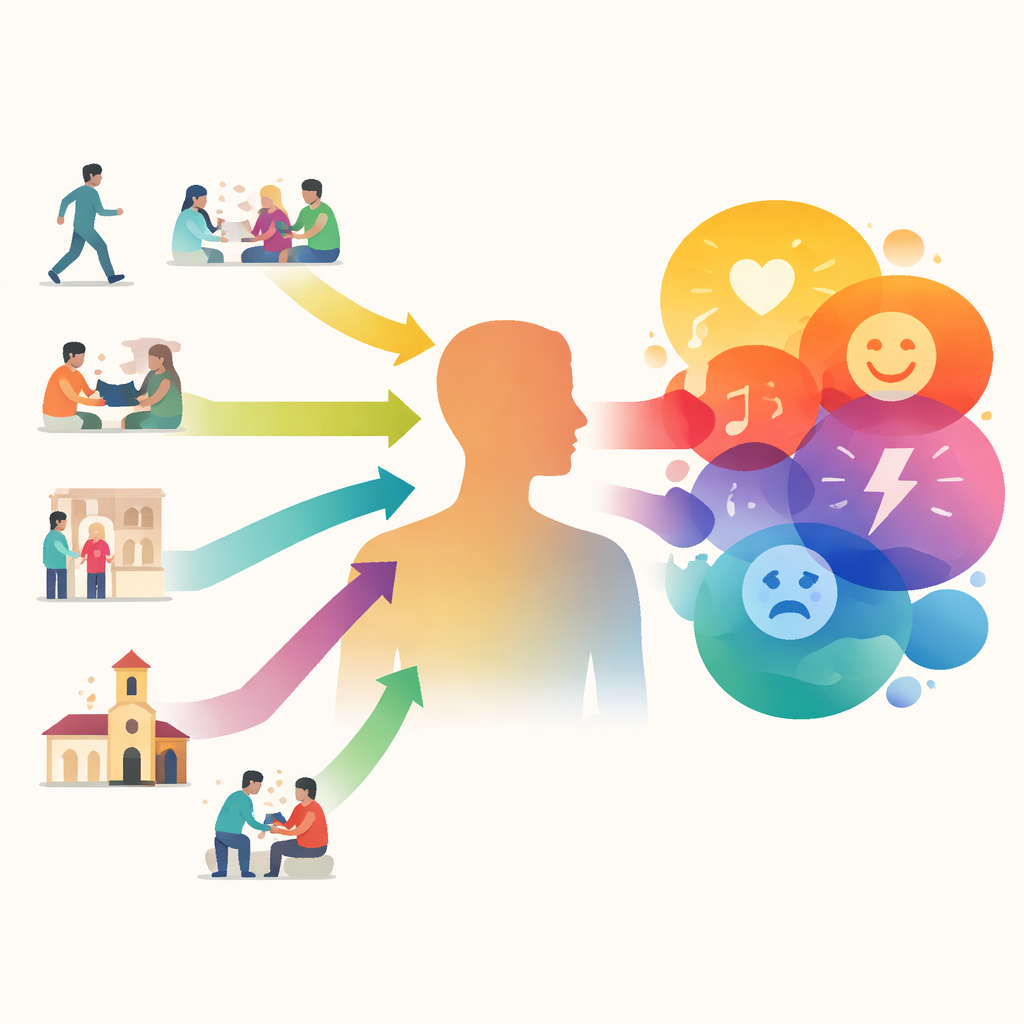
The team drew on the American Time Use Survey, which has thousands of adults reconstruct everything they did over the previous 24 hours, from 4 a.m. one day to 4 a.m. the next. In years when a special wellbeing module ran, three activities from each person’s day were randomly chosen—excluding sleep and basic personal care. For each chosen activity, people rated how happy, sad, stressed, tired, and in pain they felt on simple 0–6 scales, and how meaningful the activity was to them. The researchers focused on 11,144 people who happened to report at least one of eight “health-enhancing” behaviors: physical activity, attending sports events, doing or experiencing the arts, reading, social engagement, religious or spiritual activities, and volunteering.
Which activities people do most—and for how long
Across this large sample, social engagement was the standout: almost half of participants spent time socializing, attending gatherings, or talking on the phone. Reading and physical activity were also common, each done by about one in five people. By contrast, attending sports events and taking part in arts activities were relatively rare on any given day. When people did engage in these pursuits, however, they often devoted substantial time to them—typically two to three hours for each type of health-enhancing behavior. This allowed the researchers to estimate what an “average minute” in each activity felt like emotionally for people in the United States.
How different activities feel in the moment
Emotional patterns varied strikingly across activities. Physical activity stood out for its mix of moderate happiness, low sadness and stress, but high tiredness and pain—consistent with the idea that challenging movement can be both uplifting and physically taxing. Receptive arts, such as listening to music, attending performances, or visiting museums, were linked to the highest happiness and generally low negative feelings, making them the most emotionally rewarding overall. Religious and spiritual activities also tended to pair higher positive feelings with lower sadness, stress, and tiredness. In contrast, volunteering and reading were associated with lower happiness than physical activity, and reading in particular often coincided with more sadness and tiredness, perhaps because it was typically done alone, at home, and sometimes when people were already feeling unwell or winding down for the night.
Why company, place, and meaning change the mood
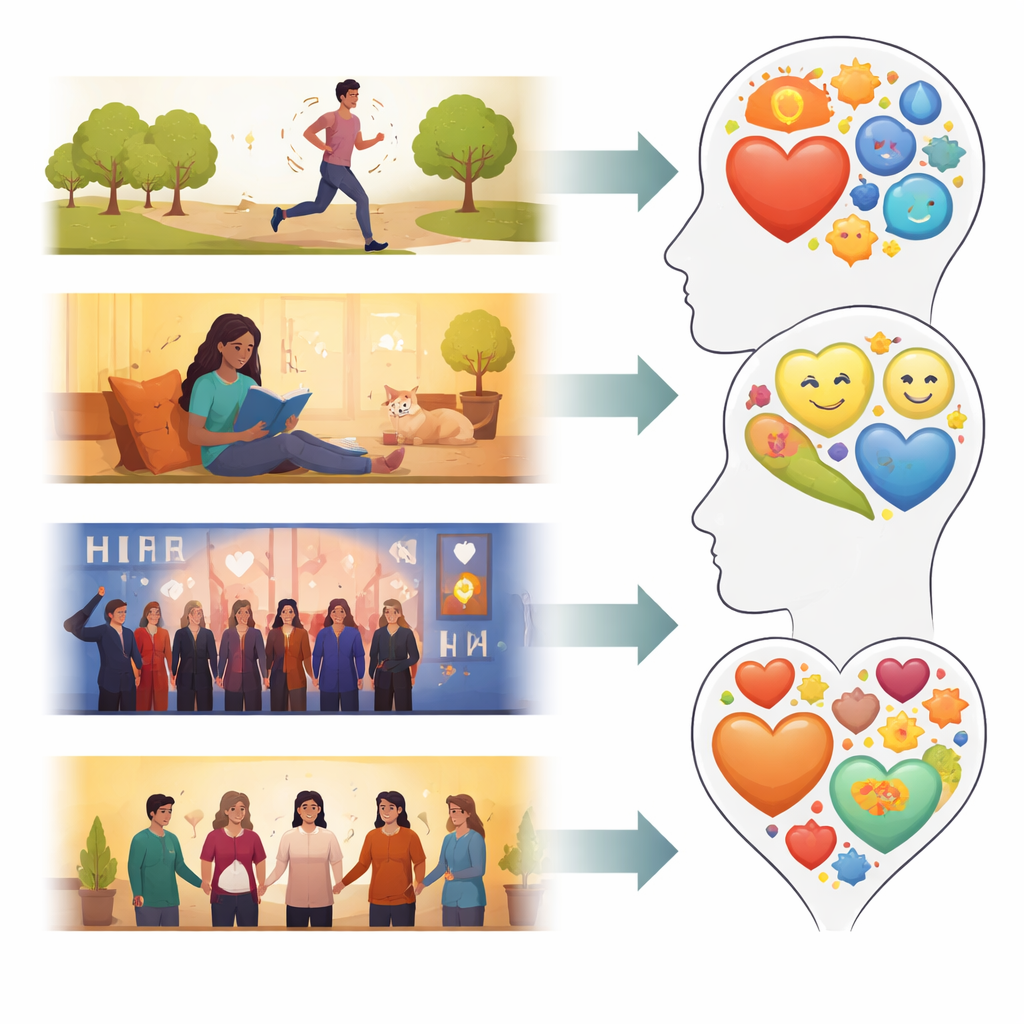
The study also looked beyond the activity itself to its context. Social engagement, sports events, and volunteering were most likely to involve interacting with others, while reading was usually solitary. Overall, doing health-enhancing activities with other people, outside the home, and feeling that the activity was very meaningful all tended to boost happiness and reduce negative feelings. Yet these factors did not change every activity equally. For example, volunteering and religious or spiritual activities were strongly shaped by meaning and setting: when they were done at home or felt less meaningful, they were linked to more stress and lower happiness than physical activity; when done outside the home or rated as very meaningful, they were associated with less stress and more positive feelings. This suggests that it is not just what we do, but how and where we do it, that shapes our moment-to-moment wellbeing.
What this means for choosing feel-good activities
To a layperson, the main takeaway is that there is no single “best” healthy activity for feeling good in the moment. Physical activity, arts, social time, worship, volunteering, and even reading all bring their own blends of joy, strain, calm, and challenge. Some, like receptive arts and meaningful religious activities, tend to feel especially pleasant and low in distress. Others, like exercise and participatory arts, can pair positive feelings with tiredness or discomfort that may still be worthwhile. Because these fleeting emotional “micropatterns” can add up over time, the authors argue that health advice should expand beyond exercise alone. Encouraging a mix of movement, arts, social, spiritual, and helping activities—and paying attention to doing them with others, outside the home, and in ways that feel personally meaningful—may offer richer support for both emotional and physical health.
Citation: Bone, J.K., Bu, F., Sonke, J.K. et al. A comparison of transient experiential wellbeing across health enhancing behaviours in the American Time Use Survey. Sci Rep 16, 10410 (2026). https://doi.org/10.1038/s41598-026-40985-7
Keywords: experiential wellbeing, leisure activities, arts and health, social engagement, time use survey