Clear Sky Science · en
Obstacle crossing when dual-tasking in children with and without developmental coordination disorder
Why stepping over toys is harder than it looks
For many children, walking around the house or playground means constantly stepping over toys, curbs and other small obstacles—often while talking, looking around or thinking about something else. This study asked what happens when children must cross an obstacle while also doing a simple thinking task, and whether this is especially challenging for children with developmental coordination disorder (DCD), a condition that makes everyday movements like running, catching or handwriting more difficult.
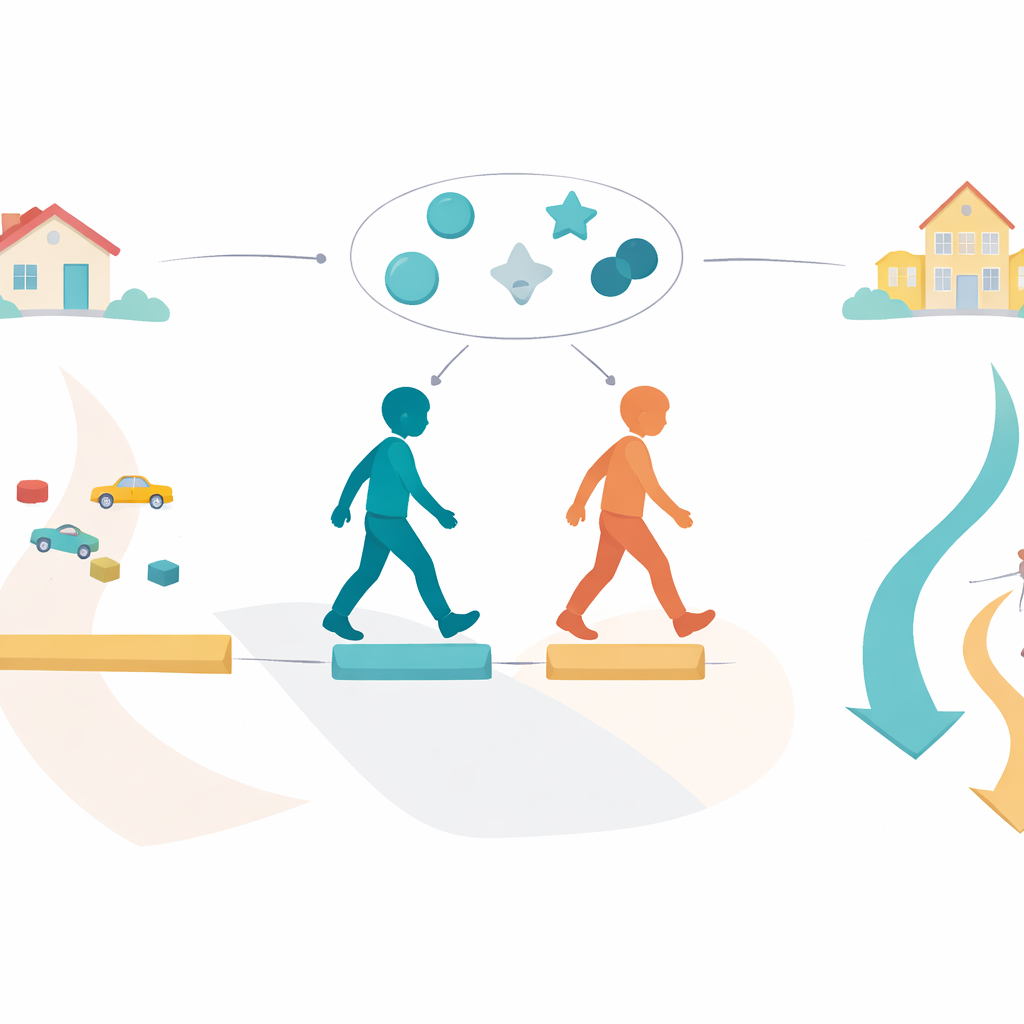
Two groups of kids, one everyday challenge
The researchers studied 110 children aged 7 to 12 years. About a third had DCD, meaning their movement skills were below what is typical for their age and affected daily activities at school and home. The rest were typically developing peers. All children were asked to walk along a 10‑meter walkway and step over a low hurdle adjusted to their leg length, much like stepping over a toy on the floor. As they walked, sensitive force plates in the floor measured how hard and how smoothly they landed and pushed off after the obstacle, while motion‑capture cameras tracked their leg movements.
Walking while thinking at the same time
On some trials, the children only walked and stepped over the obstacle. On other trials, they had to do a visual decision task at the same time. Just before the obstacle, a picture appeared to one side of the walkway. In the simple version, children said which side it appeared on. In the harder version, they had to say the opposite side, which required stopping themselves from giving the obvious answer. The researchers recorded how quickly and accurately children responded, as well as how their walking pattern and balance changed when their attention was split between moving and thinking.
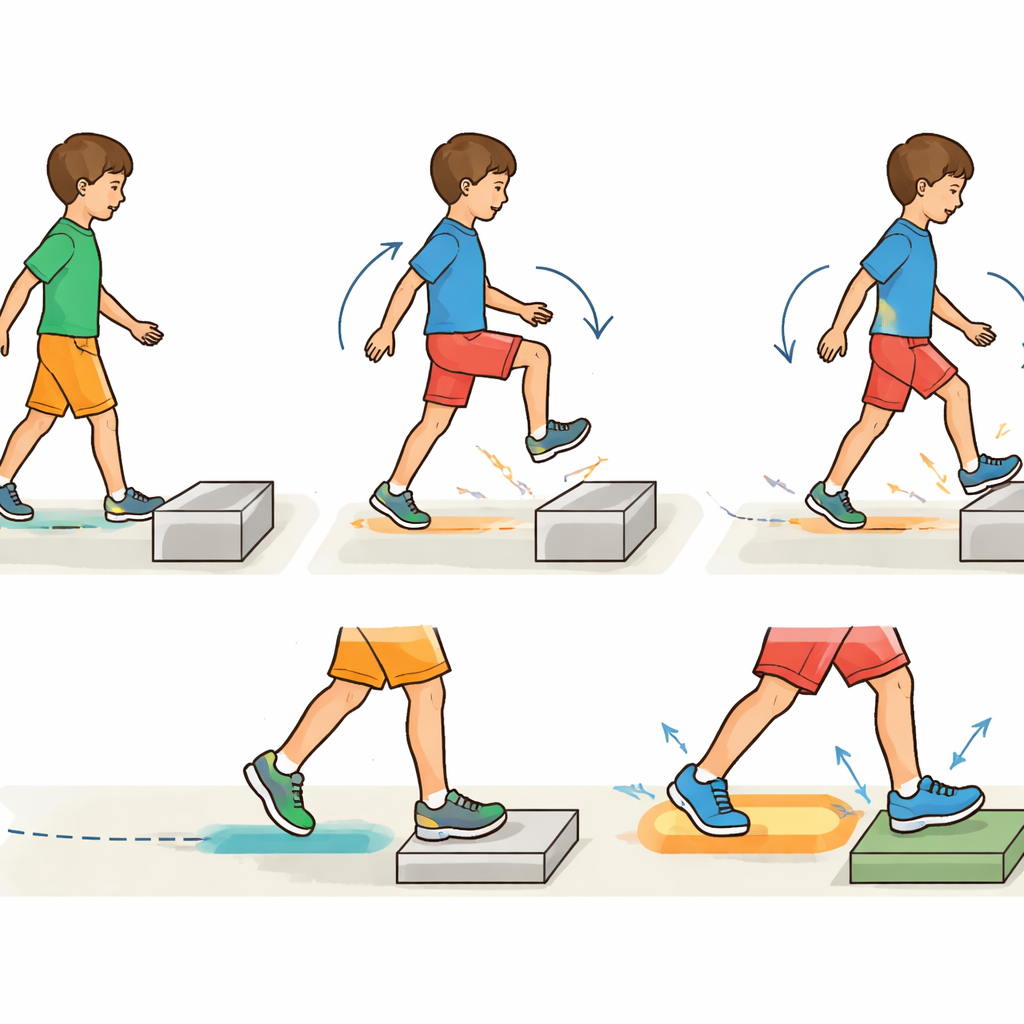
Landing looks similar, recovery tells a different story
When it came to clearing the obstacle itself—how high they lifted the foot and how far they stepped—children with DCD and their peers looked surprisingly similar, even under dual‑task conditions. Both groups also stayed accurate on the thinking task, though children with DCD took longer to respond. The key differences appeared after the obstacle, during the first step and push‑off. Children with DCD showed more side‑to‑side movement of the pressure under the foot, a sign of shakier balance, and they tended to delay the moment when they pushed themselves forward again after landing, especially when also doing the thinking task. Typically developing children, in contrast, maintained a steadier post‑obstacle push‑off even when their attention was divided.
Growing into a more efficient way of moving
Age made a clear difference across the board. Older children, regardless of whether they had DCD, generally walked with shorter but more controlled steps, absorbed the landing forces more smoothly, and restarted walking faster after crossing the obstacle. They also responded more quickly in the visual task. These patterns suggest that as children grow, they learn a more economical walking strategy: they do less braking when landing and regain speed sooner after stepping over something, even when their mind is busy with another task.
What this means for real‑world safety and support
In simple terms, the study shows that children with DCD can step over obstacles and do a second task as accurately as other children, but they pay a hidden price in how steady they are and how quickly they get going again afterward. Their balance is less stable and their forward push‑off is delayed when attention is divided, exactly the situation children face in busy classrooms, crowded hallways or playgrounds. The authors suggest that therapy and training should focus not only on clearing obstacles safely, but especially on the "recovery" step after the obstacle, and should practice this under conditions where children also have to look, listen or think. Strengthening this post‑obstacle phase could lower the risk of trips and falls and make everyday movement feel easier and safer for children with coordination difficulties.
Citation: Svoboda, Z., Bizovska, L., Klein, T. et al. Obstacle crossing when dual-tasking in children with and without developmental coordination disorder. Sci Rep 16, 10329 (2026). https://doi.org/10.1038/s41598-026-40826-7
Keywords: developmental coordination disorder, dual-task walking, obstacle crossing, children’s balance, gait stability