Clear Sky Science · en
Predefined-time tracking control for underwater robots
Robots on a Tight Schedule Under the Sea
Autonomous underwater vehicles—torpedo-shaped robots that roam the oceans—are increasingly trusted with jobs like mapping the seafloor, inspecting offshore structures, and monitoring marine ecosystems. Many of these missions are on the clock: several vehicles must meet at the same place and time, scan an area before a ship passes, or dodge obstacles in crowded waters. This study presents a new way to steer such robots so they can be guaranteed to lock onto their planned path within a precise, user‑chosen amount of time, even when currents push them off course or their exact behavior is hard to model.
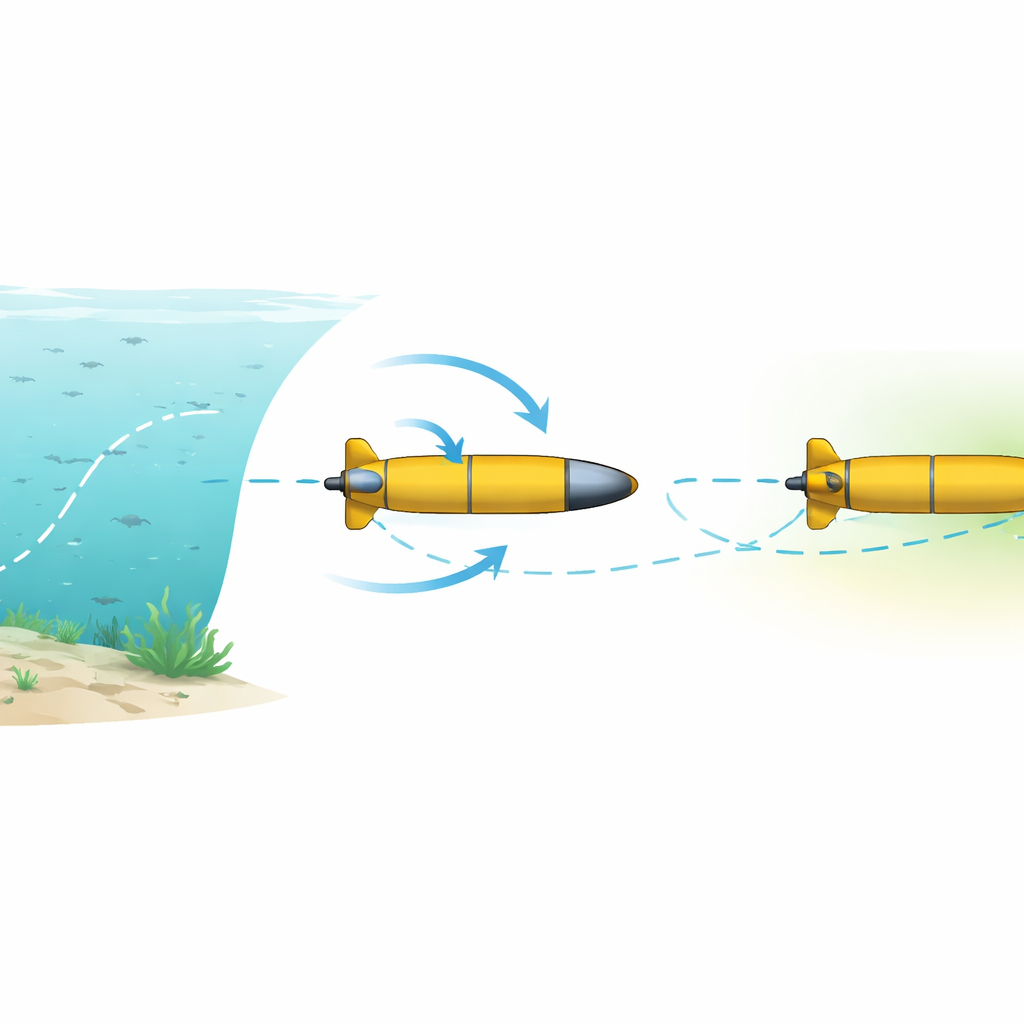
Why Timing Matters for Ocean Robots
Conventional guidance methods for underwater robots focus on eventually shrinking the gap between where the robot is and where it should be. A widely used approach, called sliding‑mode control, is prized because it keeps the robot on track even when the model of the vehicle or the ocean environment is imperfect. But it has a key drawback for time‑critical missions: the time it needs to settle onto the desired path depends on how far off the robot starts and on details of the motion, so operators cannot easily know in advance how long convergence will take. For tasks that demand precise synchronization or strict safety margins, this uncertainty can be costly or even dangerous.
A Steering Method with a Built-In Deadline
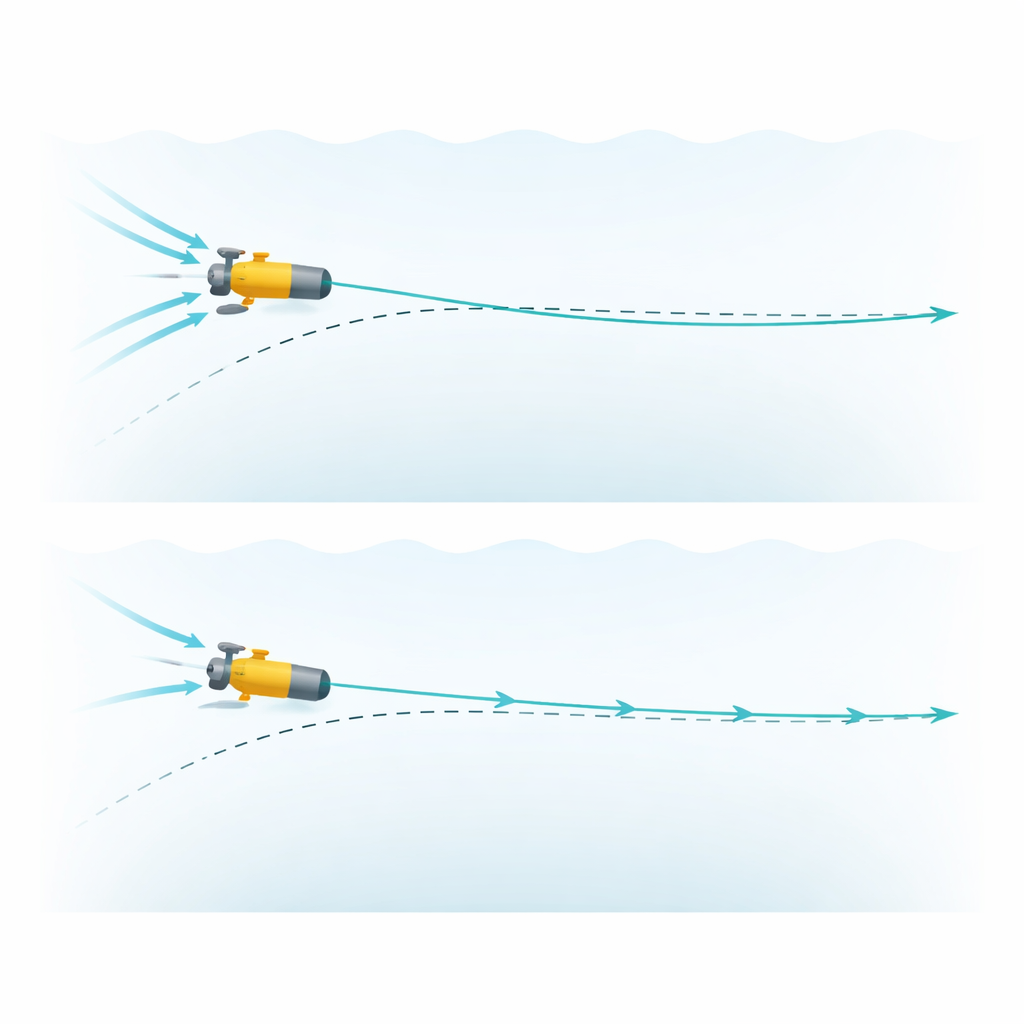
The authors develop a predefined‑time control strategy that bakes the desired settling time into the steering law itself. Instead of merely promising that errors will vanish “eventually,” the method allows an engineer to specify a convergence horizon—say a few seconds for a quick maneuver or longer for a gentler response—and designs the control signals so that both position and velocity errors are guaranteed to approach zero before that deadline, regardless of the robot’s starting point. This is achieved through a two‑layer scheme: an outer layer computes desired speeds in the robot’s forward and sideways directions based on how far it is from the target path, and an inner layer generates the propulsive forces needed to make the real speeds match those targets. Carefully chosen mathematical energy functions prove that this combination will always pull the robot onto its path within the prescribed time.
Putting the Method to the Test
To see how this guaranteed‑time steering compares with a more familiar approach, the researchers apply both to a detailed computer model of a well‑known underwater vehicle called REMUS‑100. They ask the virtual robot to track two kinds of paths in a horizontal plane: a smooth circle and a more demanding flower‑shaped loop with changing curvature. For the new controller, they try several convergence times, from very fast to more relaxed. The results show that both methods can eventually guide the robot along the requested curves, but the predefined‑time controller reaches the path sooner when its time horizon is short, while longer horizons yield gentler motion.
Balancing Speed, Effort, and Stability
The study goes beyond simple visual inspections of paths. It tallies how far the robot strays from the desired track over time, how much force the thrusters must generate, how much mechanical energy is spent, and how smooth the force commands are once the robot has settled. When the convergence time is chosen to be very short, the new controller slashes tracking error but demands sharp bursts of force and more energetic maneuvers. As the allowed convergence time is lengthened, these forces and the associated energy use drop, and the control actions become as smooth—or smoother—than those of sliding‑mode control while still keeping the robot closer to its path. Even when the researchers inject strong currents, large changes in vehicle parameters, and noisy sensor readings, both approaches remain robust, but the predefined‑time controller maintains tighter tracking.
What This Means for Future Ocean Missions
For operators planning fleets of underwater robots, the key message is that they can now trade speed against effort in a transparent way and, crucially, guarantee when the robots will settle onto their routes. If a mission demands strict timing—such as coordinating multiple vehicles, inspecting a moving object, or rapidly steering away from hazards—the predefined‑time controller offers precise, tunable convergence. When long‑term smoothness and minimal actuator wear are more important than raw speed, more traditional methods still have advantages. By clearly mapping out these trade‑offs, this work lays the groundwork for more predictable, reliable, and efficient underwater robot guidance in real‑world seas.
Citation: Keymasi-Khalaji, A., Tajpour-Fard, S. Predefined-time tracking control for underwater robots. Sci Rep 16, 10218 (2026). https://doi.org/10.1038/s41598-026-40596-2
Keywords: underwater robots, trajectory tracking, time-bounded control, robot navigation, ocean autonomy