Clear Sky Science · en
Structure elucidation and evaluation of the antimicrobial and antitumor activities of 5-methylthiazole-based Schiff base and its metal chelates
Why tiny metal-linked molecules matter
Antibiotic resistance and cancer are two of the biggest challenges in modern medicine. Chemists are searching for small, smart molecules that can slip into cells, latch onto biological targets, and shut down harmful microbes or tumor growth with fewer side effects. This study explores a family of such molecules built from a sulfur‑ and nitrogen‑containing ring called thiazole, then strengthened by attaching metal ions. The researchers show how carefully designed metal–organic particles can become powerful fighters against bacteria, fungi, and cancer cells, while also using advanced calculations to understand why they work.
Building a new medicine-ready molecule
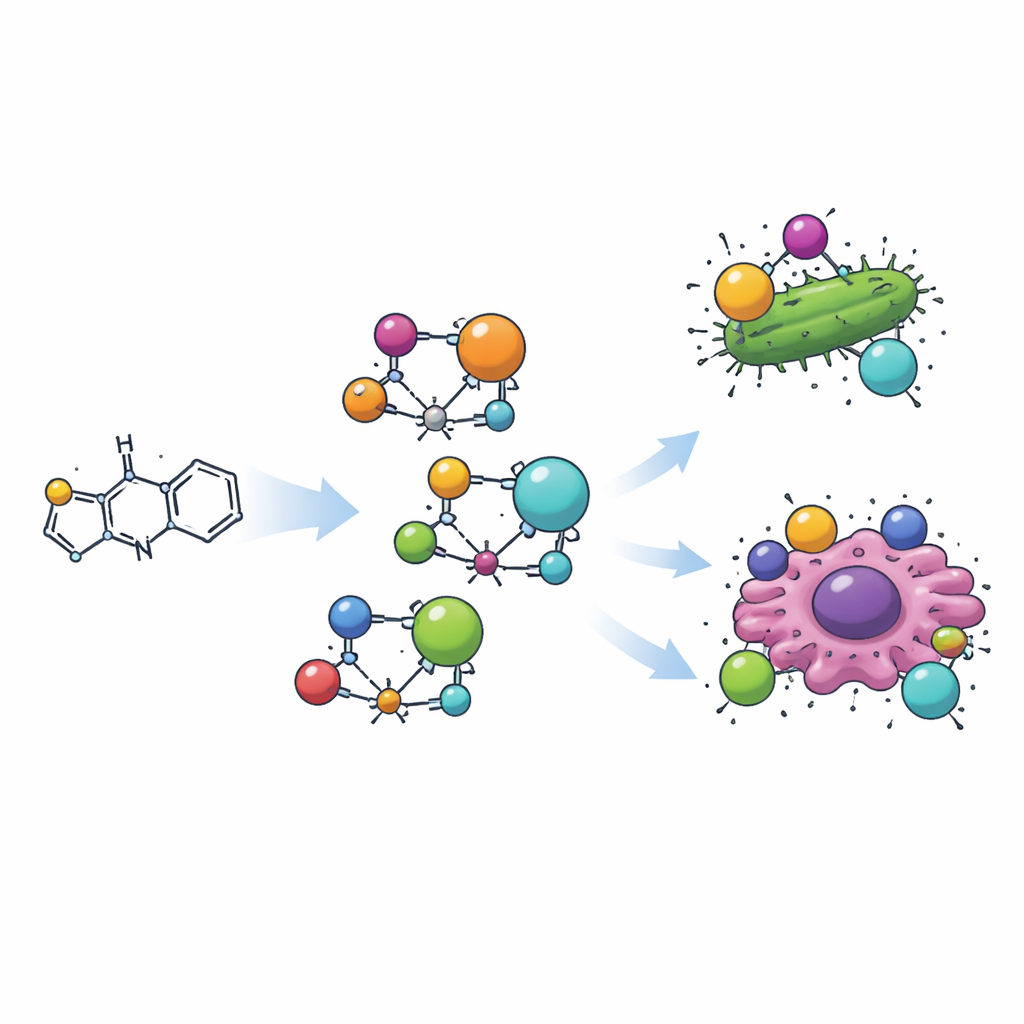
The team first created an organic molecule by joining a thiazole ring to a small aromatic (ring-shaped) fragment using a classic "Schiff base" reaction. This new molecule, called H2L, was then combined with four different metal ions—manganese, copper, zirconium, and cadmium—to form four distinct metal–organic complexes. Each complex has the thiazole-based ligand gripping the metal through a nitrogen atom and a nearby oxygen atom, wrapping around the metal like a claw. Careful measurements of color, magnetism, and light absorption revealed that the metals adopt different three-dimensional shapes: manganese and cadmium form tetrahedral (four-cornered) structures, copper forms a flat square-planar unit, and zirconium sits in an octahedral (six-cornered) arrangement.
Seeing structure from atoms to nanoparticles
To confirm how these complexes are built, the researchers combined many tools. Infrared and nuclear magnetic resonance spectra showed that specific bonds in the ligand shift when the metal is bound, proving that the nitrogen–carbon double bond and a nearby oxygen atom are involved in gripping the metal. Mass spectrometry confirmed the expected molecular weights, while heat-based tests revealed when water and parts of the organic framework are released as the complexes decompose. X-ray diffraction and transmission electron microscopy demonstrated that the resulting materials are crystalline or nearly crystalline, and—crucially—nanometer sized. Particle sizes ranged roughly from 7 to 34 nanometers, small enough to move through biological barriers more easily than bulk materials.
Computers reveal how electrons and cells respond
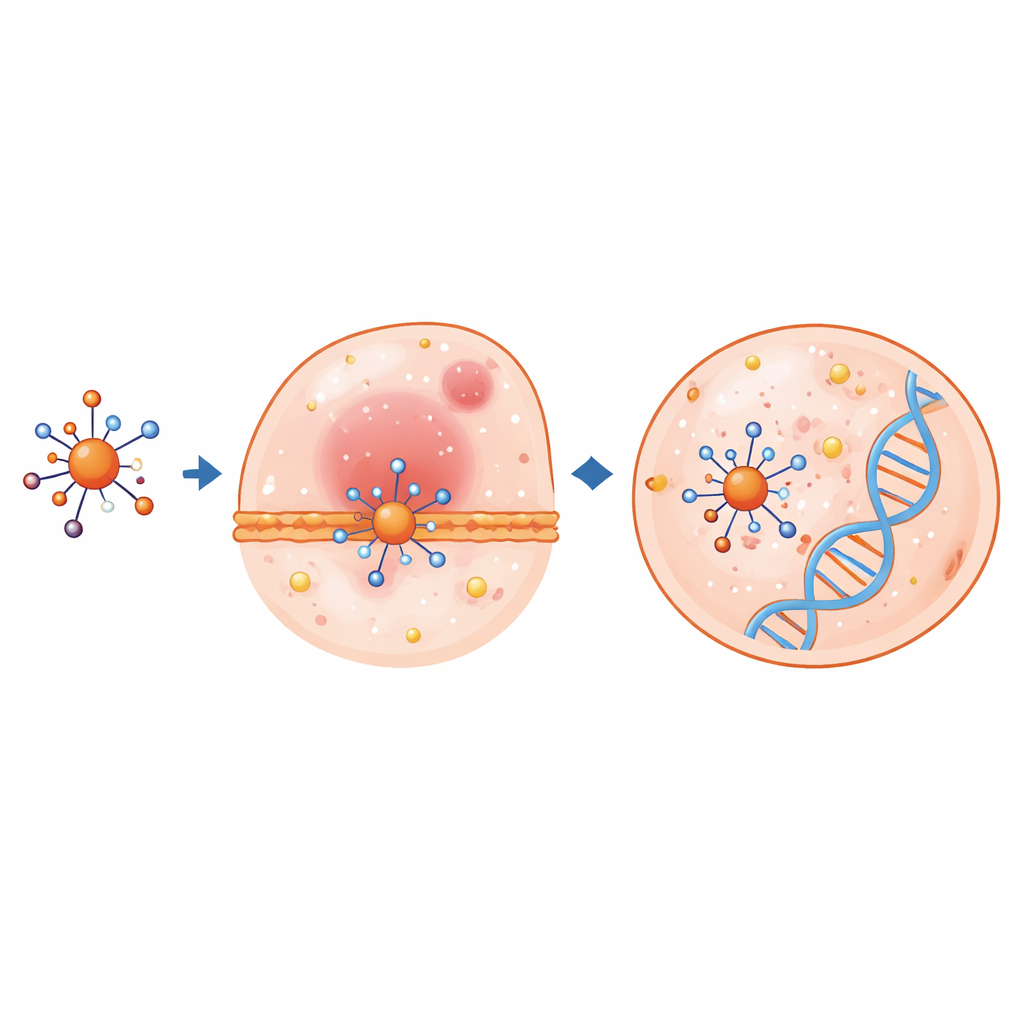
Advanced quantum chemical calculations helped explain how these complexes might behave inside the body. Using density functional theory, the scientists optimized the atomic structures and examined the highest occupied and lowest unoccupied molecular orbitals, which indicate how easily electrons can move or be shared. When the ligand binds metals, key bond lengths and angles change, and the energy gap between occupied and empty orbitals often shrinks—signaling higher chemical reactivity. The copper complex in particular shows a very small gap and a strong tendency to accept electrons, traits that often correlate with strong biological effects. Maps of electrostatic potential highlighted regions on the molecules most likely to interact with charged parts of proteins or DNA.
Fighting germs and attacking tumor cells
The real test was biological. The free ligand and its four metal complexes were challenged against common bacteria and fungi using standard plate assays. All showed notable antimicrobial activity, and in many cases the metal complexes outperformed established drugs such as gentamicin and amphotericin B. For example, some complexes produced larger zones of inhibition against both Gram-positive and Gram-negative bacteria, as well as problem fungi like Candida albicans. The compounds were also tested against human liver cancer (HepG‑2) and breast cancer (MCF‑7) cell lines. Here, too, metal binding greatly boosted potency. The copper complex was especially impressive against breast cancer cells, inhibiting growth at lower concentrations than the widely used chemotherapy drug 5‑fluorouracil. Computer docking studies supported these findings, showing that the ligand and complexes can fit snugly into pockets of cancer-related proteins and DNA helices, forming stabilizing interactions that could disrupt normal function.
What this work means for future treatments
To a non-specialist, the key message is that small design changes at the atomic level—adding a metal center, tuning shape, and redistributing electrons—can turn a modest organic molecule into a nanometer-scale complex with strong, targeted biological activity. This study shows that thiazole-based Schiff bases, when paired with metals like copper, can rival or even surpass standard drugs in lab tests against microbes and cancer cells. While much more work is needed before any of these complexes become medicines, the combination of experimental measurements and computer modeling offers a roadmap for creating next-generation metal–organic therapies that are both potent and selective.
Citation: Wahdan, K.M., Mandour, H.S.A., El-Ghamry, H.A. et al. Structure elucidation and evaluation of the antimicrobial and antitumor activities of 5-methylthiazole-based Schiff base and its metal chelates. Sci Rep 16, 10738 (2026). https://doi.org/10.1038/s41598-026-40320-0
Keywords: thiazole metal complexes, nanoparticle anticancer agents, Schiff base ligands, antimicrobial coordination compounds, molecular docking drug design