Clear Sky Science · en
The catalytic enantioselective [1,2]-Wittig rearrangement cascade of allylic ethers
Turning Molecular Jumble into Order
Chemists often want to build molecules that are mirror‑image selective, because our bodies can tell “left‑handed” and “right‑handed” versions apart. This paper tackles a long‑standing puzzle in that area: how to steer a notoriously unruly type of bond‑shuffling reaction so that it gives mostly one mirror image rather than a random mix. The authors not only find a way to do this, they also show that the reaction works through an unexpected route that overturns decades of textbook thinking.
Why These Shape‑Shifts Matter
Many powerful reactions in organic chemistry work by quietly sliding bonds around inside a molecule rather than breaking everything apart and starting over. These “rearrangements” are prized because they waste very little material and can build complex structures in just one step. Among them, a set of moves known as Wittig rearrangements can turn simple ether groups into valuable alcohols. However, a particular version, the so‑called [1,2]-Wittig rearrangement of allylic ethers, has been difficult to control: it typically gives mixtures of products and, crucially, tends to scramble the 3D arrangement of atoms instead of preserving or creating a single handed form.
A New Cascade Pathway
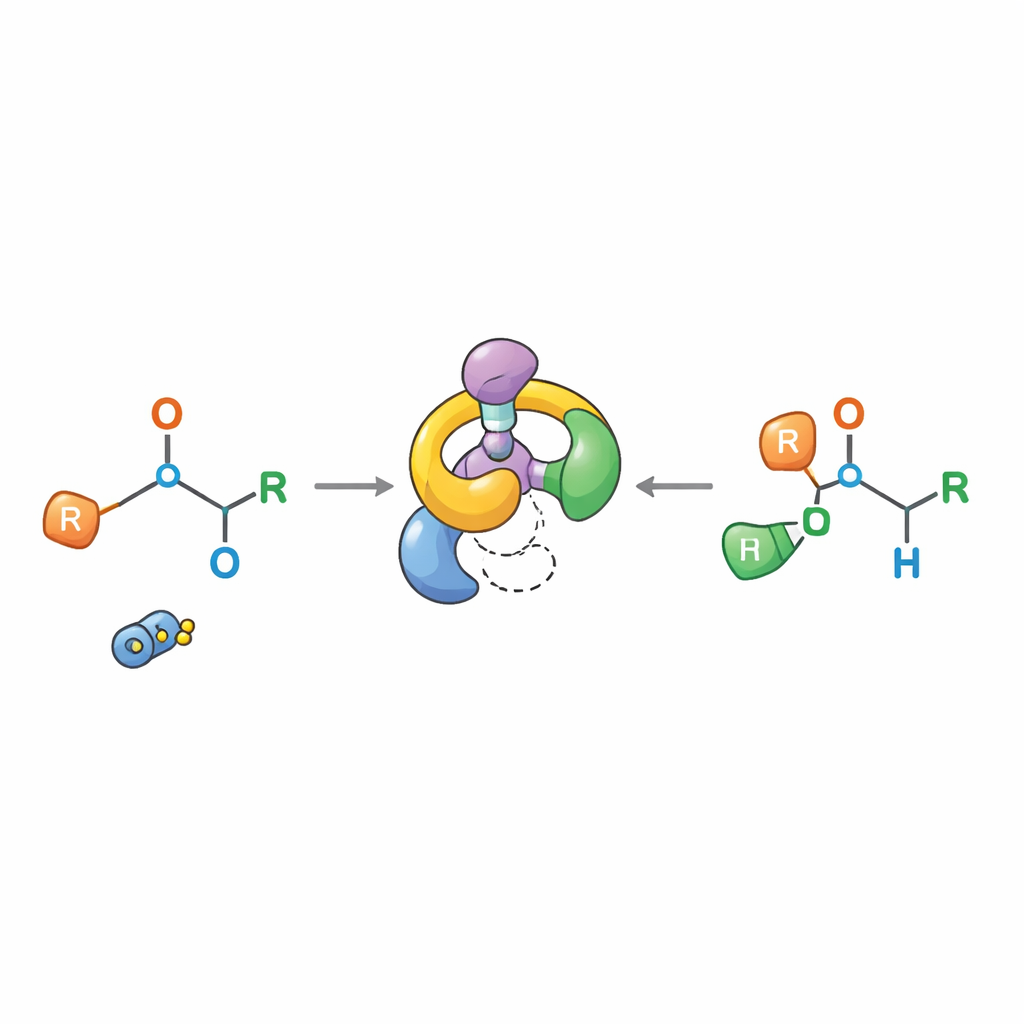
The researchers show that this troublesome reaction can be tamed by making it part of a two‑step cascade guided by a specially designed organic catalyst. Their catalyst, called a bifunctional iminophosphorane, is both an exceptionally strong base and a precise “handed” environment. First, it triggers a well‑behaved bond shift known as a [2,3]-rearrangement, which constructs a chiral tertiary alcohol with very high preference for one mirror image. Then, under basic conditions, this intermediate quietly reshuffles again into the final [1,2]-Wittig product. Across many different starting materials, the sequence reliably delivers chiral homoallylic alcohols in good yields and with high enantiomeric ratios, meaning one handed form strongly dominates.
Probing How the Reaction Really Works
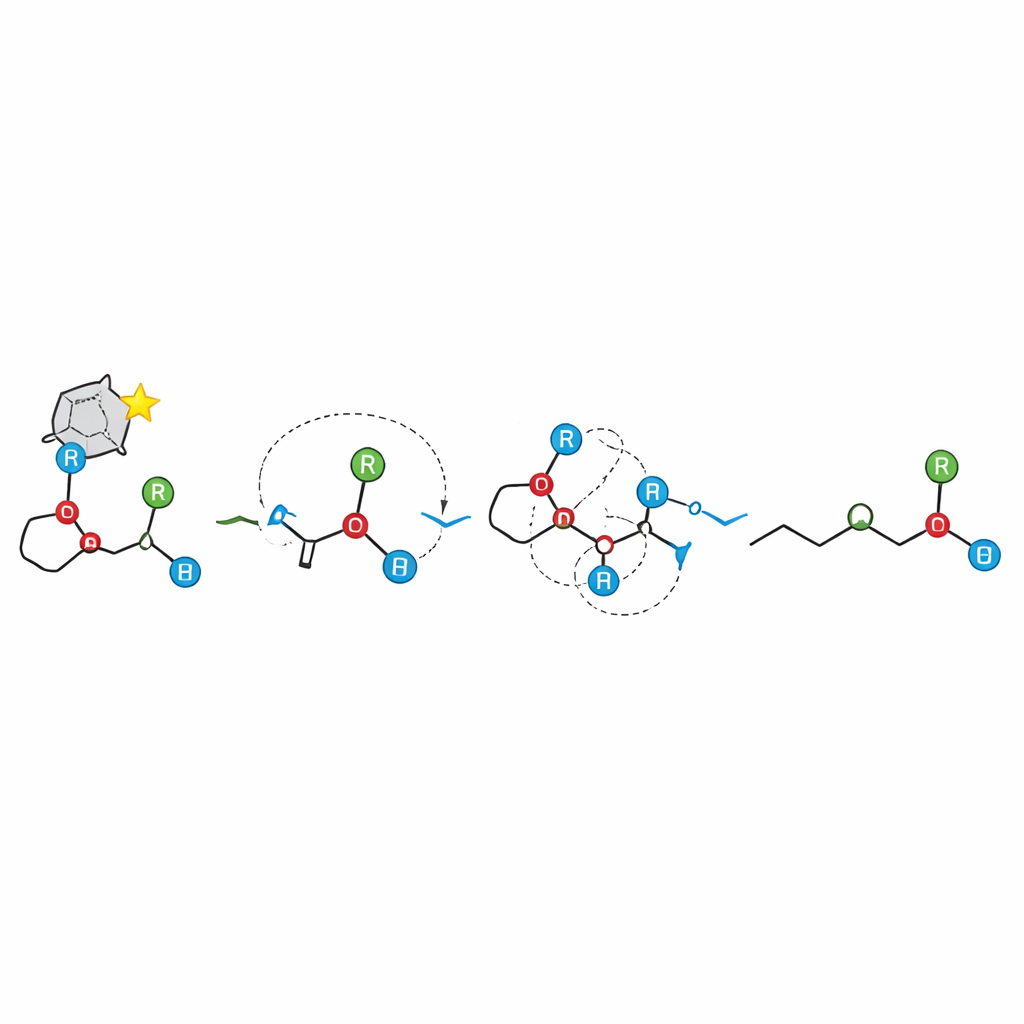
Classical explanations held that [1,2]-Wittig products came from breaking a bond to form a loose pair of radicals that later recombine, a picture that made precise stereochemical control seem unlikely. The new work paints a different picture. Through careful experiments—including trapping attempts with radical‑sensitive additives, “crossover” tests that mix different molecules, and detailed time‑resolved NMR monitoring—the authors show that the reaction proceeds through a specific [2,3]-rearranged intermediate and that atoms stay paired within a single molecule rather than swapping partners. The second step behaves like a formally forbidden [1,3]-rearrangement, but in practice it unfolds through fragmentation into a tightly associated ion pair that snaps back together in a highly ordered way, preserving the configuration at the chiral center.
Computers Confirm the Hidden Steps
To back up this mechanistic picture, the team carried out extensive quantum‑chemical calculations on realistic models of the catalyst and substrates. These computations reveal why one enantiomer is favored in the first step: the preferred transition state forms a network of three strong hydrogen bonds and a favorable stacking interaction between aromatic rings, while competing arrangements suffer from weaker interactions and steric crowding. For the second step, the calculations fail to find a single, smooth, concerted pathway; instead, they support a stepwise ionic fragmentation with a modest energy barrier, followed by almost barrier‑free recombination. The predicted energy barrier closely matches that measured experimentally, strengthening the case for the ion‑pair mechanism.
Implications for Building Chiral Molecules
From a practical standpoint, this work provides synthetic chemists with a robust new tool for making chiral tertiary alcohols from readily available allylic ethers, and it maps out which structural tweaks help or hinder the process. More broadly, it demonstrates that even when a reaction proceeds through charged fragments, stereochemical information can be carried through with remarkable fidelity, as long as those fragments remain closely associated. By overturning the radical‑based view of the [1,2]-Wittig rearrangement and showcasing a highly selective ionic cascade, the study opens the door to rethinking and redesigning other complex bond‑rearranging reactions to achieve precise 3D control.
Citation: Kang, T., O’Yang, J., Kasten, K. et al. The catalytic enantioselective [1,2]-Wittig rearrangement cascade of allylic ethers. Nat. Chem. 18, 800–809 (2026). https://doi.org/10.1038/s41557-025-02022-4
Keywords: asymmetric catalysis, sigmatropic rearrangement, chiral tertiary alcohols, reaction mechanism, organic synthesis