Clear Sky Science · en
CycloPepper: a machine learning platform for predicting cyclization outcomes and optimizing synthesis of therapeutic cyclopeptides
Turning flexible chains into powerful rings
Cancer drugs, antibiotics, and other modern medicines are increasingly built from short chains of amino acids called peptides. When these chains are stitched into closed rings, or cyclic peptides, they often become tougher, longer‑lasting, and better at slipping into cells. But making these tiny rings in the lab is surprisingly finicky, and chemists can waste weeks guessing which way to close a chain. This study introduces CycloPepper, a machine‑learning–driven platform that helps researchers predict, in seconds, which peptide chains are likely to form stable rings and which will fail, potentially speeding up the search for new peptide medicines.
Why ring‑shaped peptides matter
Peptides are strings of amino acids, the same building blocks that make up proteins. When left as open chains, they can be floppy and easy for enzymes in the body to chew up. If the two ends of the chain are joined head‑to‑tail to make a ring, the molecule becomes more compact and rigid. This often improves how strongly it binds to its biological target, how well it survives digestive enzymes, and how easily it crosses cell membranes. Several important drugs, including powerful antibiotics, are based on such cyclic structures. For drug designers, turning a linear peptide into a ring is a key strategy for turning a weak, fragile molecule into a potent and durable medicine.
The hidden difficulty in closing the ring
Despite their appeal, cyclic peptides are hard to make. To form a ring, a flexible chain must fold into just the right shape so its two ends can react with each other rather than with a neighbor. Short chains in particular pay a steep “organizational cost” to adopt this looped shape, and crowded amino acids near the joining point can physically block the reaction. Chemists usually build peptides on tiny beads of solid material, which simplifies purification but can further restrict how freely the chain can fold. As a result, the success or failure of ring formation often depends sensitively on where, along an otherwise similar sequence, the chemist chooses to close the loop. Until now, this choice has largely been guided by experience and trial and error.
Robots and algorithms build a learning library
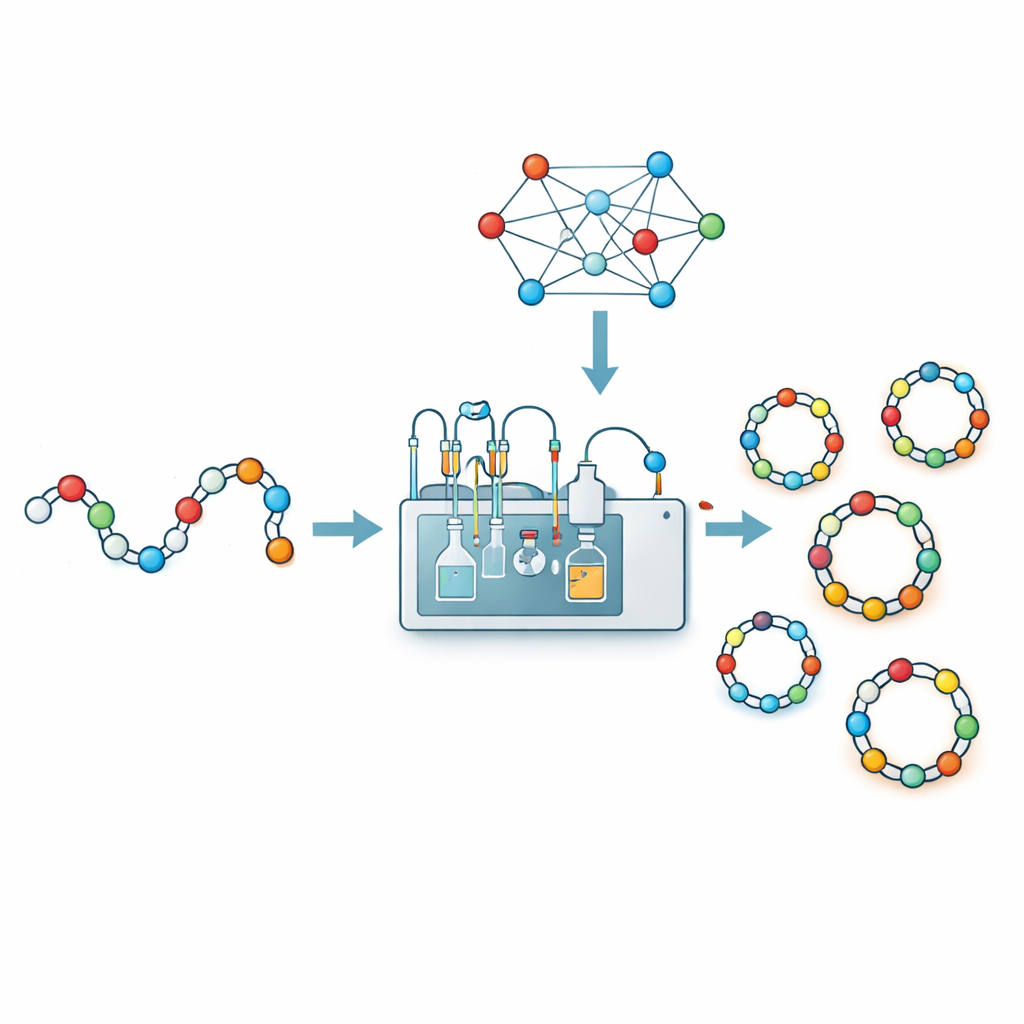
To replace guesswork with data, the researchers combined automated chemistry with machine learning. Using a robotic flow‑synthesis system called CycloBot and a special linker that allows ring closure to happen directly on the solid support, they rapidly made and tested 306 different peptide chains ranging from 2 to 14 amino acids. For each sequence, they simply recorded whether a clean cyclic product was detected or not. They then translated every sequence into a rich numerical description: which amino acids it contains, how they are ordered in pairs, a position‑by‑position code, and a handful of hand‑picked flags based on lab experience (for example, that certain amino acids at either end tend to help or hinder ring formation). Feeding these 414‑dimensional fingerprints into several types of machine‑learning models, they found that a support vector classifier gave the best performance, correctly predicting cyclization success or failure about 84 percent of the time in cross‑validation tests.
Putting predictions to the experimental test
The team then challenged their model with new peptides it had never seen. They designed eight artificial sequences and four naturally inspired therapeutic candidates, and for each one tried all possible places to close the ring along the chain. In total, they carried out 74 cyclization experiments. The machine‑learning model’s predictions lined up with the lab results in 64 of these cases, an accuracy of 86 percent. Importantly, the model was good at flagging both promising and poor sites, meaning it could help chemists avoid wasting effort on uncooperative sequences as well as highlight the most likely winners.
A practical tool for drug designers
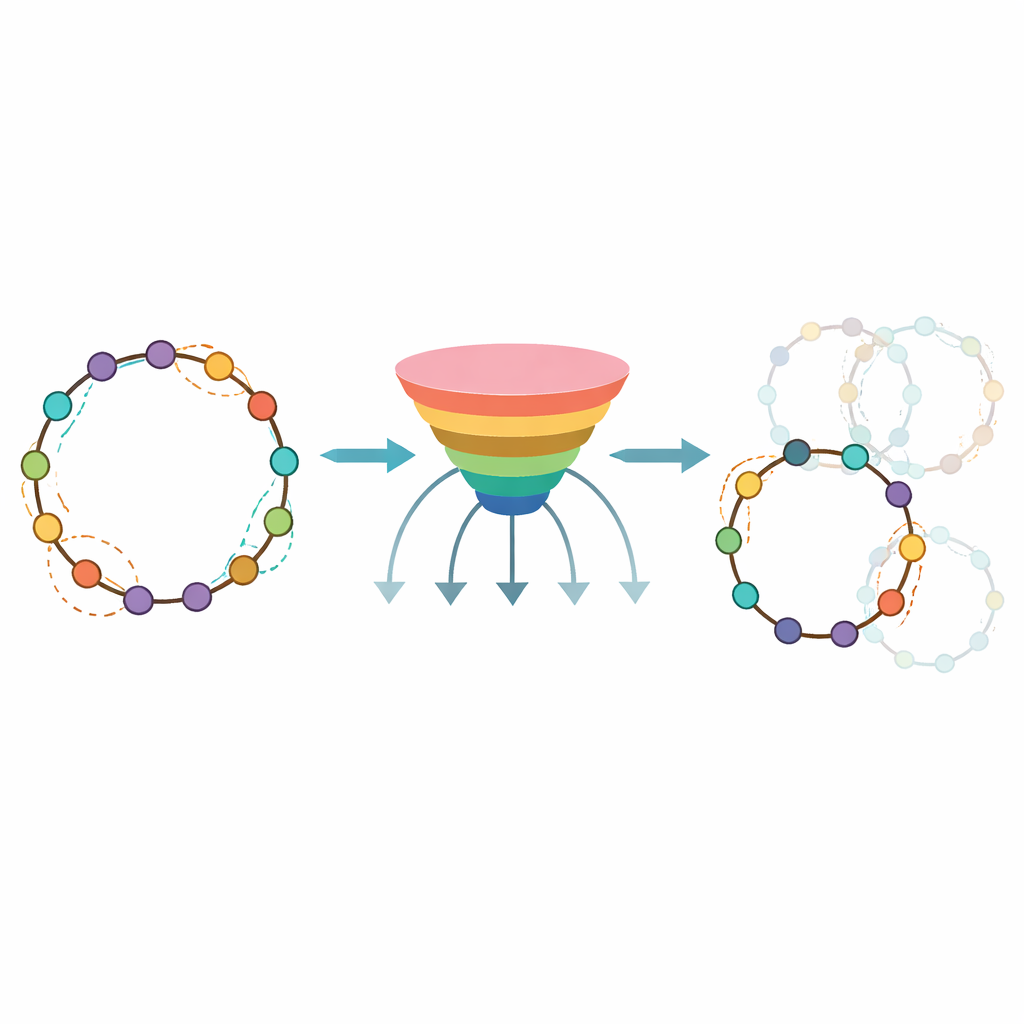
To make their approach useful beyond their own lab, the authors wrapped the trained model into a public platform called CycloPepper, available as both downloadable software and a web tool. Users can type in a single peptide or upload many at once, and within seconds receive a map of which head‑to‑tail closure sites are likely to work. The team demonstrated its value by designing hundreds of potential cyclic peptides aimed at protein targets involved in cancer and immune diseases, showing that the tool can quickly filter out nearly 40 percent of sequences that are unlikely to cyclize. For non‑specialists, the takeaway is that CycloPepper acts like a smart pre‑screening assistant, shrinking a vast design space down to a practical set of candidates. By combining automated synthesis with predictive algorithms, this work brings the promise of faster, more rational discovery of ring‑shaped peptide drugs a step closer to reality.
Citation: Pan, Y., Hu, C., Li, J. et al. CycloPepper: a machine learning platform for predicting cyclization outcomes and optimizing synthesis of therapeutic cyclopeptides. Nat Commun 17, 2803 (2026). https://doi.org/10.1038/s41467-026-69441-w
Keywords: cyclic peptides, peptide drug design, machine learning in chemistry, automated synthesis, cyclization prediction