Clear Sky Science · en
Sex differences in the risk of autistic-related traits in toddlers born to mothers with perinatal depression: Evidence from human cohort and mouse study
Why mothers’ moods before and after birth matter
Many parents worry about how stress during pregnancy might affect their child. This study looks closely at that concern, asking whether depression around the time of birth is linked to early signs of autism in toddlers, and why girls and boys may not be affected in the same way. By combining a large study of Japanese families with detailed experiments in mice, the researchers explore how a mother’s mood, bonding with her baby, and brain chemicals that support social connection may shape early development.
Following thousands of families over time
The research team analyzed data from more than 23,000 Japanese mother–child pairs enrolled in a long-running health study. Mothers filled out short questionnaires that measured psychological distress during early and mid-pregnancy, and another survey that screened for depression one month after birth. When their children were 2 to 3 years old, parents completed a checklist of behaviors related to social interaction, communication, and repetitive habits. Children with higher scores on this checklist were considered to have stronger autistic-related traits. 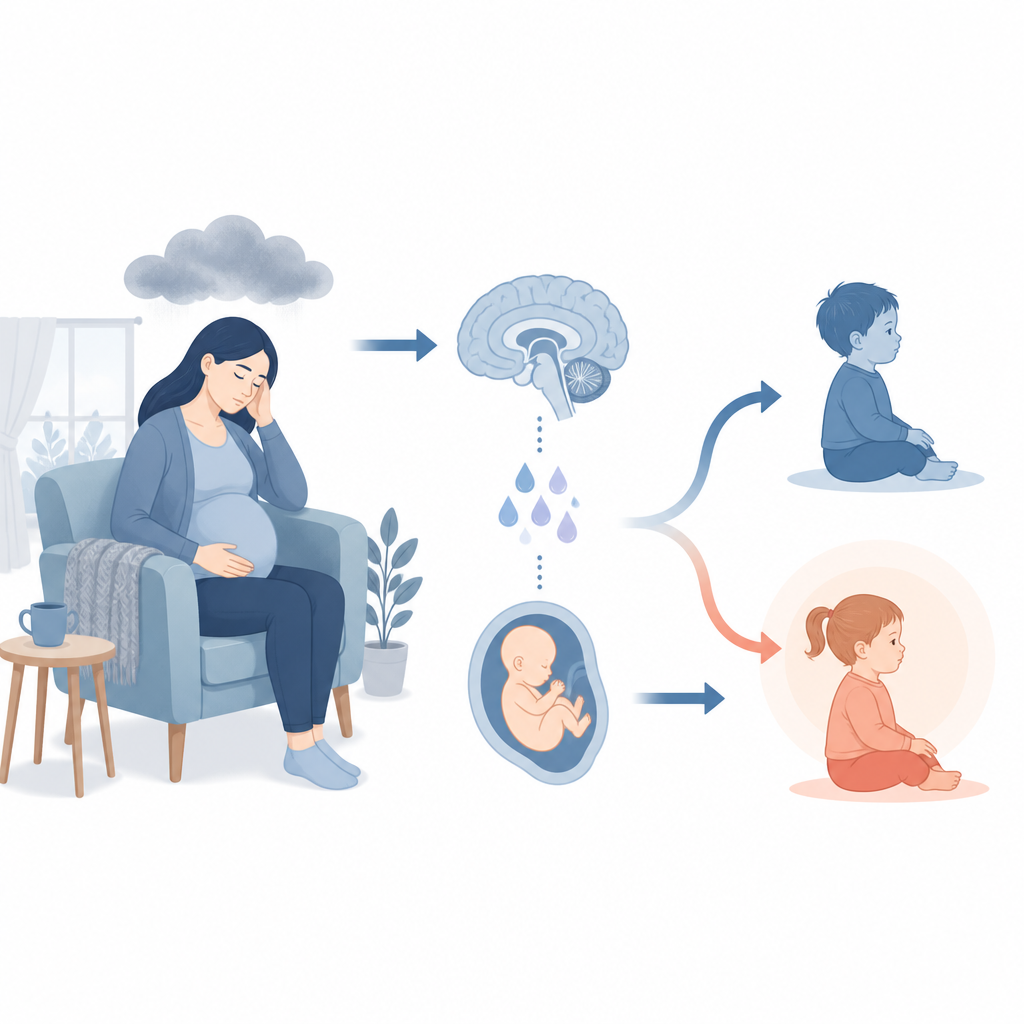
Links between maternal mood, bonding, and toddler behavior
Mothers who reported more distress during pregnancy were more likely to show signs of depression after birth, and they also tended to struggle more with feeling attached to their babies. Across the whole group, higher distress and depression scores were tied to higher autistic-related behavior scores in toddlers and to poorer mother–infant bonding. When the researchers focused on children whose scores crossed a threshold for notable autistic-related traits, the odds were roughly two to four times higher if their mothers had been depressed during pregnancy or shortly after delivery. These patterns held even when taking into account factors such as family income, education, prior mental health history, and use of certain medicines.
Striking sex differences in risk
Autism diagnoses are usually more common in boys, and in this study boys overall still showed higher behavior scores than girls. However, when the team looked at how maternal depression changed risk, an unexpected picture emerged. Boys whose mothers had depression did not show a clear increase in reaching the high-risk range. In contrast, girls whose mothers had depression during early or mid-pregnancy, or after birth, were five to nine times more likely to fall into the high autistic-related trait range than girls whose mothers were not depressed. Girls born to depressed mothers also tended to have slightly lower birth weights. For these girls, stronger autistic-related traits were linked with both higher maternal distress in mid-pregnancy and with weaker mother–infant bonding after birth.
What mouse experiments reveal about underlying biology
To explore how stress might cause these differences, the scientists created a mouse model of perinatal depression. Pregnant mice were exposed to a series of mild, unpredictable stressors. These stressed mothers later showed behaviors resembling despair and built poorer nests and were slower to gather their pups. Their offspring weighed less at birth and had lower survival rates. As juveniles, male offspring from stressed mothers moved more and showed increased activity, while females groomed themselves excessively and failed to prefer a new play partner over a familiar one, echoing social and repetitive behavior patterns seen in human autism. 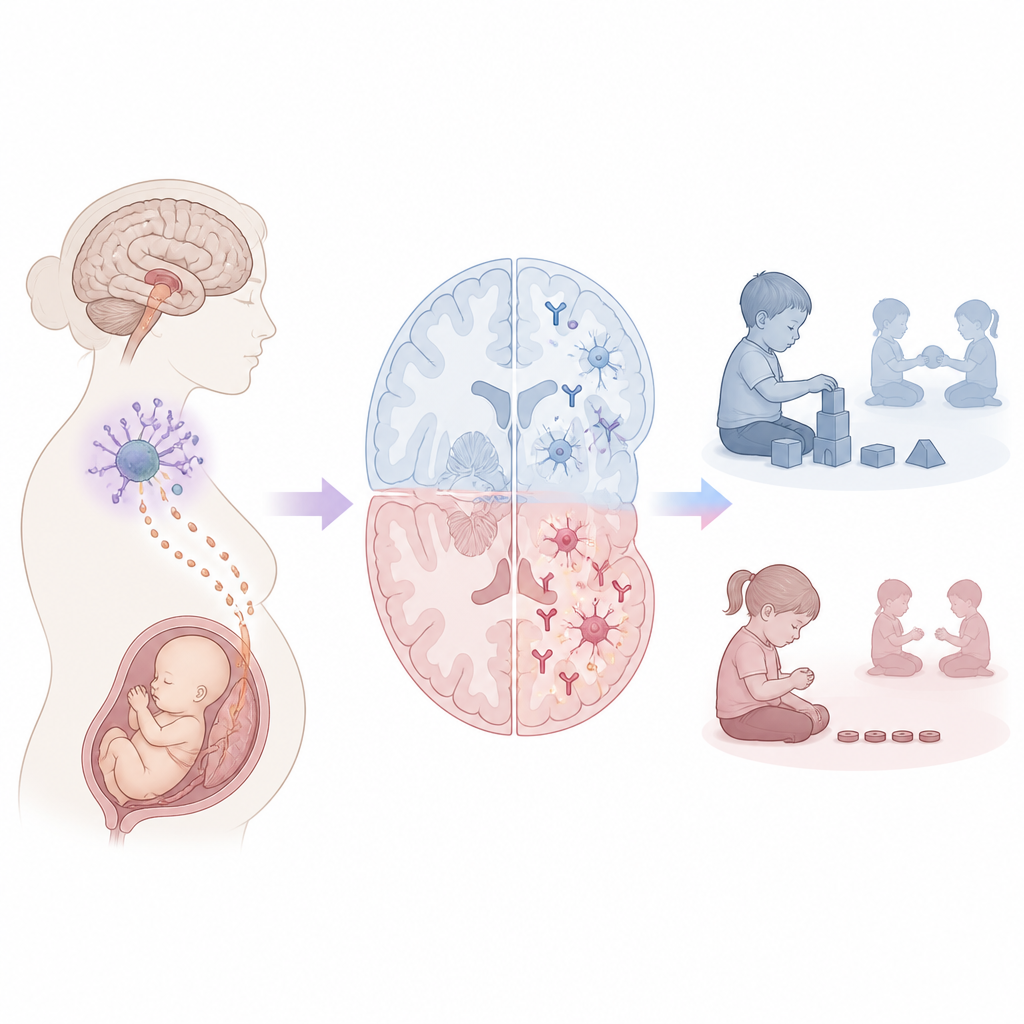
Changes in brain chemistry that differ by sex
The team then examined brain tissue. In stressed mouse mothers, certain immune cells in the thinking region of the brain produced less oxytocin, a hormone involved in bonding and social behavior. In their daughters, but not sons, the same brain region showed lower levels of the oxytocin receptor and of a growth-supporting protein called BDNF. Both molecules are known to be important for shaping social circuits in the brain. These findings suggest that stress during pregnancy can alter the mother’s brain chemistry and, in turn, subtly rewire developing brain networks in offspring, with girls showing particular sensitivity.
What this means for parents and clinicians
Taken together, the human and mouse data point toward a clear message: depression during and after pregnancy is not only a serious concern for mothers, but may also increase the likelihood of autistic-related traits in young children, especially daughters. The work does not claim that maternal depression alone causes autism, nor that all children of depressed mothers will have difficulties. Rather, it highlights maternal mental health as one important, and potentially modifiable, piece of a larger puzzle. Early detection and support for depression, along with efforts to strengthen mother–infant bonding, may help reduce risk and support healthier development for both boys and girls.
Citation: Duan, C., Yu, Z., Li, X. et al. Sex differences in the risk of autistic-related traits in toddlers born to mothers with perinatal depression: Evidence from human cohort and mouse study. Mol Psychiatry 31, 3229–3242 (2026). https://doi.org/10.1038/s41380-026-03456-z
Keywords: perinatal depression, autistic traits, maternal mental health, sex differences, oxytocin