Clear Sky Science · en
Establishing the inclined postural imaginary in Netherland: a phenomenological approach to spatial and bodily mediated relational possibilities
Why how we stand together matters
After the attacks of September 11, 2001, many stories focused on fear, loss, and clashing nations. This article looks at something quieter but surprisingly powerful in Joseph O’Neill’s novel Netherland: how people stand, sit, lean, and move through space. It argues that the way bodies relate to skyscrapers, airplanes, sports fields, and a giant observation wheel can reveal new ways of living together with more care and less domination.
Skyscrapers, planes, and standing above others
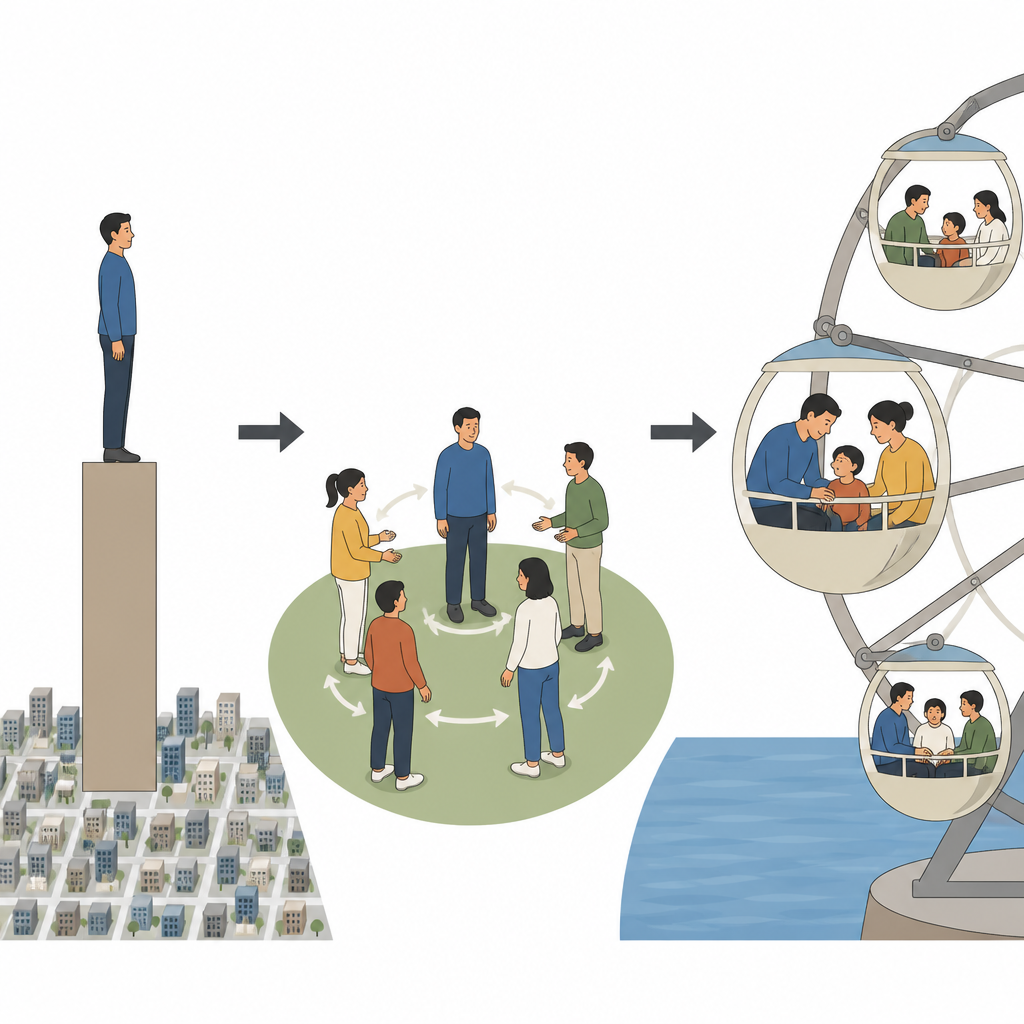
The paper begins by showing how Netherland links tall buildings and air travel to a habit of seeing the world from above. The main character, Hans, works in Manhattan’s financial towers, where height encourages a distant, controlling viewpoint. Airplanes extend this sense of superiority, joining vertical takeoffs and surveillance from the sky with the spread of money, goods, and military force across the globe. The destruction of the Twin Towers exposes how fragile this “stand above it all” attitude really is, as the same technologies that promise safety and progress also carry risk, inequality, and violence.
Fear, control, and life on the ground
After 9/11, the United States tries to restore its sense of height and control through stricter security at home and wars abroad. The article traces how fear spreads through airports, streets, and workplaces, especially for immigrants and people who look or sound “foreign.” Surveillance, racial profiling, and bombing campaigns all combine a view from on high with a wide reach across borders. In parallel, Hans’s personal life unravels: his marriage falters and his work loses meaning. His once-confident upright posture comes to feel hollow, mirroring a country that clings to dominance instead of rethinking its stance toward others.

Cricket fields and side-by-side connections
The turning point for Hans takes place not in an office or plane but on rough, out-of-the-way cricket grounds under highway ramps and flight paths. Cricket forces players to pay attention to the ground’s bumps, weather, and the positions of teammates and opponents. Instead of looking down from a great height, Hans must look across at others at the same level. The diverse, mostly immigrant cricket community shares rides, food, and emotional support, showing a more equal, side-by-side way of relating. Yet this open spirit is fragile: efforts to turn cricket into a flashy American brand pull the game back toward hierarchy and hard competition, and the physical field itself is eventually erased.
Leaning toward others instead of standing on a pedestal
The article then turns to Hans’s relationships with his mother, his wife Rachel, and his friend Chuck to show how family and friendship can also slip into vertical patterns. Hans often expects women or mentors to act as pedestals that hold him up, rather than as people he leans toward in return. Over time he becomes uneasy with this imbalance, especially when Chuck’s dreams of success rely on gendered and racialized forms of power. Gradually, Hans chooses a different posture: he returns to London, takes responsibility as a father, and reconnects with Rachel. Their reunion atop the London Eye matters not only for its emotional weight but also for its setting. Suspended in a slow-turning capsule over a river, Hans is neither firmly planted on the ground nor enthroned above it; instead, he shares a gently tilted, moving viewpoint with others.
What it means to live on an incline
In the end, the paper proposes a new way to think about posture in stories and in real life. It offers a toolkit for noticing how bodies are placed, where they face, what they can see, and how spaces invite or limit contact. Using Netherland, it shows how rigid “up and down” habits can give way to more level, side-by-side connections and, finally, to an “inclined” stance that gently leans toward other people. This inclined posture does not erase differences or power, but it treats vulnerability, mutual recognition, and shared responsibility as guiding values. Hans’s journey from towers to cricket fields to the London Eye becomes a model for reimagining how nations and individuals might stand with, rather than over, one another.
Citation: Li, Y. Establishing the inclined postural imaginary in Netherland: a phenomenological approach to spatial and bodily mediated relational possibilities. Humanit Soc Sci Commun 13, 696 (2026). https://doi.org/10.1057/s41599-026-06921-w
Keywords: Netherland, posture, 9/11 literature, spatial ethics, cricket communities