Clear Sky Science · en
The diffusion of new energy technology among the water sightseeing transportation industry: an evolutionary game perspective driven by tourists’ low-carbon behavior
Why boats and tourists matter for a cleaner future
River cruises and lake tours are often sold as an escape into nature, yet the boats that carry tourists usually burn diesel and leave a heavy footprint. This paper explores a hopeful twist: what if tourists’ own choices could push sightseeing boat companies to switch to cleaner, new‑energy technology? By tracing how “green” tourists influence business decisions over time, the authors show when and how cleaner boats can take over the market—and when they are unlikely to appear at all.
Two kinds of tourists, two kinds of boats
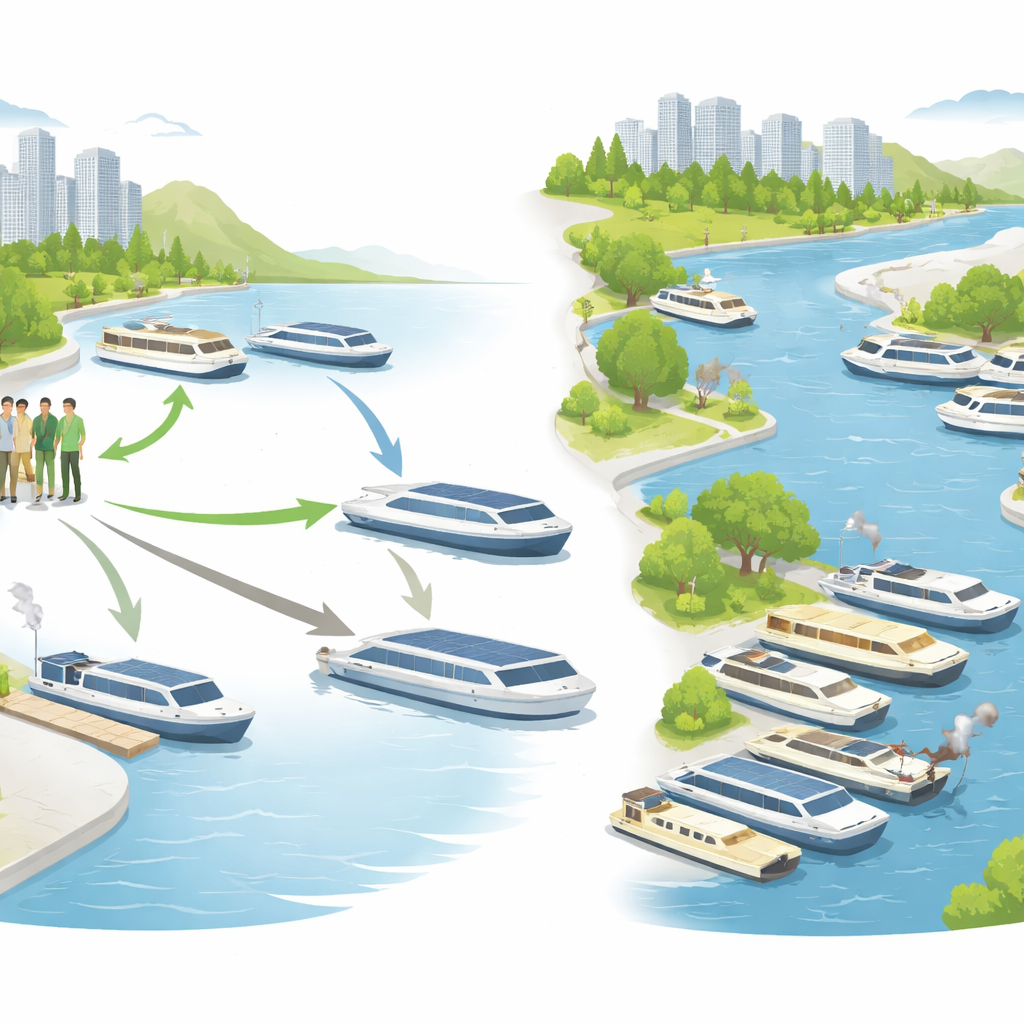
The study starts by distinguishing between two broad types of travelers. Green tourists care strongly about the environment. They are willing to pay a bit more, or accept small inconveniences, in return for cleaner experiences—such as quiet electric boats that avoid fumes and protect local ecosystems. Brown tourists, in contrast, focus mainly on price and convenience and are less sensitive to environmental impacts. Sightseeing boat operators can also choose between two paths: investing in new‑energy vessels powered mainly by electricity or other low‑carbon sources, or sticking with traditional fuel‑burning boats that are cheaper to operate in the short run but dirtier overall. The interplay between these two tourist types and the two technology options sets the stage for the rest of the analysis.
A game of imitation and profit
Rather than assuming companies instantly make perfect decisions, the authors use an approach borrowed from biology and economics called evolutionary game theory. In this framework, firms try strategies, watch how well they pay off, and gradually imitate the more profitable ones. All boat manufacturers are treated as facing similar rules, costs, and tourist markets, so no single firm has a built‑in advantage. If many tourists are green and consistently choose cleaner boats, the firms that invest in new technology earn more in the long run, and their strategy spreads. If most tourists are brown and prefer cheaper, dirtier options, traditional boats remain dominant, and cleaner technology fails to take off.
Hidden tipping points in tourist demand
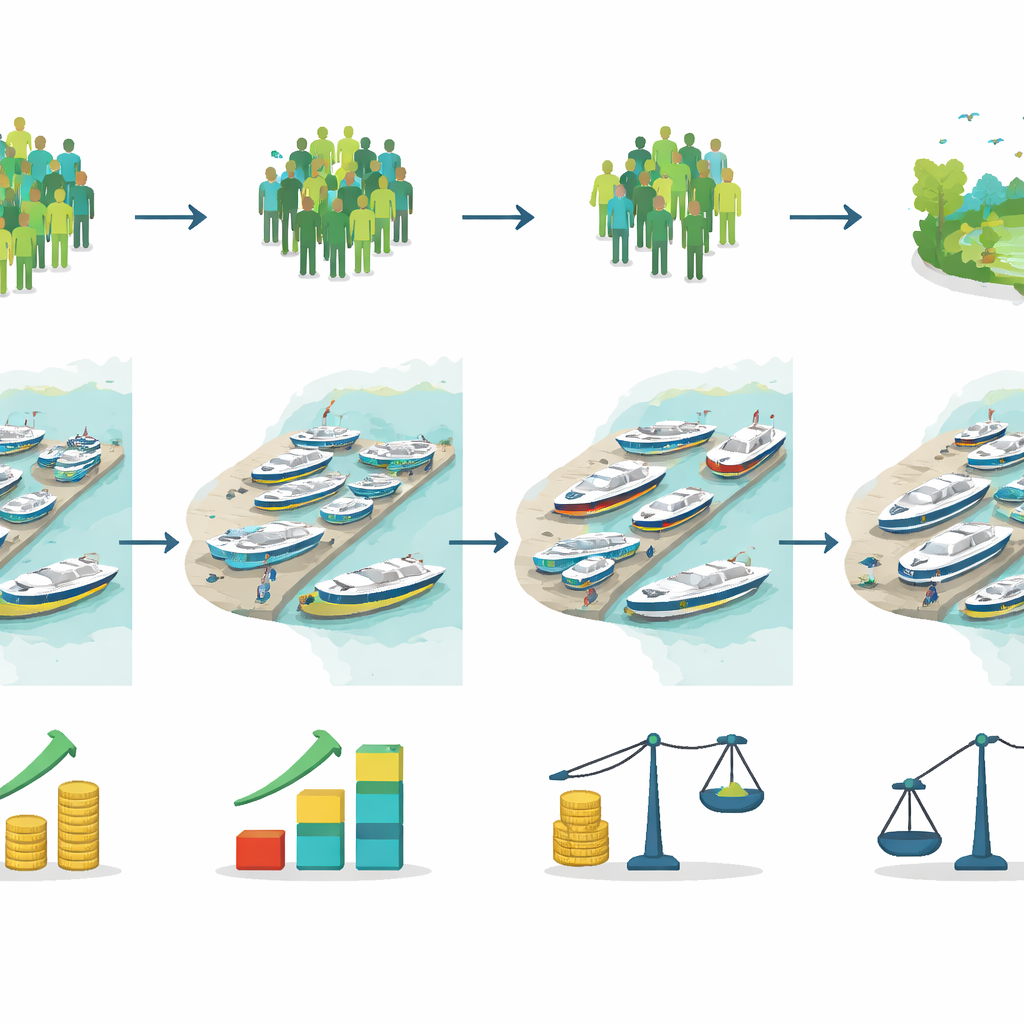
The model reveals that the share of green tourists is not just another factor—it is a tipping‑point variable. When the proportion of green tourists is below a lower threshold (about 40 percent in the case study), companies have little incentive to invest in new‑energy vessels, so traditional boats continue to rule the waterways. Between this lower threshold and a higher one (around 75 percent), both technologies can coexist: some companies go green, others do not, and the overall level of clean boats rises with the green segment of the market. Once the share of green tourists passes the upper threshold, the picture flips. In this zone, firms find that clean boats clearly pay off, so the industry gradually shifts until almost all sightseeing boats use new‑energy systems.
Prices, policies, and the power of demand
Beyond tourist preferences, the authors test how ticket prices, operating costs, taxes, and subsidies nudge the system. Making new‑energy boats more profitable—by raising their ticket price slightly, lowering their costs, or offering moderate subsidies—lowers the green‑tourist share needed to trigger widespread adoption. Penalizing traditional boats with higher carbon taxes helps, but less dramatically. Numerical simulations suggest that fine‑tuning prices and costs for clean boats is more effective than simply making dirty boats more expensive. At the same time, the study finds that firms are highly sensitive to profit after they switch. If discounts to reward green tourists cut too deeply into revenue, or if carbon taxes are mostly passed on to passengers, companies can quickly lose enthusiasm for investing in clean vessels.
What this means for travelers and policymakers
For non‑specialists, the main takeaway is both simple and empowering: tourists’ collective choices can make or break the transition to cleaner sightseeing boats. When only a small minority demands low‑carbon options, even generous policies struggle to move the industry. But once a critical mass of travelers insists on cleaner experiences and is willing to support them financially, the market can tip toward new‑energy technology and stay there. This suggests that educating and encouraging travelers to act as green tourists—alongside smart pricing, moderate subsidies, and sensible carbon taxes—may be one of the most effective ways to clean up water‑based tourism and protect the very landscapes people come to enjoy.
Citation: XU, X., WU, Q. The diffusion of new energy technology among the water sightseeing transportation industry: an evolutionary game perspective driven by tourists’ low-carbon behavior. Humanit Soc Sci Commun 13, 560 (2026). https://doi.org/10.1057/s41599-026-06880-2
Keywords: green tourism, new energy boats, sightseeing transport, technology diffusion, low-carbon travel