Clear Sky Science · en
Adaptive management for improving livestock production and grassland conservation in pastoral Qinghai, China
Why yaks and sheep matter for the world
High on the Qinghai–Tibet Plateau, herding families rely on yaks and sheep to survive long, bitter winters. Yet the grasslands that feed these animals are wearing thin, threatening both local livelihoods and a major storehouse of global biodiversity and carbon. This study explores how relatively simple changes in herding practices—selling animals earlier and feeding them during the hungriest months—could help protect fragile pastures while still supporting prosperous pastoral communities.
Life on a harsh high plateau
Qinghai Province, on the northeastern edge of the plateau, is a vast sea of grass at more than 3,000 meters above sea level. It holds some of China’s largest remaining natural pastures and supports millions of cattle, sheep, and goats. Winters are long and severe, with about seven months of forage scarcity when animals often hover near starvation. Traditionally, herders graze animals year-round on open rangeland, provide little extra feed, and are reluctant to sell or slaughter stock, partly for cultural and religious reasons. As a result, herd sizes often exceed what the land can support, leading to soil exposure, poor plant regrowth, and growing vulnerability to storms and droughts.
Too many mouths, not enough grass
Using county-level livestock records, satellite measurements of plant growth, and detailed interviews with herders, the authors built a model of how much forage the grasslands can sustainably provide and how much the animals demand. They found that, on average from 2008 to 2018, forage use in Qinghai’s middle- and high-elevation grazing counties exceeded sustainable supply by about 9%. Middle-elevation counties were especially strained, with many running 50% above their safe grazing limit, while some higher, colder counties still had grass to spare. Yaks consumed most of the pasture, sheep a smaller share, and goats only a little, reflecting local preferences and herd structures.
Testing smarter herding strategies
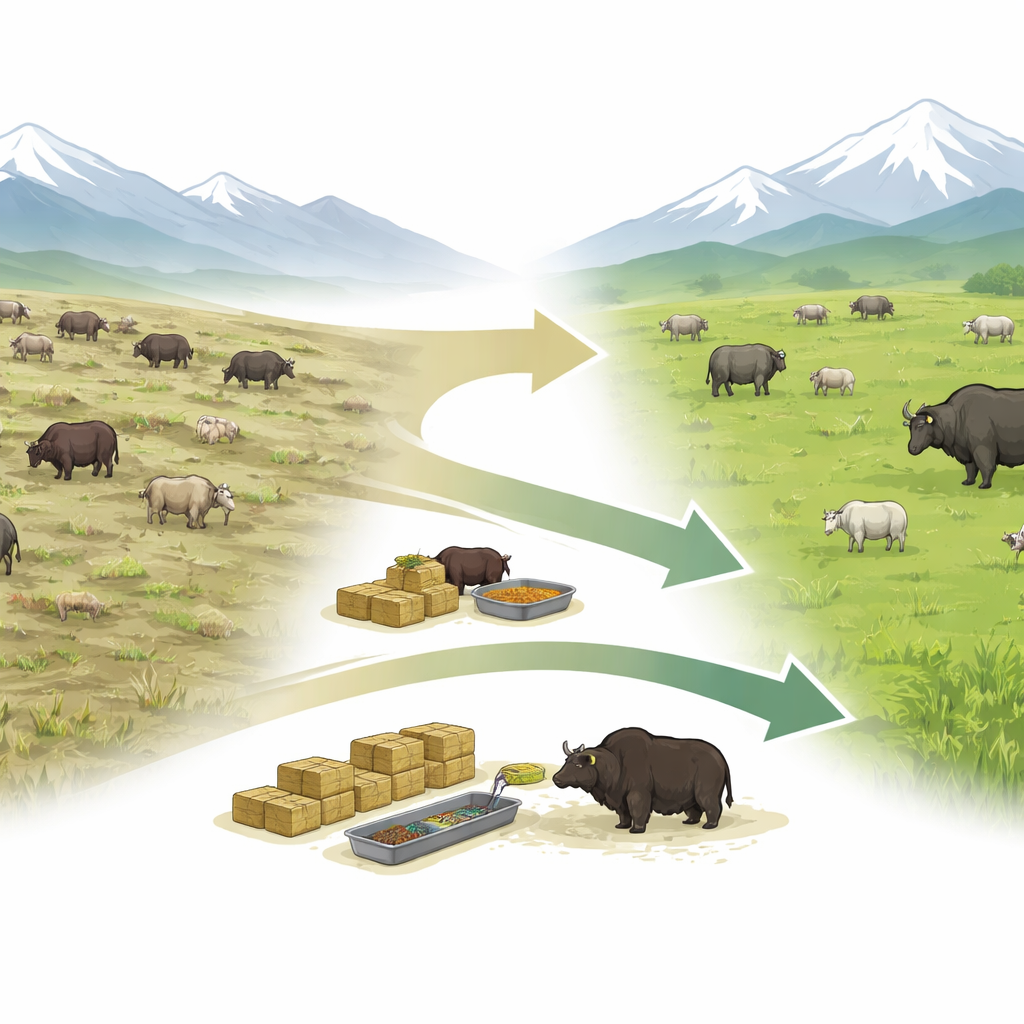
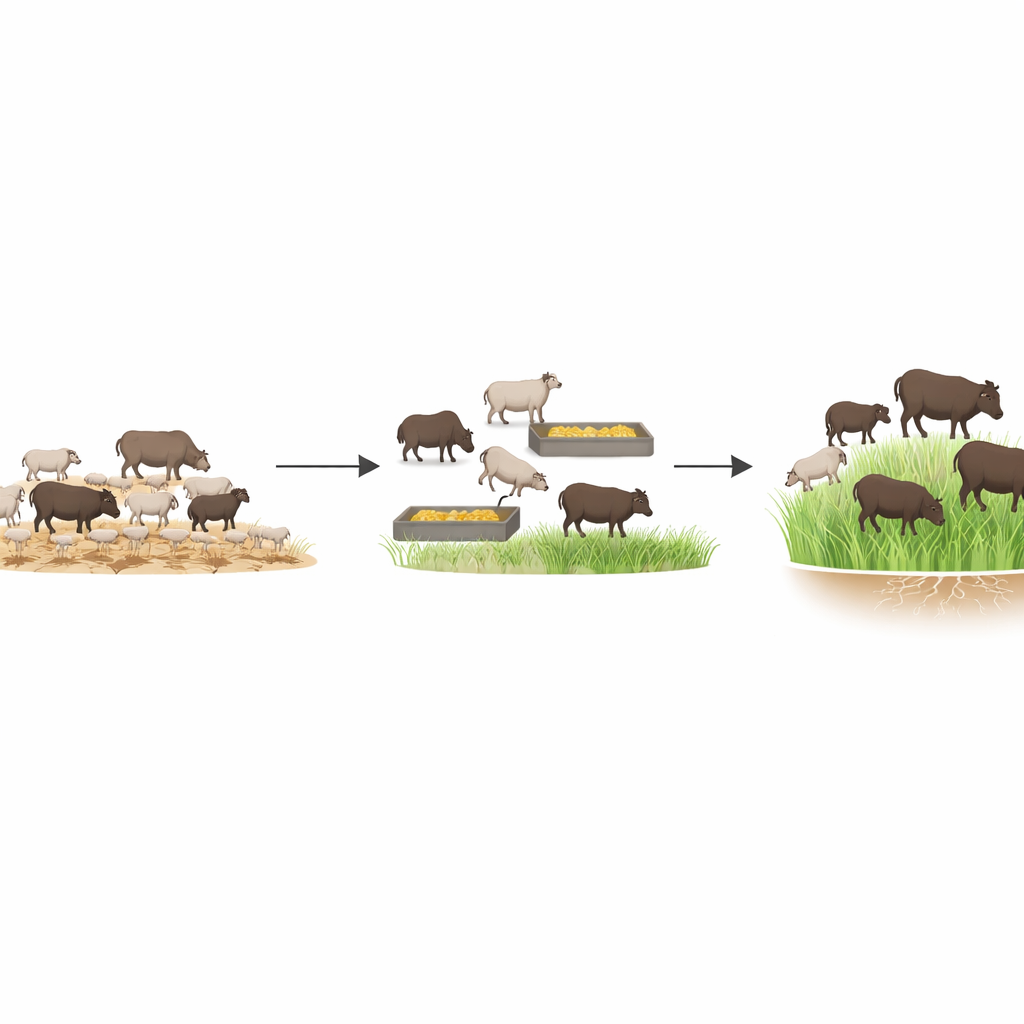
To see how things might improve, the team compared three broad approaches. The first was the current, traditional pattern of late sale and little extra feed. The second strategy moved “off-take”—the removal of animals through sale or slaughter—to younger ages, so animals would spend fewer winters on the range. The third strategy combined early off-take with systematic winter and spring feeding, modeled on the practices of a minority of more intensive cooperatives. Their model tracked how these choices affected animal body weight, total meat production, forage demand, and herders’ incomes, under both current overgrazing and a strict rule that grass use must stay within ecological limits.
More meat from less stress on the land
The simulations show that better timing and feeding can deliver striking gains. Simply selling animals earlier increased the amount of meat produced per unit of forage by up to about one-fifth for sheep and goats, with smaller gains for yaks. When early off-take was paired with winter feeding, production efficiency for sheep and goats more than doubled in some high, cold counties, where animals otherwise lose a great deal of weight over winter. Within sustainable grazing limits, total liveweight production across Qinghai’s grassland counties could rise by around 70% under the combined strategy, with especially large boosts in high-elevation areas. Sheep, in particular, proved far more efficient than yaks in turning grass and feed into meat.
Balancing profits and costs
The picture is more mixed when money is considered. Early off-take alone could raise overall income from livestock by about 10% without worsening overgrazing, mainly by improving returns in high-elevation regions. However, the strategy that relies heavily on purchased feed, while excellent for meat output and grass recovery, reduced net earnings under current conditions because transport and feed prices are high. The authors argue that for supplementary feeding to become widely attractive, public investment in roads, feed storage, and supply chains is needed, along with shared feed reserves to buffer poor households against harsh winters.
New rules and old traditions together
Beyond numbers, the study emphasizes that herding choices are deeply tied to culture: in many Tibetan communities, large herds symbolize wealth and religious values discourage killing animals. The authors suggest that durable change will require more than top-down grazing bans. Cooperative herding, better market access, and participatory education campaigns can help families see how earlier sale, modest herd sizes, and targeted winter feeding can actually strengthen both household security and sacred grasslands. Although focused on Qinghai, the lessons are relevant to other mountain and steppe regions—from Mongolia to the Andes—where people, livestock, and fragile grasslands must adapt together.
Citation: Yu, L., Huang, H., Chen, Y. et al. Adaptive management for improving livestock production and grassland conservation in pastoral Qinghai, China. Humanit Soc Sci Commun 13, 383 (2026). https://doi.org/10.1057/s41599-026-06752-9
Keywords: pastoralism, grassland conservation, Qinghai Tibet Plateau, livestock management, adaptive grazing