Clear Sky Science · en
Homophily and in-group bias in pension game
Why helping strangers today can shape your own retirement
Modern pension systems quietly depend on a simple act of trust: people who are working today give up some income to support current retirees, hoping that tomorrow’s workers will do the same for them. This study asks how feelings of similarity and group belonging influence that fragile chain of support. By recreating a stripped‑down pension system in the lab, the authors explore when people choose to help, whom they help more, and how subtle group identities can strengthen or weaken cooperation between generations.
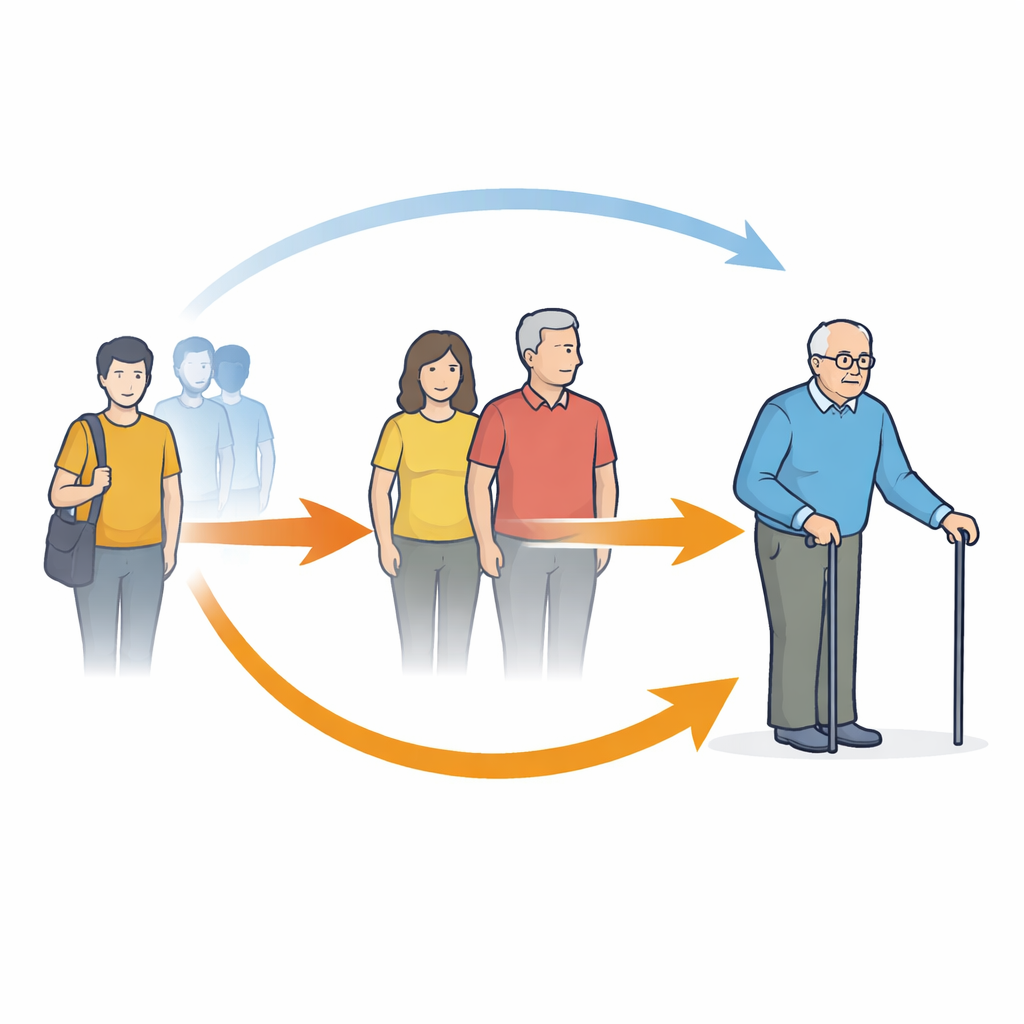
A simple game of giving across generations
The researchers used a “pension game” that mimics a pay‑as‑you‑go public pension. Each player lives through two stages: first as a worker with plenty of income and then as a retiree with almost none. When working, a player decides how much to transfer to an older player who is already retired; later, when that player is retired, they depend on the next worker’s transfer. Giving is personally costly but makes the whole chain better off if everyone participates. Economic theory predicts that purely self‑interested players should give nothing, yet earlier experiments showed that people often do give, raising the question: what exactly keeps this cooperative chain from collapsing?
How group lines are drawn in the lab
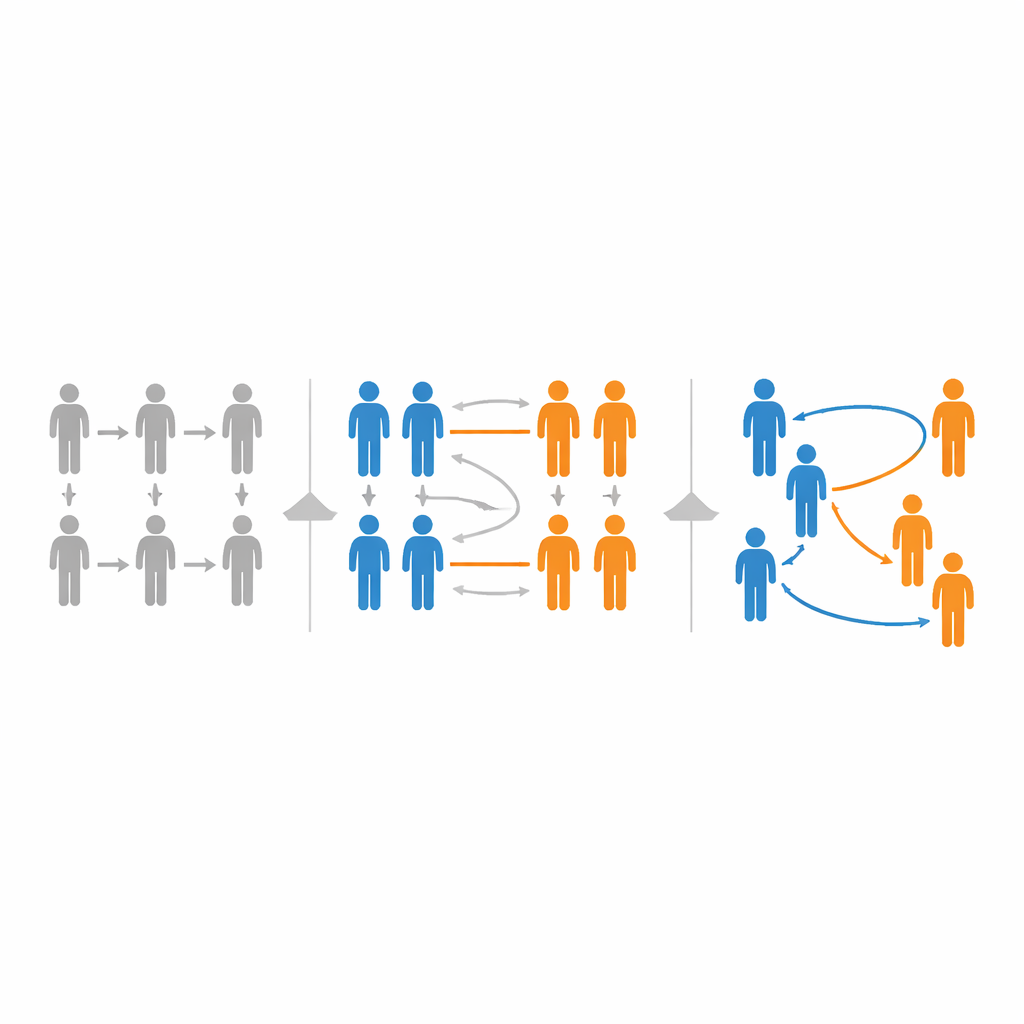
To uncover the role of social identity, the study ran several versions of this game with university students. In the basic version, everyone was anonymous and indistinguishable. In other versions, participants were randomly assigned to one of two colored groups—an artificial “us” and “them” with no history or real‑world meaning. In the exogenous grouping version, who played with whom was random, but everyone could see each partner’s group color. In the endogenous versions, players could pay a small, probabilistic cost to increase the chance of being paired with someone from their own color group. This willingness to sacrifice some expected payoff just to meet a similar partner is used as a measure of homophily—the desire to interact with people like oneself.
Giving more to one’s own side
Across all versions, people did make positive transfers, achieving more than half of the potential gains from cooperation, contradicting the purely selfish prediction. But once group colors were introduced, a clear pattern emerged: transfers to same‑group partners were on average almost 40 percent higher than transfers to other‑group partners. This in‑group bias was strongest when players could influence who they would meet in the future. Many participants were willing to “pay” in the game’s currency for a better chance of being matched with someone from their own group, and those with stronger risk aversion were especially likely to do so. In other words, seeking similar partners seemed to be a way to manage uncertainty in an environment where future help is never fully guaranteed.
When reciprocity meets group identity
The experiment also looked at reciprocity—whether people reward past generosity and punish stinginess. Transfers tended to move in the same direction as what had been received earlier, showing that forward‑looking reciprocity played a real role: generous givers were more likely to be rewarded by the next generation in line. Intriguingly, when matchings were random, this reciprocal pattern was actually stronger in cross‑group interactions than within groups, suggesting people used rewards and sanctions more heavily with outsiders. However, once players could steer themselves toward same‑group partners, attention shifted from policing outsiders to selecting “safe” insiders. In these settings, homophily—who you choose to interact with—mattered at least as much as how strongly you rewarded or punished others.
What this means for real‑world pensions
For a general reader, the key takeaway is that pension systems do not rest only on cold calculations of personal gain. Feelings of similarity, belonging, and trust—often triggered by something as minimal as a color label—shape who we are willing to support and how confident we are that support will come back to us later. In the experiment, artificial group identities led people both to give more to their own side and to invest in staying within that side, which in turn helped sustain cooperation over time. This suggests that policies which nurture a shared sense of community and intergenerational solidarity may be crucial for keeping real‑world pay‑as‑you‑go pensions stable, especially as societies become more diverse and economic pressures grow.
Citation: Öztürk Göktuna, B., Yurdakurban, E.Ö. Homophily and in-group bias in pension game. Humanit Soc Sci Commun 13, 386 (2026). https://doi.org/10.1057/s41599-026-06744-9
Keywords: pension systems, social identity, reciprocity, homophily, intergenerational cooperation