Clear Sky Science · en
Mapping university prestige and hierarchy in China via faculty hiring networks of internationally active Ph.D.s.
Why This Story About Universities Matters
Behind every new professor is a long journey that begins with a Ph.D. The universities that train these researchers, and the universities that later hire them, quietly shape what kind of science and scholarship gets done. This article looks at how that process works inside China, now one of the world’s largest producers of doctorates. By following nearly 24,000 research‑active Ph.D. holders, the authors reveal a steep pecking order among Chinese universities and show how hard it has become for young scholars to move up that ladder.
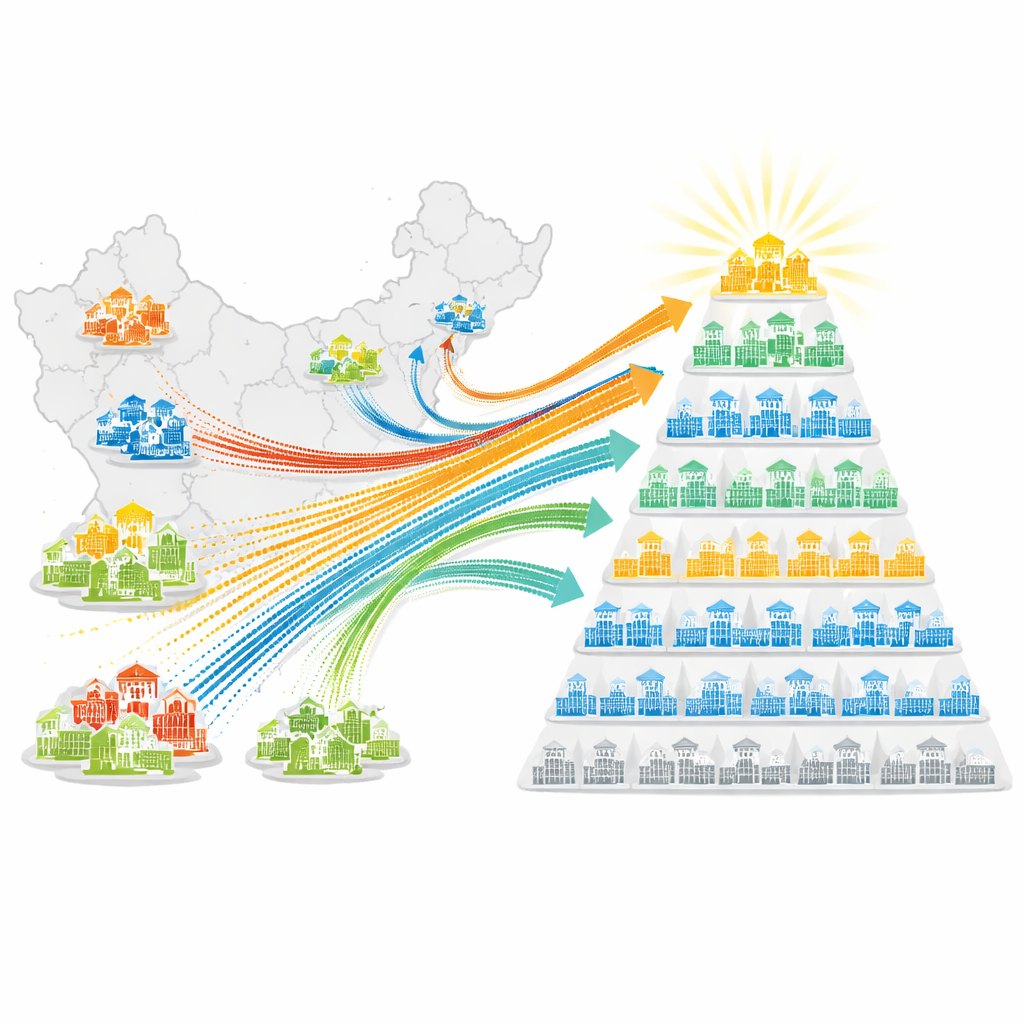
Following Careers Through a Web of Universities
The researchers focused on a specific slice of the academic world: people who earned Ph.D.s at Chinese universities between 1990 and 2020 and later held academic jobs in China, while also publishing in international outlets. Using public databases that track researchers and their publications, they identified 23,994 such scholars working across 501 universities and related academic units. They then built a “hiring network” in which each university is a node and each move from a doctoral institution to a first faculty job is a link. This network captures who trains whom, and where those graduates end up working.
Revealing a Steep Academic Ladder
To uncover the hidden order in this web of connections, the authors used a ranking method that looks for the arrangement of universities that minimizes the number of cases where someone moves to a more prestigious employer than their Ph.D. school. When the data line up in a way that produces very few such “upward” moves, it signals a strong hierarchy. The Chinese hiring network fits this pattern: a small group of elite universities produce a large share of research‑active faculty, while most other institutions mainly hire from the same or higher tiers. A measure of inequality, the Gini coefficient, shows that just over one‑fifth of universities account for almost four‑fifths of all faculty production in the sample, and this concentration has intensified over the past three decades.
How Prestige and Discipline Shape Opportunities
The network also reveals structure within the upper ranks. China’s well‑known group of top universities forms a tight cluster that mainly exchanges talent among itself and sends graduates outward to lower tiers. When the authors compare their network‑based prestige ordering with popular international rankings, they find important differences. Some universities that specialize in areas like agriculture or traditional medicine rank higher in the hiring network than in global league tables, because they are especially important suppliers of Ph.D.‑trained faculty at home. Different fields show their own patterns: in materials science, computer science, chemistry, and biology, the set of leading institutions and the ease of moving upward vary, echoing the idea that each discipline is its own “community” with distinct norms and power structures.
Upward Moves Becoming Rarer
A key question is how often new Ph.D.s manage to land jobs at universities considered more prestigious than their doctoral alma mater. In this research‑active group, only about 9.3 percent do so. Most start their careers at institutions of similar or lower standing, and the chances of moving up have declined over time. For those who graduated in the 1990s, upward moves were somewhat more common than for those who finished after 2010. Statistical models suggest that having postdoctoral training and a stronger publication and citation record does help, as do coming from a newer doctoral university that is still building its reputation. Yet even with these advantages, the overall structure remains rigid, especially in fields like chemistry where upward movement is particularly rare.

What This Means for the Future of Scholars
To make sense of these patterns, the authors draw on sociological ideas about how elite institutions accumulate “symbolic capital” and how different academic fields form their own tribes. They argue that China’s system combines these long‑recognized dynamics with local forces such as government prestige projects, rapid expansion of Ph.D. programs, and rising competition from scholars trained abroad. The study does not try to prove exactly what causes each hiring decision, and it looks only at early career moves among internationally visible researchers trained in China. Still, the big picture is clear to a lay reader: within this part of Chinese higher education, a small circle of universities sits at the top of a tall pyramid, most new scholars move sideways or down rather than up, and the ladder has become harder to climb over time.
Citation: Tian, C., Jiang, X., Huang, Y. et al. Mapping university prestige and hierarchy in China via faculty hiring networks of internationally active Ph.D.s.. Humanit Soc Sci Commun 13, 379 (2026). https://doi.org/10.1057/s41599-026-06717-y
Keywords: faculty hiring, university prestige, China higher education, academic mobility, PhD careers