Clear Sky Science · en
Identifying suitable mussel cultivation sites in European offshore waters—an assessment for co-location with the wind industry
Feeding People from the Open Sea
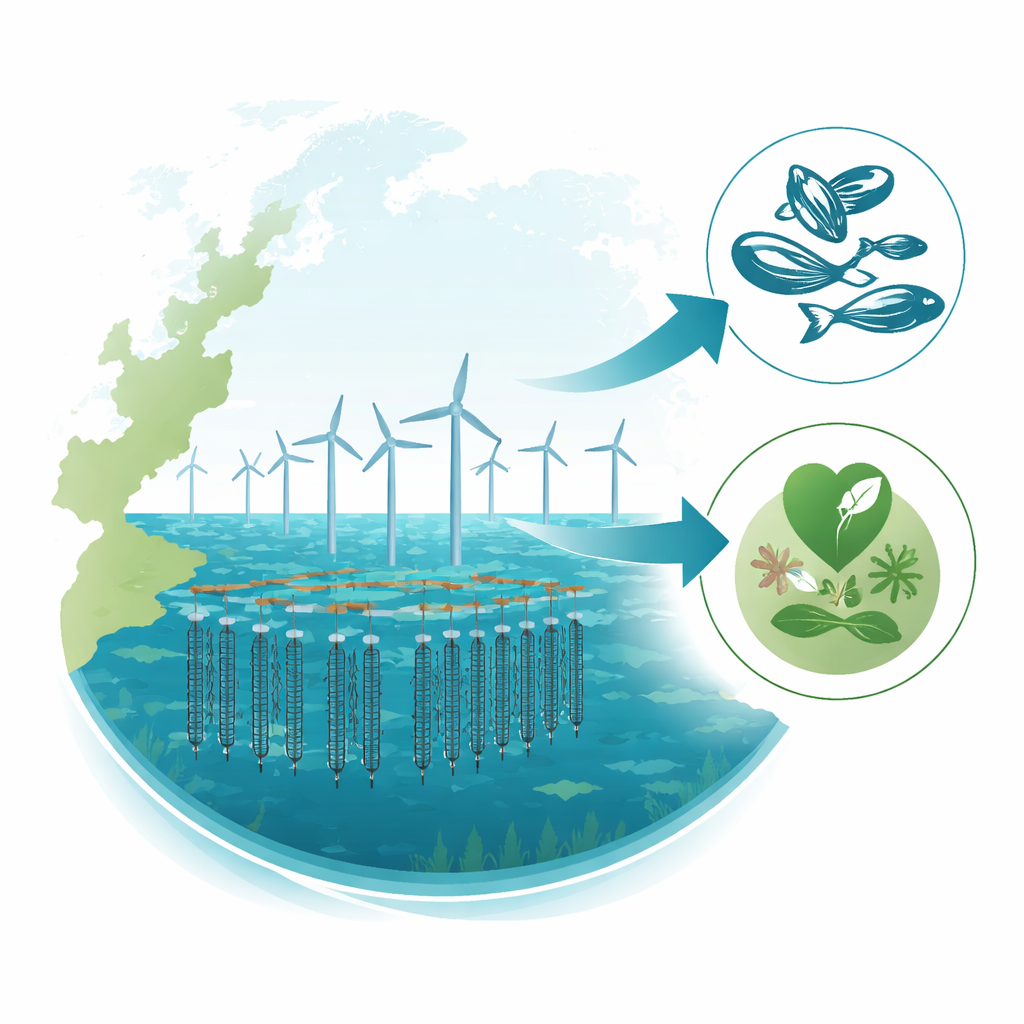
As the world’s population grows and appetites for protein rise, we face a basic question: where will tomorrow’s food come from without further straining land, freshwater, and climate? This study explores an intriguing answer—growing blue mussels far offshore in the same ocean spaces already used for wind farms. By combining seafood production with clean energy in European seas, the authors show how one patch of water might provide both power and protein while easing pressure on crowded coastlines.
Why Mussels and Why Offshore?
Mussels are small shellfish that pack a nutritional punch: they are rich in protein and micronutrients, yet their environmental footprint is far lower than that of most meat. Despite this, mussel farming in Europe has grown slowly. Nearshore waters are crowded, sometimes polluted, and more vulnerable to extreme heat, disease, and algae blooms. The authors argue that moving farms farther out to sea could unlock more space and more stable conditions. Offshore waters tend to be cooler, cleaner, and better mixed, which can support faster growth and reduce some climate-related risks—if farms can withstand waves, currents, and distance from ports.
Sharing Space with Wind Farms
At the same time, offshore wind power is spreading rapidly across European waters to meet climate goals. Wind farms take up large areas, limiting where other activities can go and creating conflicts over ocean space. Yet these installations are built to survive harsh conditions, and their undersea structures already attract wild mussels that cling in dense clusters. The authors explore a practical idea: deliberately farming mussels within or around wind farms. In its simplest form, this “co-location” means two industries use the same patch of sea at the same time, without necessarily sharing equipment or staff. Done carefully, it could allow both energy and food production to expand without carving up even more of the ocean.
Finding the Best Spots in a Vast Sea
To move from concept to map, the researchers used a spatial decision method that layers many types of data across European seas. First, they asked where offshore farming is technically feasible. Areas were excluded if the water was too deep, currents too strong, or if surface temperatures spiked above 25 °C for several days—conditions known to cause mussel die-offs. This left about 1.13 million square kilometres of feasible area, especially in the North Sea, Baltic Sea, Irish Sea, and along the Atlantic coasts of France and the British Isles. They then checked where existing or planned wind farms overlap with these feasible zones and found that the vast majority—420 out of 454 sites—fall within areas that could, in principle, host mussel cultivation.
Where Mussels Would Thrive Today and Tomorrow
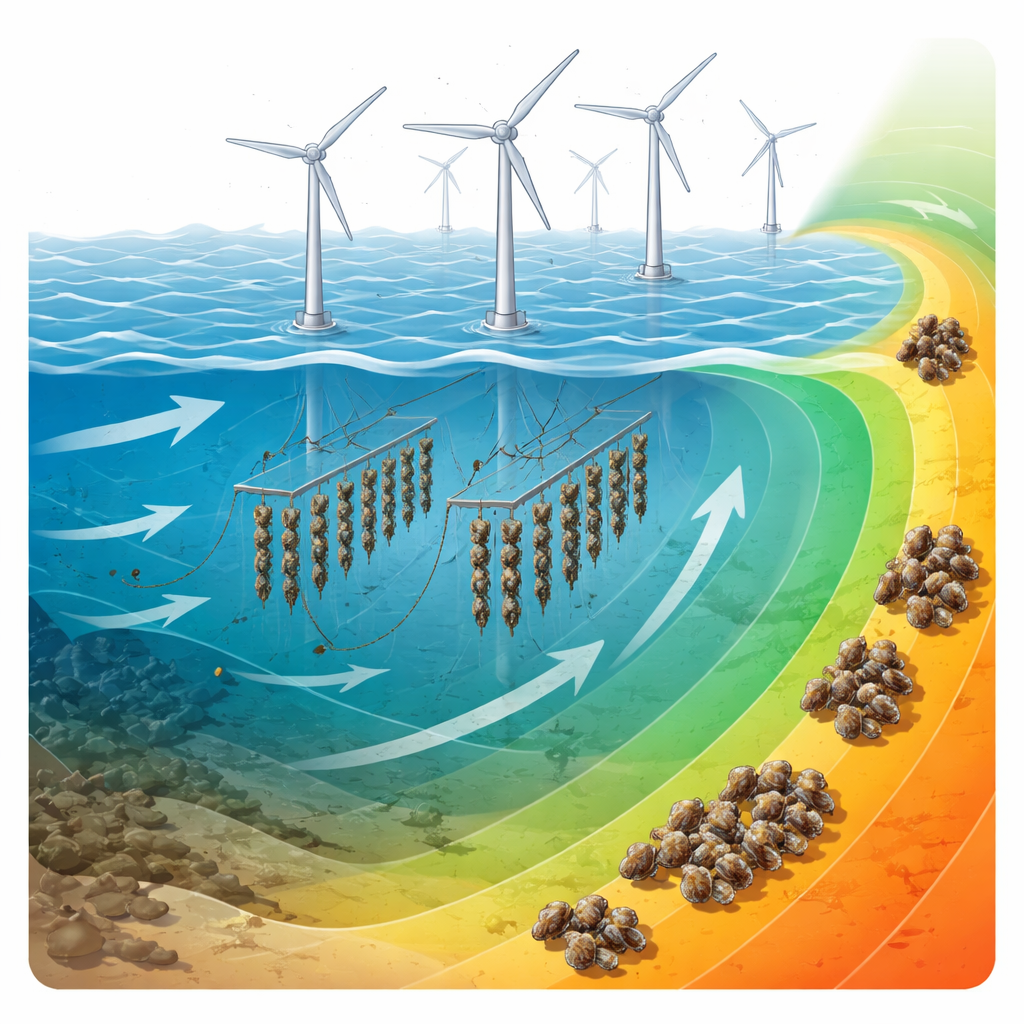
Next, the team asked not just whether farming is possible, but how good each feasible area would be for mussel growth. They combined information on average sea temperature, saltiness, microscopic plant life (a food source), and suspended particles. Using published experiments on mussel biology, they translated these conditions into a “suitability index” from very low to very high. Large swaths of the southern and central North Sea, the Irish Sea, the English Channel, and parts of the French and Portuguese coasts emerged as highly suitable. In contrast, the Mediterranean Sea offered virtually no suitable offshore area for this particular mussel species, largely because of high temperatures, while parts of the Baltic were limited by low salt levels. The study then looked ahead to mid-century climate projections. Warming seas are expected to shift the sweet spot for mussel growth northward: northern European waters become slightly more favorable, while southern areas become too warm. Because many future wind farms are planned in the North Sea and Baltic, this northward shift could actually increase opportunities for co-location there—though short, intense marine heatwaves remain a worrying wild card that long-term averages cannot capture.
What Still Needs to Be Figured Out
The authors are careful to note that their maps are not building permits. Many other questions must be answered before offshore mussel farms can be woven into wind parks. These include local wildlife protections, how many mussels an area can support without damaging ecosystems, and the willingness of wind farm operators to share space. Uncertainties about extreme events, such as marine heatwaves, and about how mussels respond to changing oxygen levels and ocean acidity add further caution. Economic realities also matter: offshore operations are expensive, and the benefits of shared boats, infrastructure, and monitoring need to be weighed against new risks and regulatory hurdles.
A Blueprint for Shared Seas
In plain terms, this study shows that there is ample room in European offshore waters where mussels and wind turbines could coexist—and often thrive together. The work maps where conditions are technically safe enough and biologically favorable for blue mussels, now and under a warming climate, and highlights that most current and planned wind farms already sit in such zones. While real-world projects will require detailed local studies, business planning, and new rules for sharing ocean space, the message is clear: with smart planning, the same stretch of sea can help keep lights on and plates full, easing competition for space while supporting both food security and a low-carbon future.
Citation: Lecordier, E.M., Gernez, P., Mazik, K. et al. Identifying suitable mussel cultivation sites in European offshore waters—an assessment for co-location with the wind industry. npj Ocean Sustain 5, 20 (2026). https://doi.org/10.1038/s44183-026-00187-0
Keywords: offshore aquaculture, blue mussels, offshore wind farms, marine spatial planning, climate change impacts