Clear Sky Science · en
Tri-stream multi-model architecture for real-time detection of BeiDou signal manipulation in UAV swarms
Why keeping drone swarms honest matters
Imagine a fleet of delivery drones or rescue robots flying in tight formation over a busy city. They rely on satellite signals to know where they are. If a malicious actor quietly fakes those signals, the entire swarm can drift off course, collide, or enter restricted airspace. This paper explores how to spot and counter such trickery in real time, so that large groups of unmanned aerial vehicles can stay safe and on mission even when the sky is lying to them.
The hidden weakness in today’s drone navigation
Most modern drones use global navigation satellite systems, like China’s BeiDou, to track their position and time. Consumer drones typically have simple, single-frequency receivers without added security. That makes them easy targets for spoofing, where attackers broadcast fake satellite signals that overpower the real ones. In swarm flights, the danger multiplies: if many drones accept the same lies about where they are, their carefully choreographed spacing breaks down, raising the risk of collisions and mission failure, especially in crowded urban “canyon” environments full of reflections and signal blockages.
Many ways to fool a swarm
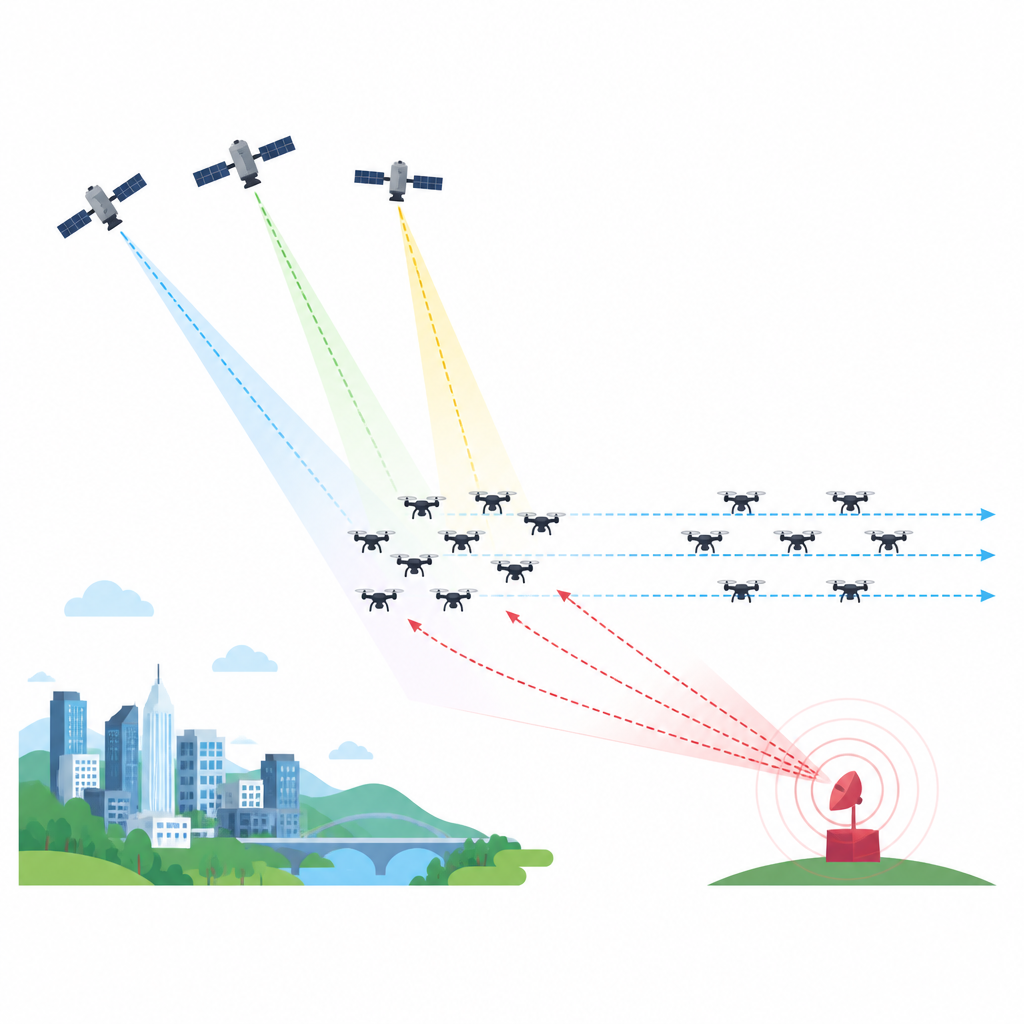
The authors map out a rich catalogue of attack styles that can mislead a swarm. A powerful ground transmitter can flood an area with counterfeit signals, pulling the whole group away from its geofenced region. A moving spoofer mounted on a van can slowly drag the swarm’s path off course before suddenly shifting it. A compromised drone inside the formation can act as a local deceiver, steering nearby neighbors into each other. Other tactics replay real signals with a delay, gradually bias frequencies, or combine jamming and spoofing so that receivers first lose lock, then reacquire on false signals. Together, these scenarios show that simple one-drone defenses are not enough when dozens of vehicles must coordinate in real time.
A multi-layer “sense and share” defense
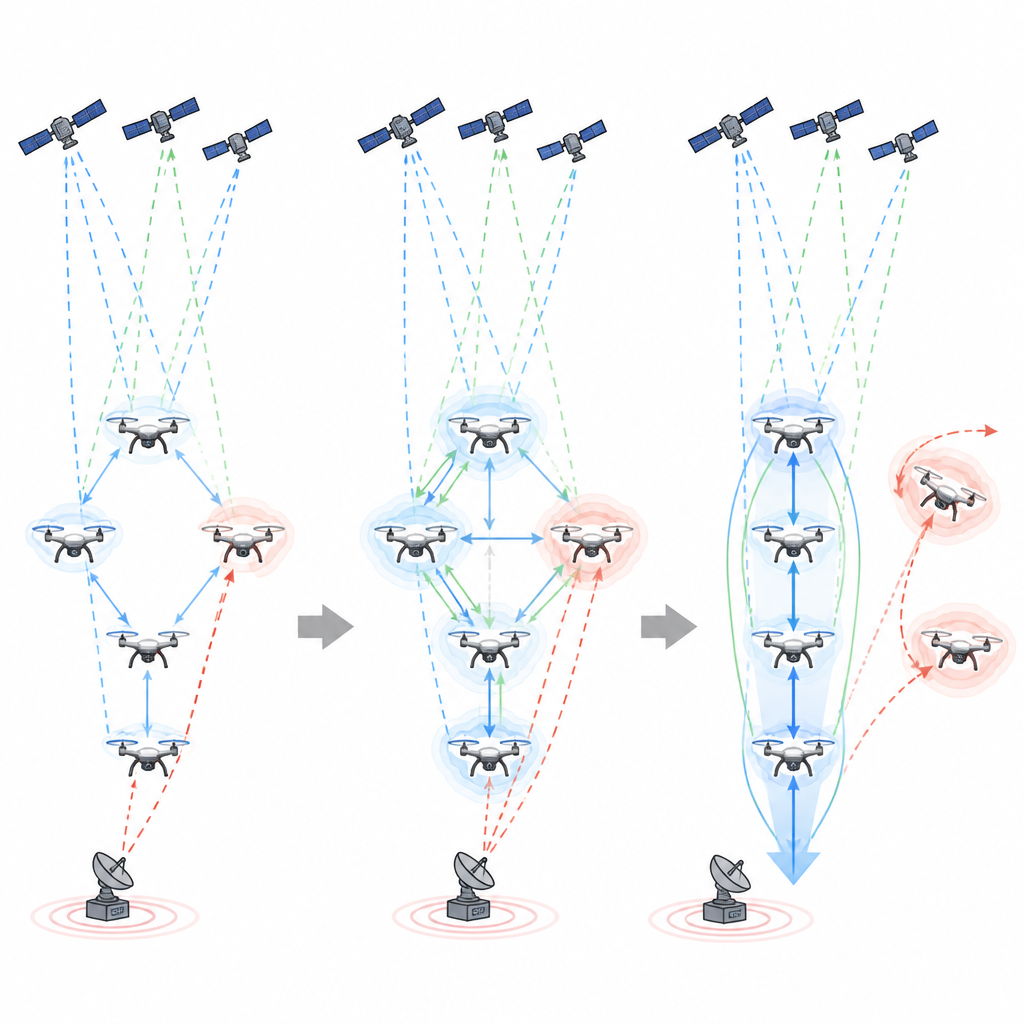
To counter these threats, the study proposes a hybrid detection system that watches individual drone behavior and swarm patterns at the same time. At its core, each drone runs a mathematical tracker that predicts how it should move based on past motion and onboard sensors, then compares that to what BeiDou says. Unusual differences raise suspicion. Alongside this, three types of learning models look for clues: one focuses on patterns in the satellite signals themselves, another tracks how motion evolves over time, and a third examines how drones relate to one another in the formation. Their outputs are combined into a single risk score. A specialized language model, trained on drone telemetry logs, provides an extra “sanity check” when the situation is unclear, helping to distinguish hostile interference from normal quirks like reflections or gusts of wind.
Teaching the swarm to react together
Detection is only half the story; the swarm must also respond wisely. In this framework, every drone regularly shares compact summaries of its position, motion, and spoofing risk with nearby peers. Each drone then forms its own view of which neighbors are trustworthy, giving less weight to those that look suspicious or communicate unreliably. This trust-weighted consensus shapes how each vehicle adjusts its speed and direction. Drones that appear safe help pull the formation back into alignment, while suspect drones are effectively down-ranked, pushed away, or treated as moving obstacles. The system can also reassign “leader” roles to drones with low spoofing risk and good communication links, preserving an orderly formation without any central controller.
Testing the idea in a virtual sky
Because broadcasting fake satellite signals in the real world is tightly regulated, the team built a detailed software simulator instead. It recreates BeiDou geometry, realistic signal noise, urban reflections, and a wide range of spoofing and jamming behaviors, including rogue drones and multiple coordinated transmitters. Each virtual drone carries a simulated satellite receiver and motion sensors, and runs its own copy of the detection and control algorithms. Across dozens of test runs covering different swarm shapes, flight missions, and threat types, the system correctly flagged spoofing in about 97 percent of cases, with very few false alarms and an average reaction time of under three seconds. Even during complex attacks, the swarm’s path typically strayed less than five meters from its intended course, and nearly all missions were completed successfully.
What this means for everyday drone use
In plain terms, this work shows that networks of cooperating drones can learn to notice when their “sense of place” is being tampered with, talk to one another about it, and adjust formation on the fly to stay safe and useful. The approach works with standard satellite and motion sensors and is designed to run in a distributed way, so it could be adapted to real fleets used for deliveries, inspections, or emergency response. While the current results come from simulation and still depend on relatively powerful onboard computation, they lay a path toward making drone swarms far more resilient in cities and other contested environments where trusted navigation cannot be taken for granted.
Citation: Tariq, U., Ahanger, T.A. & Shaukat, K. Tri-stream multi-model architecture for real-time detection of BeiDou signal manipulation in UAV swarms. Sci Rep 16, 15802 (2026). https://doi.org/10.1038/s41598-026-46655-y
Keywords: UAV swarms, GNSS spoofing, BeiDou security, drone navigation, cyber-physical attacks