Clear Sky Science · en
Sex differences, perceived stress, gaming motives, and gambling-like attitudes toward loot-boxes predict risky loot box use among Polish gamers
Why mystery boxes in games matter
Many popular video games now include “loot boxes” – virtual mystery chests that give random rewards when opened. For some players these offers are harmless fun, but for others they start to look and feel a lot like gambling. This study explores which factors make people more likely to use loot boxes in risky ways, focusing on adult gamers in Poland and looking at stress, reasons for playing, views about loot boxes, gambling problems, and differences between women and men. 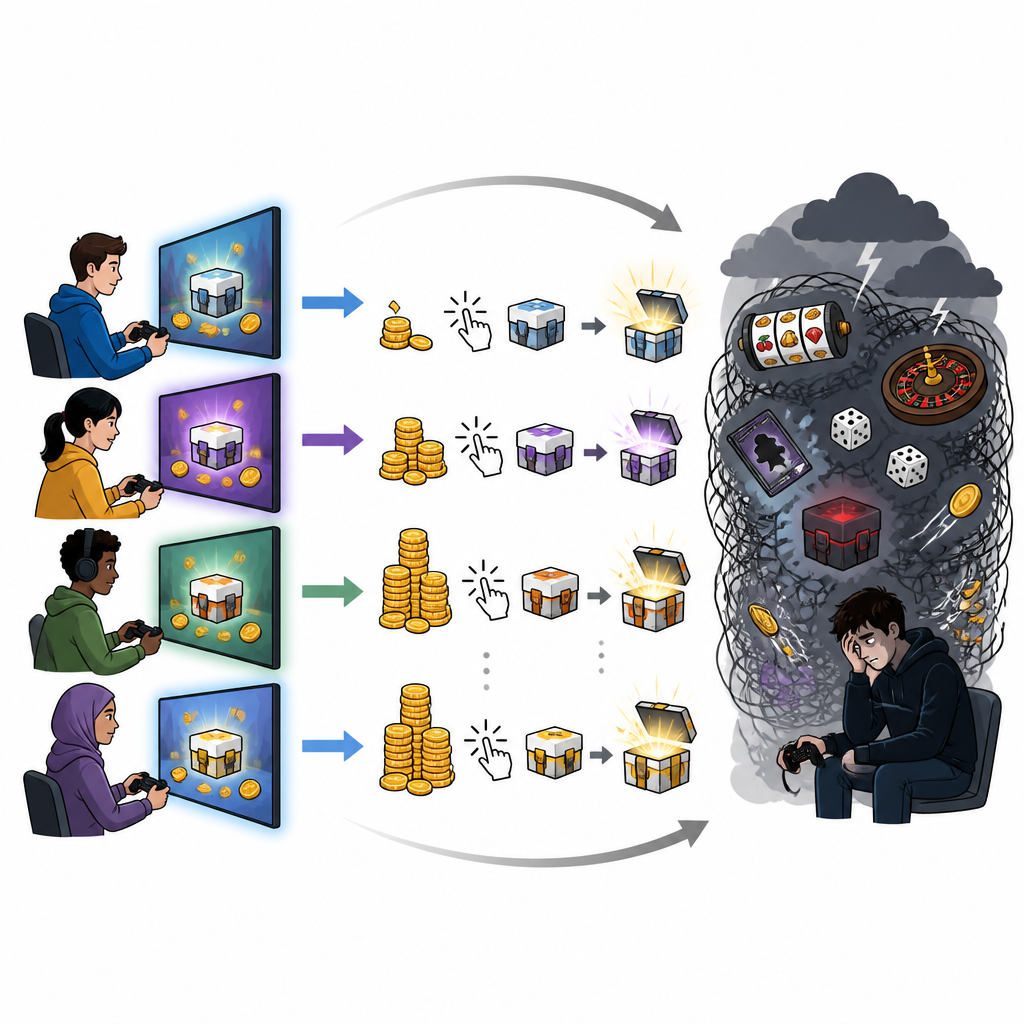
Loot boxes and the blurry line with gambling
Loot boxes can be earned through play or bought with real money, but the contents are random and some rewards are far more valuable than others. This mix of chance, excitement, and potential profit resembles slot machines, especially when bright lights, sounds, and rare items encourage players to keep opening “just one more.” Policymakers in several countries are debating whether these features should be regulated like gambling. At the same time, researchers have begun to treat risky loot box use as its own problem behavior, rather than just a side effect of heavy gaming.
How the researchers studied Polish gamers
The authors surveyed 1,358 adult Polish gamers who had opened loot boxes in the past year. Participants answered questions about how often they used loot boxes and how often they paid for them, whether they saw loot boxes as fun or harmful, and whether they thought loot boxes were a form of gambling or a way to earn money. They also completed standard questionnaires about gaming disorder, gambling problems, perceived stress, and three main motives for gaming: achievement (improving skill and progress), escapism (using games to escape real life), and social contact. The team then used statistical models to see which of these factors best predicted higher scores on a scale of risky loot box use.
What drives risky loot box behavior
Risky loot box use was strongly linked to several patterns: more frequent opening of loot boxes, paying for them more often than earning them through play, and seeing loot boxes as a positive part of a game. Gamers who believed that loot boxes are a good way to make money, enjoyed games based on chance, or agreed that loot boxes resemble gambling also tended to show more risky use. Higher levels of stress, more severe gaming disorder symptoms, and more serious gambling problems each added to the risk in a stepwise fashion. Players who played mainly for achievement or to escape real life were especially prone to risky loot box behavior, whereas purely social motives were less important. Overall, the model explained more than half of the differences in risky loot box scores between individuals. 
Differences between women and men
The sample contained more women than men, and women were generally younger and reported higher stress. When looking only at simple averages, men and women did not differ much in their risky loot box scores. However, once the authors took other factors into account in their model, women showed higher risky loot box use than men. Younger women were at particular risk, while age made little difference for men. At the same time, men were more likely to show problem gambling. These patterns suggest that the path into risky loot box use may differ by sex, and that stress and age are especially important for women.
What this means for players and policymakers
To a layperson, the study’s message is that loot boxes are not just harmless bonus features. For many players, especially younger women, frequent and paid use of these random rewards goes hand in hand with high stress, gambling-like thinking, and symptoms of gaming and gambling disorders. The authors argue that risky loot box use likely follows the same psychological pathways as other behavioral addictions, in which people chase rewards and use the activity to cope with stress. They call for long-term studies in different countries and age groups, as well as prevention efforts that teach healthier stress management and challenge unrealistic beliefs about chance and winning.
Citation: Lelonek-Kuleta, B., Cudo, A., David, J. et al. Sex differences, perceived stress, gaming motives, and gambling-like attitudes toward loot-boxes predict risky loot box use among Polish gamers. Sci Rep 16, 15637 (2026). https://doi.org/10.1038/s41598-026-46637-0
Keywords: loot boxes, problem gaming, problem gambling, gaming motivation, stress