Clear Sky Science · en
The efficacy of combined bandage contact lens and nasal margin suture fixation in pterygium patients and its impact on inflammatory cytokines
Why this eye surgery study matters
Pterygium is a common eye growth in sunny parts of the world. It can look alarming, feel gritty, blur vision, and often comes back after surgery. This study tests a simple twist on an existing operation that aims to make recovery quicker and more comfortable, while also calming the tiny inflammatory signals on the surface of the eye that may drive pain and relapse.
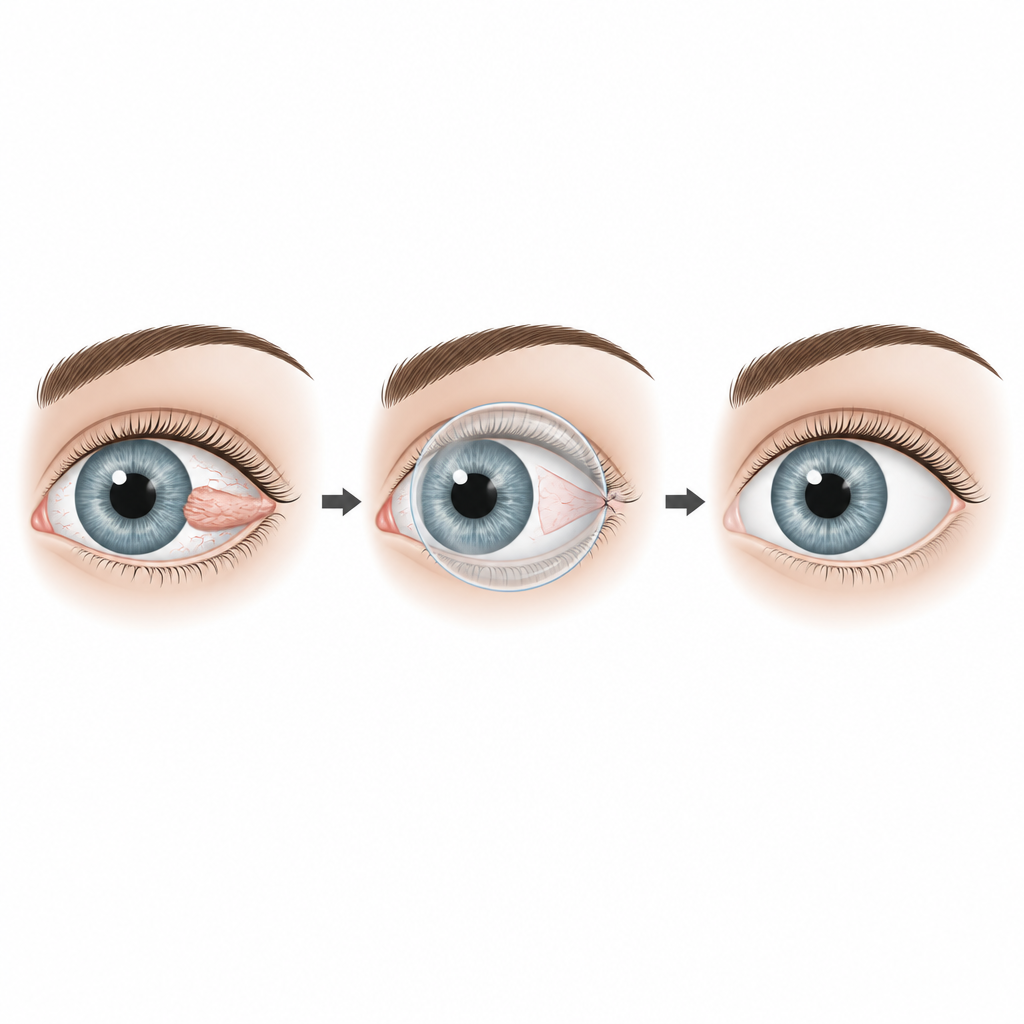
A troublesome growth on the eye
Pterygium is a wedge of tissue that creeps from the white of the eye onto the clear cornea, often linked to years of ultraviolet light exposure. Beyond its cosmetic impact, it can distort the front of the eye, causing astigmatism, blocking the pupil, and in extreme cases limiting eye movement. The most widely used surgery removes the growth and covers the bare area with a thin flap of the patient’s own conjunctiva, the clear membrane that coats the white of the eye. This approach, called a conjunctival autograft, lowers the chance that the pterygium will return, but the way that flap is fixed in place can strongly affect pain, healing, and complications.
The idea behind a gentler repair
Traditionally, surgeons anchor the graft with several tiny stitches around its edges. These sutures hold well but can hurt, prolong the operation, and act as foreign bodies that irritate the eye. Glue and other options improve comfort but bring their own problems, from cost to risk of detachment. The team in this study designed a hybrid method that borrows the best of both worlds. They used a few stitches only at the inner corner of the eye, where strong anchoring is most needed, and relied on a soft bandage contact lens to gently press and smooth the graft everywhere else. The hope was that this would keep the graft stable while reducing irritation from excess stitches.
How the study was carried out
The researchers randomly assigned 80 patients with moderate or severe pterygium to one of two groups, and 74 completed a year of follow up. All underwent the same basic operation performed by one surgeon. In the test group, the graft was fixed with a single row of sutures at the nasal margin plus a bandage contact lens. In the control group, the graft was sewn down with several traditional interrupted sutures, and then covered with the same type of bandage lens. The team recorded how long surgery took, how much pain patients reported using a visual analog scale in the first week, how thick the graft looked on high resolution imaging over a month, and whether short term issues such as bleeding, swelling, and graft shrinkage occurred. They also collected tears at several time points to measure levels of key inflammatory molecules, including interleukin 6 and tumor necrosis factor alpha.
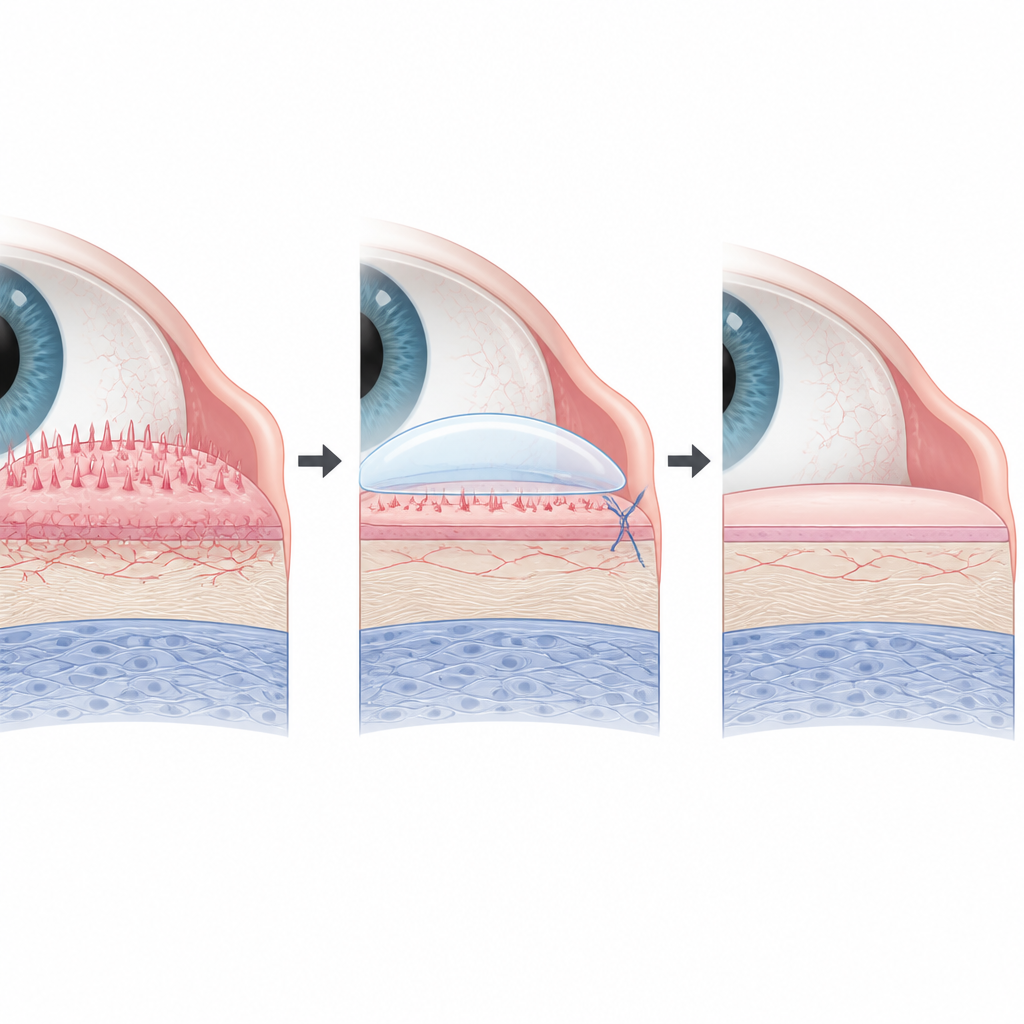
What the researchers found in the eye and in tears
Surgery using the hybrid method was noticeably faster, saving about five minutes on average compared with the fully stitched approach. Patients with the modified technique consistently reported lower pain scores on day two, day three, and at one week after surgery. Early on, imaging showed that their grafts were actually a bit thicker, likely reflecting less compression from sutures and some temporary swelling. By the end of the first week, however, grafts in the hybrid group were thinner than those in the traditional group, and by one month they looked similar. Tear testing revealed an important difference: during the first week and first month, levels of interleukin 6 and tumor necrosis factor alpha were significantly lower in the hybrid group, suggesting a calmer inflammatory environment on the eye’s surface. Levels of transforming growth factor beta1, a molecule involved in tissue repair and scarring, were similar between groups, hinting that the new method does not interfere with normal healing.
Safety and long term outcomes
Over one year, both groups showed comparable rates of common minor problems such as bleeding under the conjunctiva, graft swelling, and small amounts of graft pullback. Every eye developed some degree of corneal scarring, which is often expected in more advanced cases. Only one recurrence of pterygium occurred, and that was in the traditional suture group; the growth did not cross back over the corneal edge and did not require another operation. Serious complications like graft loss, holes, or deep tissue damage were not seen in either group, supporting the overall safety of both techniques.
What this means for patients
For people facing pterygium surgery, this study suggests that using a bandage contact lens together with just a few key stitches may make the experience smoother. The streamlined approach shortened surgery, eased pain in the first week, and was associated with lower levels of inflammatory signals in the tears, without increasing complications or recurrence during a year of follow up. In simple terms, holding the graft mainly with a soft lens and minimal stitching seems to help the eye heal in a calmer, more comfortable way while still keeping the repair secure.
Citation: Liu, X., Zhao, X., Chen, Y. et al. The efficacy of combined bandage contact lens and nasal margin suture fixation in pterygium patients and its impact on inflammatory cytokines. Sci Rep 16, 15887 (2026). https://doi.org/10.1038/s41598-026-46322-2
Keywords: pterygium surgery, bandage contact lens, eye inflammation, conjunctival autograft, ocular surface healing