Clear Sky Science · en
The effects of approach bias modification on smoking cue-reactivity in individuals who smoke: A randomized controlled fMRI study
Why training the brain to "back away" from cigarettes matters
Most people who smoke want to quit, yet many find themselves lighting up again when they see, smell, or even imagine a cigarette. These automatic urges, triggered by everyday sights like an ashtray or a coffee mug, can quietly sabotage the best intentions. The study summarized here tested whether a simple computer-based training program could retrain these gut-level reactions in the brain and, in turn, help people stay smoke-free. Using brain scans, the researchers looked under the hood of this training to see whether it truly dampened the brain’s response to smoking cues and improved quit rates.

A computer game that teaches the brain to push cigarettes away
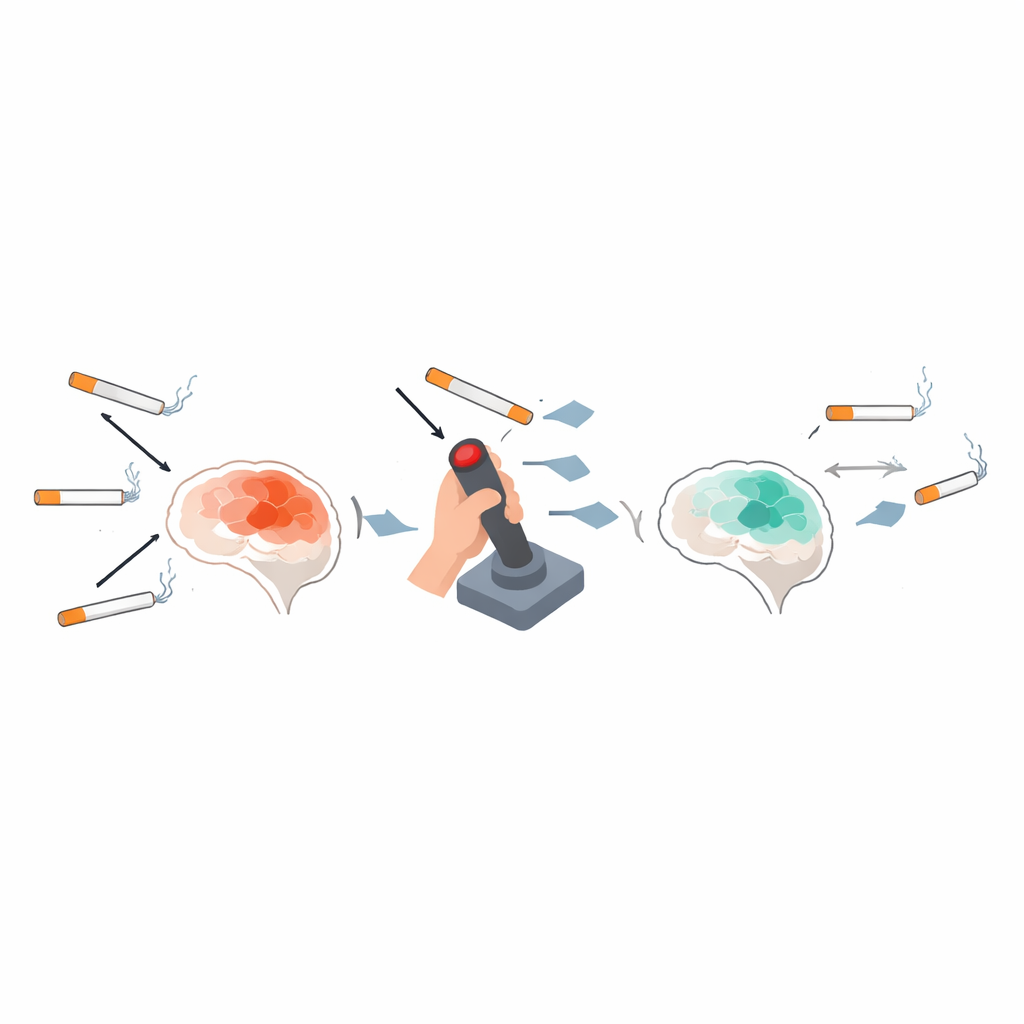
The intervention at the heart of this research is called approach bias modification. In plain terms, it is a joystick “game” in which people repeatedly push away pictures of cigarettes and pull in pictures of pleasant, smoke-free scenes. Over many trials, this is meant to flip an automatic tendency to move toward smoking cues into a tendency to move away from them. Earlier work in people with alcohol problems suggested that this kind of training can lower relapse rates and tone down activity in brain regions linked to craving. The big question here was whether the same idea would work for chronic smokers who were trying to quit.
How the study followed smokers from quit day into daily life
The researchers enrolled 117 adults who had been smoking moderately to heavily for many years. Everyone first took part in a one-day group course that used established counseling methods to help them quit. After this shared starting point, people were randomly assigned to one of three paths: seven sessions of real approach bias training at home, seven sessions of a sham version that did not favor pushing cigarettes away, or no extra training at all. Before and after this intervention phase, participants lay in a brain scanner while viewing blocks of cigarette-related pictures and similar neutral images, such as everyday objects. The team tracked how strongly different brain areas responded to smoking pictures compared with neutral ones, and whether those responses predicted who managed to stay off cigarettes up to six months later.
What the brain scans revealed about smoking cues
Contrary to expectations, the training did not produce a clear extra reduction in the brain’s response to smoking cues compared with the sham training or no training. In prize centers of the brain’s reward circuit, such as the striatum and amygdala, the response to smoking images was not higher than to neutral images at baseline—in fact, some of these regions were less active. Instead, stronger activity showed up in areas that help prepare and guide movements and habits, including parts of the cingulate cortex, the precuneus, and the supramarginal gyrus. Across all study groups, activity in these regions dropped somewhat over time, and people reported less craving and showed stronger joystick “avoidance” of smoking pictures. But these changes were similar whether or not they had received the specialized training. In line with this, quit rates did not differ: long-term abstinence at six months hovered around one in five participants in all three groups.
A hint that automatic actions may matter more than pleasure
When the researchers probed the data more deeply, they found only tentative links between brain changes and quitting success, and these did not survive strict statistical correction. One intriguing pattern emerged in a region called the precuneus, which helps connect what we see with the movements we make. For people who received the active training, increased sensitivity of this area to smoking cues was associated with a higher chance of being smoke-free six months later, whereas the opposite pattern appeared in the comparison groups. The authors speculate that repeatedly practicing “push away” movements toward cigarette pictures may strengthen an automatic tendency to turn away from smoking cues in real life, but this idea remains preliminary and may apply only to a subset of smokers.
What this means for future ways to help people quit
For a layperson, the key message is that this particular form of brain-training did not deliver the hoped-for extra boost beyond a solid group quit program, at least not in this group of long-term smokers. The study also suggests that, in chronic smoking, the brain’s response to cigarette cues may be driven less by raw pleasure signals and more by deeply ingrained routines and motor habits. That insight points the way for future research: instead of mainly targeting reward hotspots, new treatments might be more effective if they directly weaken the automatic, almost reflex-like actions that link a coffee break or a stressful moment to reaching for a cigarette.
Citation: Motka, F., Tan, H., Vollstädt-Klein, S. et al. The effects of approach bias modification on smoking cue-reactivity in individuals who smoke: A randomized controlled fMRI study. Sci Rep 16, 10519 (2026). https://doi.org/10.1038/s41598-026-45748-y
Keywords: smoking cessation, brain training, habit and addiction, cue reactivity, neuroimaging