Clear Sky Science · en
Mathematics performance predicts cognitive and affective math anxiety through mutual mediation pathways from adolescence onward with potential working memory moderations
Why Worry About Math Worry?
Many teenagers and college students feel their stomach tighten or their mind blank out when they face a math test. This study asks a deceptively simple question that matters to parents, teachers, and students alike: how does doing well or poorly in math shape those anxious thoughts and tense feelings, and why do some students seem more protected from this spiral than others?
Two Faces of Feeling Nervous About Numbers
Math anxiety is not just a single vague fear. The researchers focus on two sides of this experience. One side is made of worried thoughts: the inner voice that says “I will fail” or keeps replaying past mistakes. The other side is emotional tension: the racing heart, tight muscles, or sense of dread when math appears. Earlier work suggested these two sides are closely linked, but it was less clear how they interact once students have already been graded and tracked through years of schooling.
Following the Paths From Scores to Feelings
To trace these links, the team studied two groups in Taiwan: high-school students facing a nationwide entrance exam and university students who had already passed a major admissions test. They gathered official math scores, used a questionnaire to measure both worried thoughts and tense feelings about math, and gave computer-based memory tasks. One task tapped holding and reversing spoken items, and another did the same with visual patterns and locations. Using statistical path models, they tested two possible chains: math scores leading first to worry and then to tension, and the reverse, scores leading first to tension and then to worry. 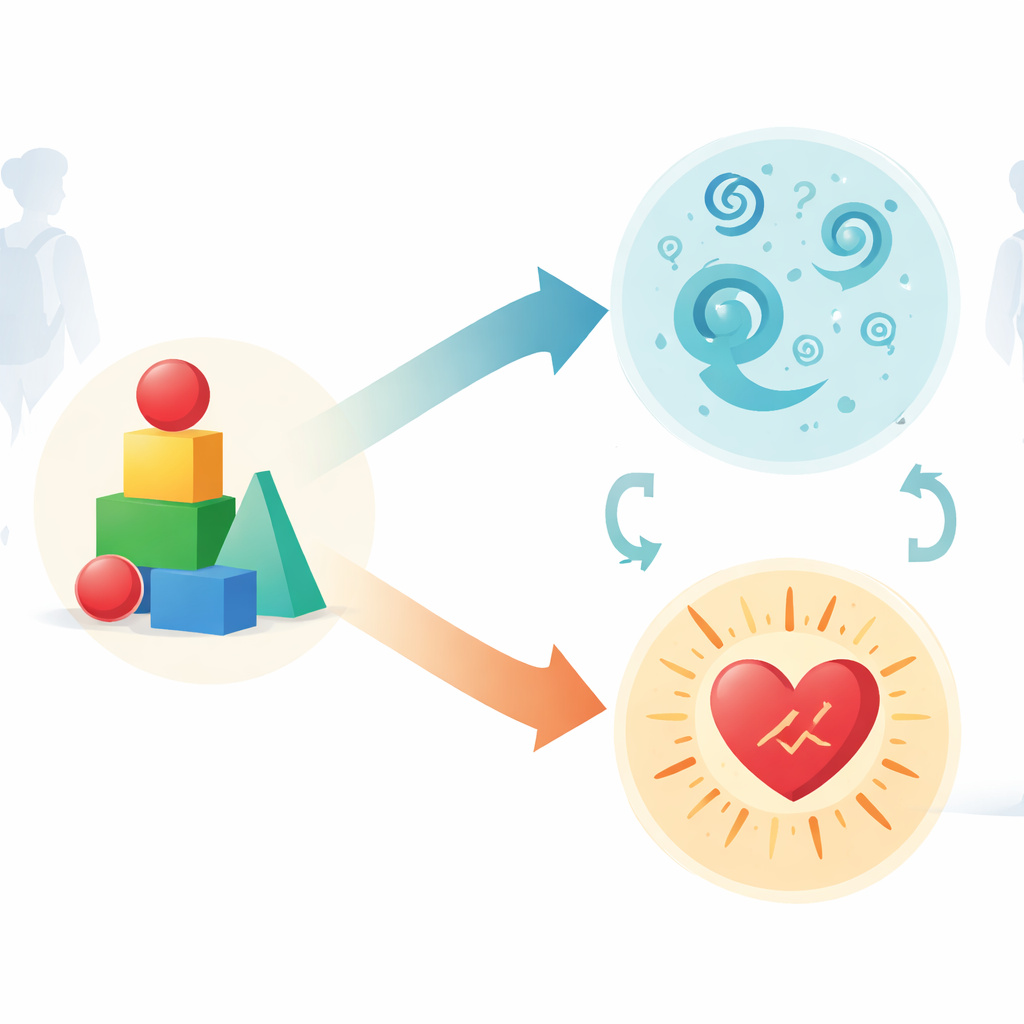
A Two-Way Loop Inside Math Anxiety
The results painted a consistent picture across both age groups. Students with lower math performance tended to report both more worried thoughts and stronger emotional tension. But the key finding was how these two sides of anxiety feed into each other. In one pathway, weaker scores were linked to more worry, which then raised emotional tension. In the other, weaker scores raised tension first, which then fueled more worry. Each pathway proved statistically meaningful and helped predict students’ anxiety levels, suggesting that thoughts and feelings form a loop rather than a simple one-way street. Models that included only these two pathways fit the data better than more complicated versions.
The Hidden Role of Mental “Scratchpads”
The researchers also asked whether students’ short-term mental storage systems—often called working memory—change how math performance spills over into anxiety. Here, the picture differed by age. In high school, the verbal side of working memory mattered most, especially for those with low to medium capacity: poor math scores were more tightly tied to tense feelings in these students, hinting that stronger verbal memory may buffer against anxiety. In university students, the visual–spatial side of memory played a larger role. For those with medium to high visual–spatial capacity, lower math performance was more strongly linked to both worried thoughts and tense feelings, suggesting that high mental capacity can sometimes mean replaying and elaborating failures more intensely. 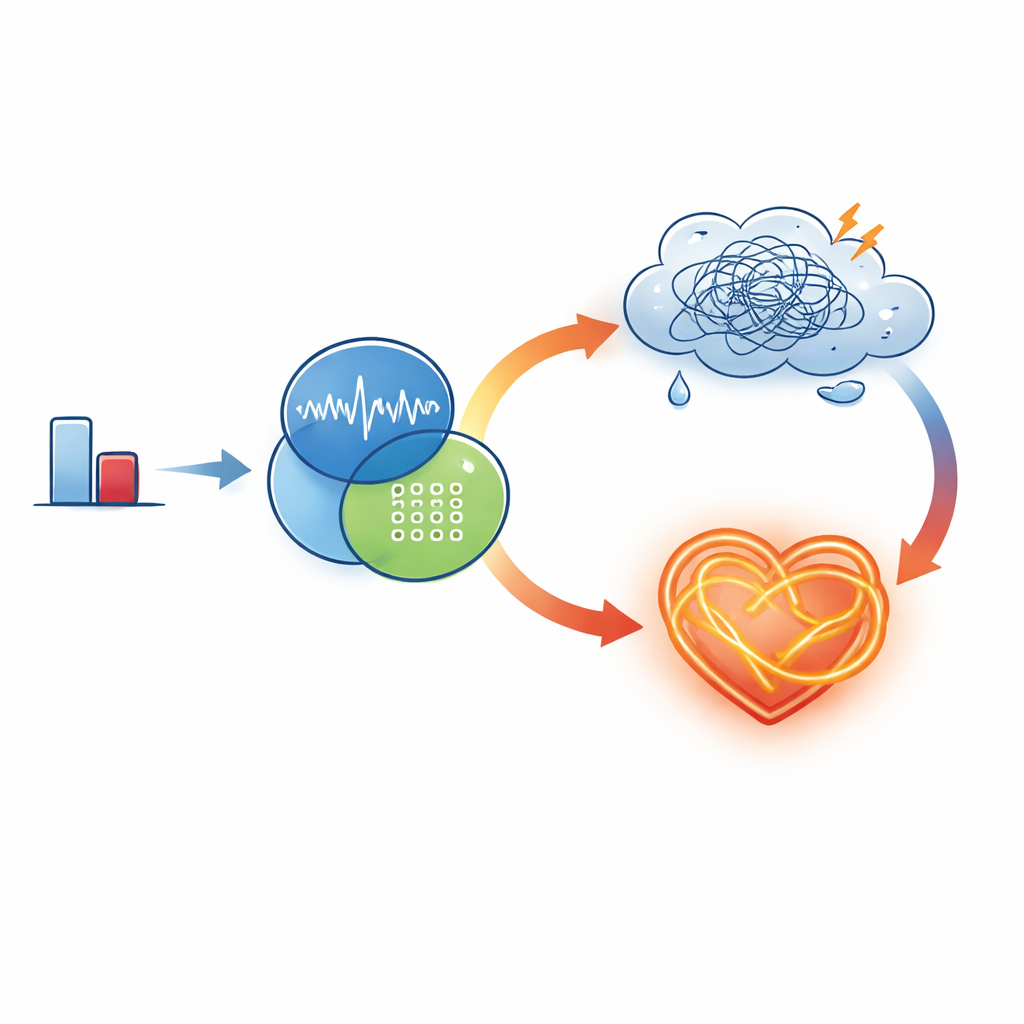
What This Means for Students and Teachers
Together, the findings suggest that math anxiety is not just “in the nerves” or “in the head” alone. Instead, performance, worried thoughts, and tense feelings form a self-reinforcing system that can solidify from adolescence into young adulthood. Extra mental capacity can sometimes protect students, and sometimes make them more prone to brooding over setbacks. For real classrooms, this means that easing math anxiety will likely require tackling both sides at once: helping students rethink their interpretations of math results while also calming the physical stress those results can trigger.
Citation: Chang, CY., Hsiao, M. & Chiang, WC. Mathematics performance predicts cognitive and affective math anxiety through mutual mediation pathways from adolescence onward with potential working memory moderations. Sci Rep 16, 10716 (2026). https://doi.org/10.1038/s41598-026-45516-y
Keywords: math anxiety, math performance, working memory, adolescent students, university students