Clear Sky Science · en
Evaluation of late-season Varroa destructor treatments and their impact on amitraz resistant mite populations
Why bee keepers and food lovers should care
Honey bees pollinate many of the fruits, nuts, and vegetables we eat, but their colonies are often weakened by tiny parasitic mites called Varroa. These mites not only feed on bees but also spread viruses, making strong hives collapse, especially over winter. This study looked at how different late season treatments used by commercial beekeepers in the southeastern United States affect both mite levels and the rise of mites that can survive a widely used chemical called amitraz.
The tiny pest that threatens winter survival
Varroa mites ride on adult bees and hide inside capped brood cells where young bees develop. If beekeepers do not control these mites, colonies can die within a year. Late fall is a critical moment, because colonies are shrinking and preparing for winter, and high mite levels at this time are strongly linked to winter losses. Many beekeepers have relied on amitraz based products such as Apivar to keep mite numbers in check, but repeated use has led to mites that no longer die when exposed to this chemical.
Testing real world treatment choices
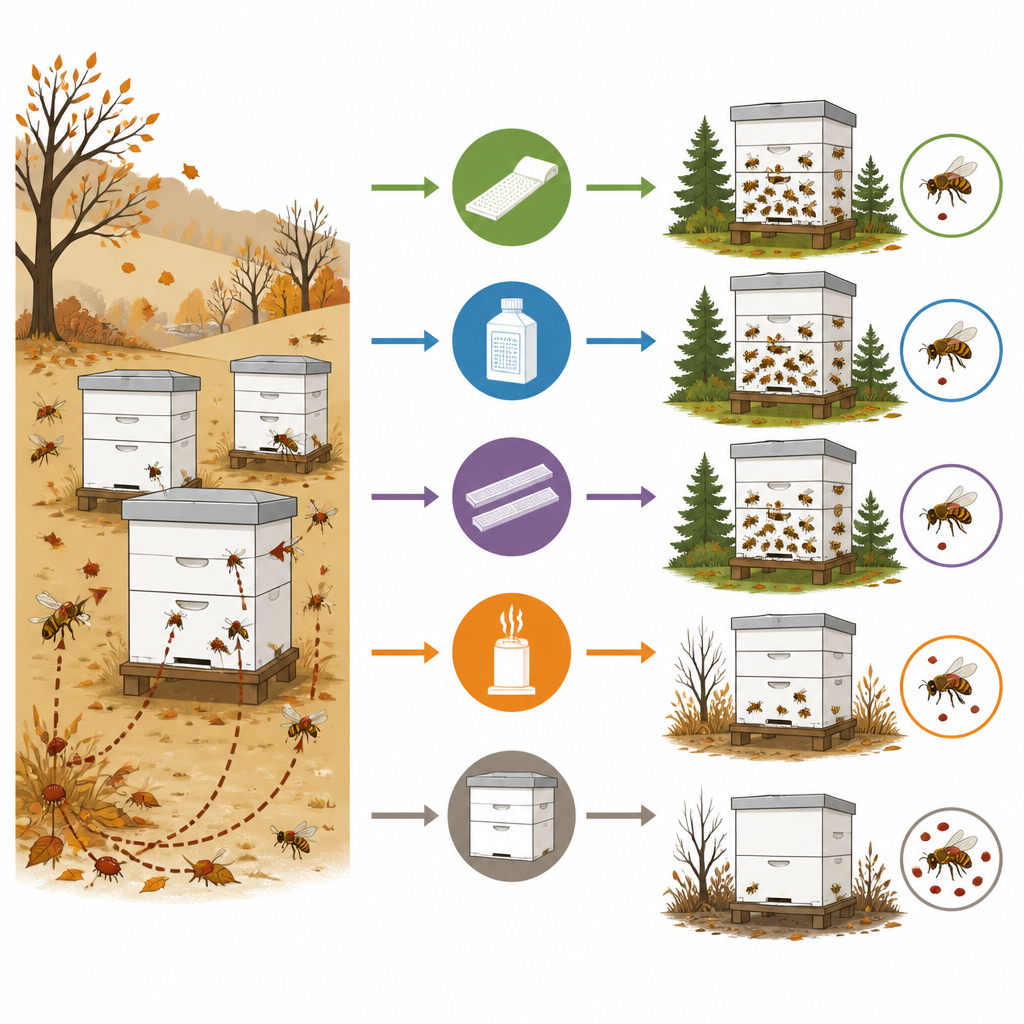
The researchers worked with 75 colonies in Alabama and compared five late season options: leaving colonies untreated, treating with Apivar (amitraz), or using three non amitraz products based on formic acid (FormicPro), hops acids (HopGuard 3), or oxalic acid vapor (Api Bioxal). All colonies started the fall with similar, relatively low mite levels of about 2 to 3 percent of adult bees infested. Treatments were applied in late September, and the team checked mite levels and colony condition about two months later in late November and again in early February after winter.
What happened to mites and colonies
By late November, untreated colonies and those given oxalic acid vapor showed steep rises in mite levels, while colonies treated with Apivar, FormicPro, or HopGuard kept mite levels close to where they started. Some colonies in the untreated and oxalic acid groups had such high mite counts that they had to be removed from the main yard and later died. In contrast, all Apivar colonies survived the full study, and most colonies treated with FormicPro or HopGuard also made it through winter, although the formic acid treatment was linked with several queen losses and temporarily lighter hives.
Following the rise and fall of resistant mites
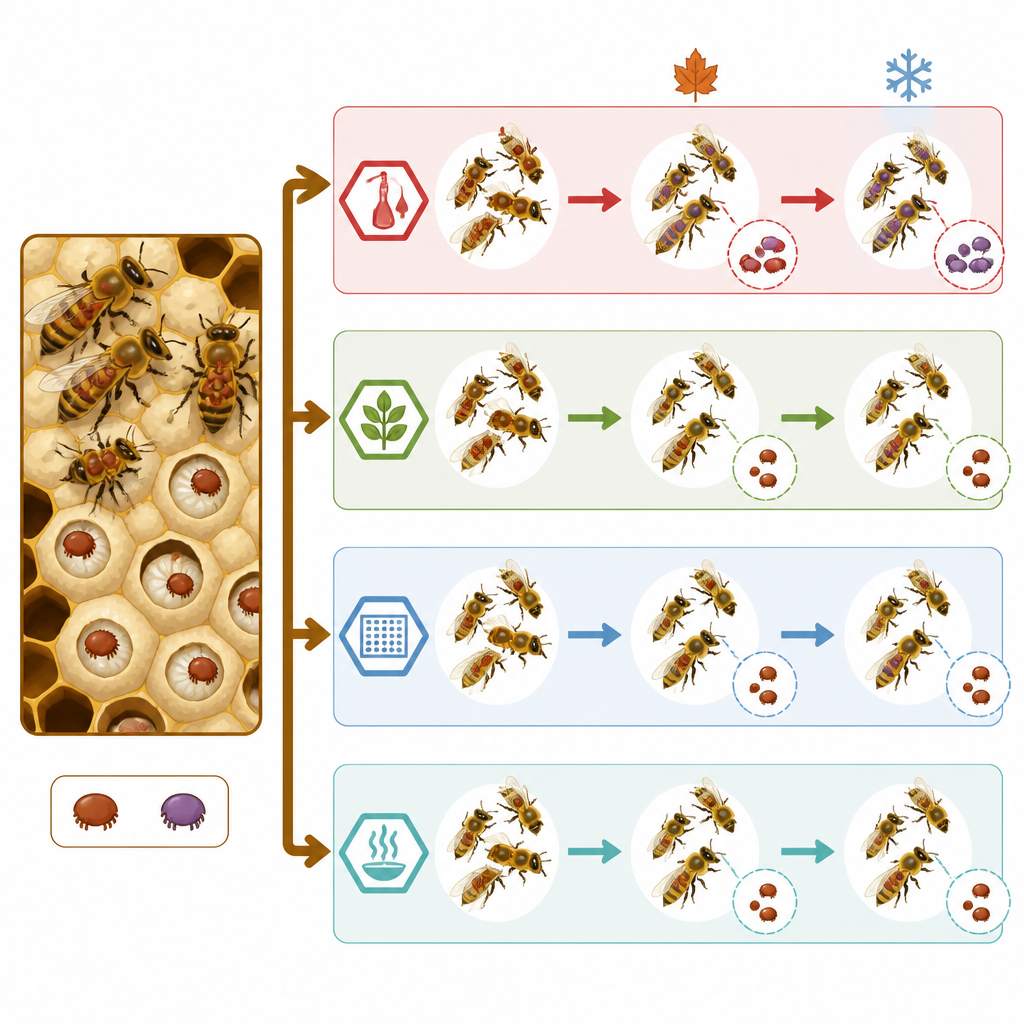
To understand how treatments shaped resistance, the team genotyped more than 1,700 individual mites, looking for a specific DNA change linked to amitraz resistance in North America. In colonies treated with Apivar, the share of mites carrying two copies of the resistance version of this gene rose sharply within two months of treatment, while fully susceptible mites became less common. After winter, however, the balance shifted back toward the starting mix of susceptible and resistant mites. In the other treatment groups, including the untreated controls, the frequency of the resistance gene stayed roughly the same over time.
What this means for bee health and management
For beekeepers, the study suggests that Apivar, FormicPro, and HopGuard can all help prevent mite levels from exploding in late fall when starting infestations are moderate, whereas oxalic acid vapor at the tested dose was not enough when brood was still present. At the same time, Apivar briefly selected for resistant mites, showing that relying heavily on amitraz can quietly shift mite populations in an unwanted direction even if total mite counts look stable. Because the resistance gene did not respond to the other treatments, these alternatives remain useful tools for managing amitraz resistant mites. The work underlines the need for rotation of treatments, careful timing when brood is low, and ongoing monitoring of mite levels and resistance so that honey bee colonies, and the crops they pollinate, can better survive the winter.
Citation: Tokach, R., Rinkevich, F.D., Aurell, D. et al. Evaluation of late-season Varroa destructor treatments and their impact on amitraz resistant mite populations. Sci Rep 16, 14778 (2026). https://doi.org/10.1038/s41598-026-44796-8
Keywords: Varroa mites, honey bee health, amitraz resistance, mite treatments, colony survival