Clear Sky Science · en
GRNN–DP–MPC Co-optimization for predictive energy management in hybrid UAVs
Why smarter drone batteries matter
Small unmanned aircraft are becoming workhorses for jobs like inspecting power lines, delivering parcels, and watching over forests. Yet one stubborn limit remains: flight time. Every extra minute in the air can mean more area surveyed or a safer return home. This study looks at solar powered drones that also carry lithium batteries and asks a simple question with a complex answer: how can we juggle sun power and stored power so the aircraft stays aloft longer without overworking its batteries?
Mixing sunshine with stored power
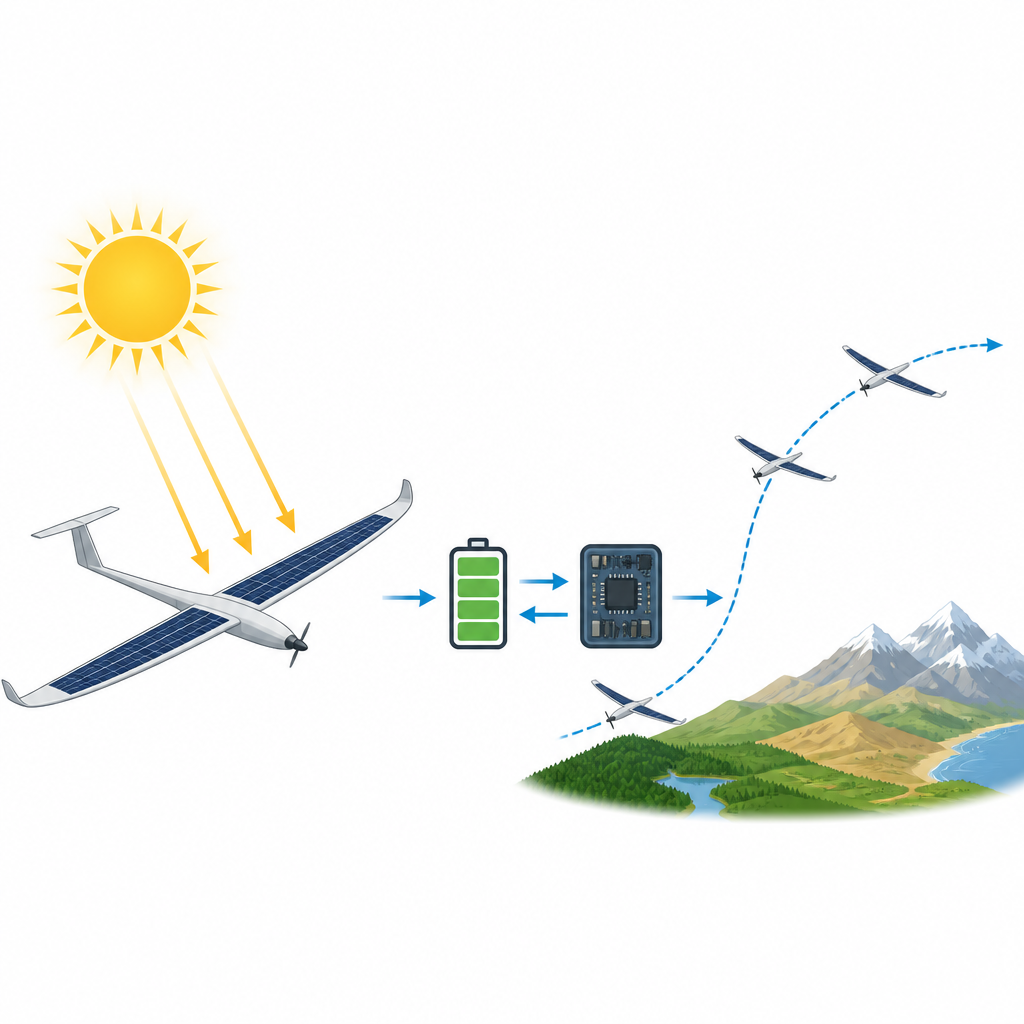
Solar hybrid drones tap sunlight through thin, lightweight solar cells spread across their wings, while lithium batteries cover power gaps during shade, steep climbs, or cloudy weather. The authors first build a detailed picture of how energy moves through such an aircraft. They describe how the panels turn sunlight into electricity depending on sun angle and flight posture, how the battery charges and discharges without being overtaxed, and how motors, avionics, and payloads draw power in different flight phases. This closed loop model lets them track exactly where each watt comes from and where it goes, forming the backbone for any smarter control strategy.
Teaching the drone to look ahead
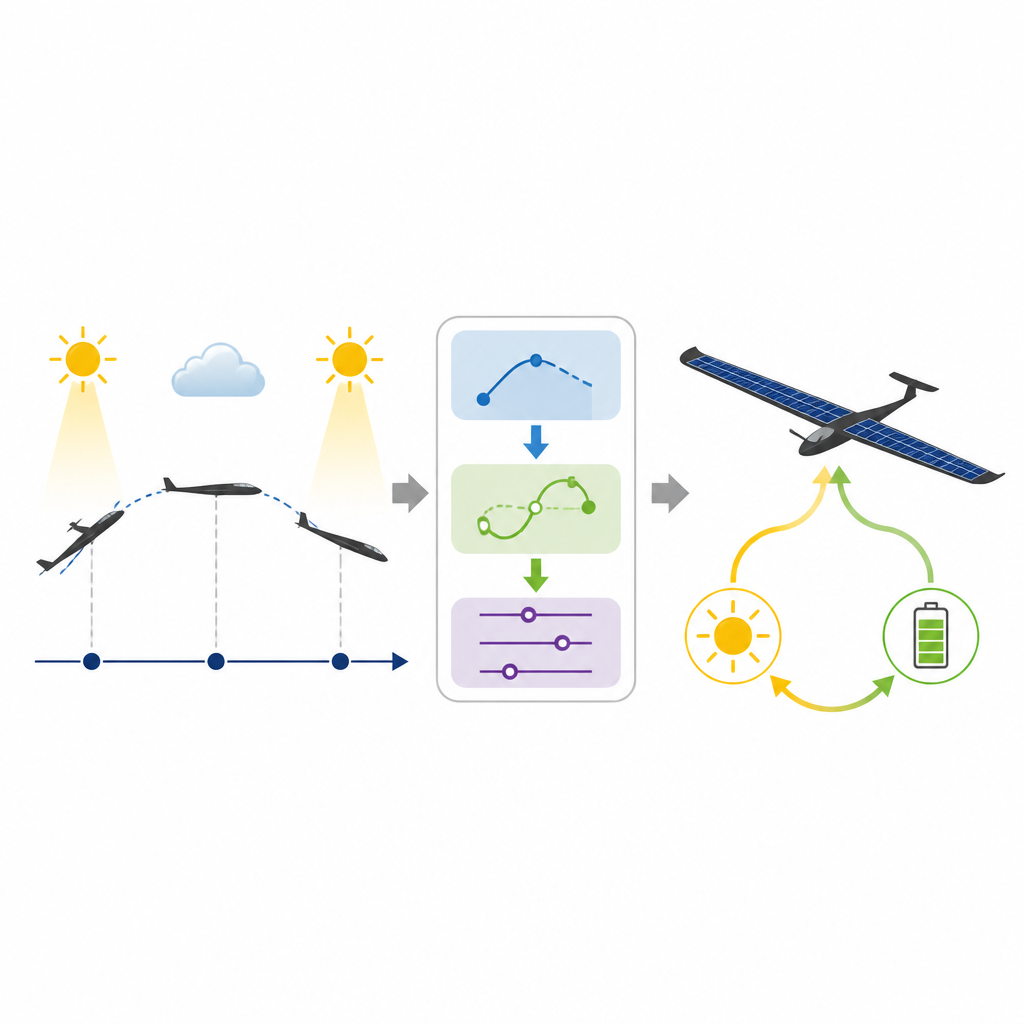
A key problem with current energy strategies is that they react to what is happening now rather than what will happen next. That can make a drone greedily drain its battery early in a mission and struggle later. To avoid this, the authors use a type of artificial neural network, called a generalized regression neural network, to predict the aircraft’s near future power needs from its recent electrical history. Instead of painstakingly coding every physical detail, this network learns patterns from real flight data, such as the typical power bumps during takeoff or the steady draw of cruising. In tests with tens of thousands of data points, this predictor estimates the battery voltage with errors of only a few percent, giving the controller an accurate short term forecast.
Planning the best use of the battery
Looking ahead is only half the story; the drone also needs a way to decide how to share the work between sun and battery. For this, the researchers adopt a planning method that searches across many possible choices and picks those that minimize battery use over a future window while keeping the aircraft safe. This planner favors using solar power whenever it is available, gently limits how hard the battery is pushed, and keeps the battery charge within a healthy range so there is enough reserve for landing. Because such global searching can be slow, they wrap it inside a rolling control scheme that repeatedly solves a shorter, easier planning problem, applies only the first decision, then updates the plan as new measurements and predictions arrive.
Keeping the battery honest in real time
Over long flights, tiny errors in measuring current or voltage can cause the estimated battery charge to drift away from reality, which is risky for an aircraft that must never unexpectedly run flat. The authors therefore weave several safety checks into their system. The neural network’s voltage prediction is continuously compared with sensor readings; when the gap exceeds a small threshold, the estimated charge is corrected. Additional checks compare calculated and measured battery power and gently steer the battery back toward a target level toward the end of each planning window. These layered safeguards keep the controller’s picture of the battery closely aligned with its true state.
What this means for future drone missions
When tested in simulations and flight experiments on a hybrid fixed wing–multirotor drone, the new strategy reduced battery power demand during climb and descent and kept the state of charge more stable than both a rule based method and a recent learning based approach. In practical terms, that means the battery is used more sparingly, solar energy does more of the work, and the aircraft can devote more of its limited weight to useful payload instead of oversized batteries. For readers, the takeaway is that combining fast prediction, thoughtful planning, and constant correction lets solar hybrid drones stretch their flight time and operate more reliably, a step toward routine long endurance missions at low altitude.
Citation: Kan, W., Chen, S., Lei, W. et al. GRNN–DP–MPC Co-optimization for predictive energy management in hybrid UAVs. Sci Rep 16, 15107 (2026). https://doi.org/10.1038/s41598-026-44118-y
Keywords: solar hybrid UAV, energy management, model predictive control, neural network prediction, lithium battery SOC