Clear Sky Science · en
Achieving precise chip control for high-end manufacturing
Why metal chips matter in modern factories
In highly automated factories, even something as humble as the curls of metal shaved from a part can shut down production. Long, stringy chips can tangle around tools, scratch carefully finished surfaces, and even damage sensors and spindles. This paper explores a new way to tame those troublesome chips using tiny grooves on the workpiece itself, promising safer, cleaner, and more efficient metal cutting for industries ranging from medical devices to aerospace.
A new way to make chips behave
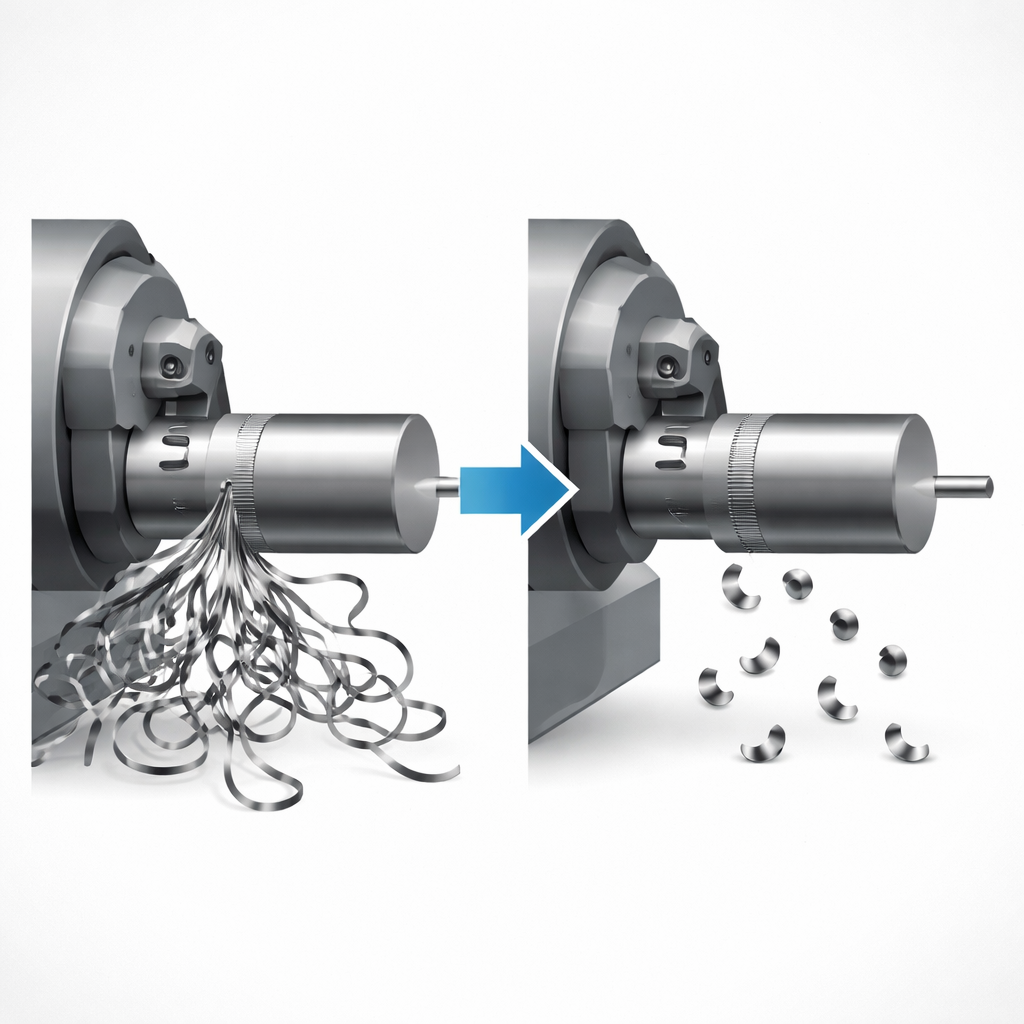
When a cutting tool turns a metal bar, it peels off a continuous ribbon of material called a chip. Ideally, that ribbon regularly snaps into short, curled pieces that are easy to remove. In practice, especially with tough alloys like stainless steel AISI 316L, chips often emerge as long, tangled strings. Existing solutions try to manage this by changing how the tool moves, how it is shaped, or how coolant is sprayed, but each option has drawbacks such as extra tool wear, higher energy use, or sensitivity to narrow process windows. The authors propose a fresh idea called grooves induced chip-breaking, or GICB: instead of focusing on the tool or the coolant, they subtly weaken the chip right at its birthplace on the workpiece surface.
Tiny grooves with a big job
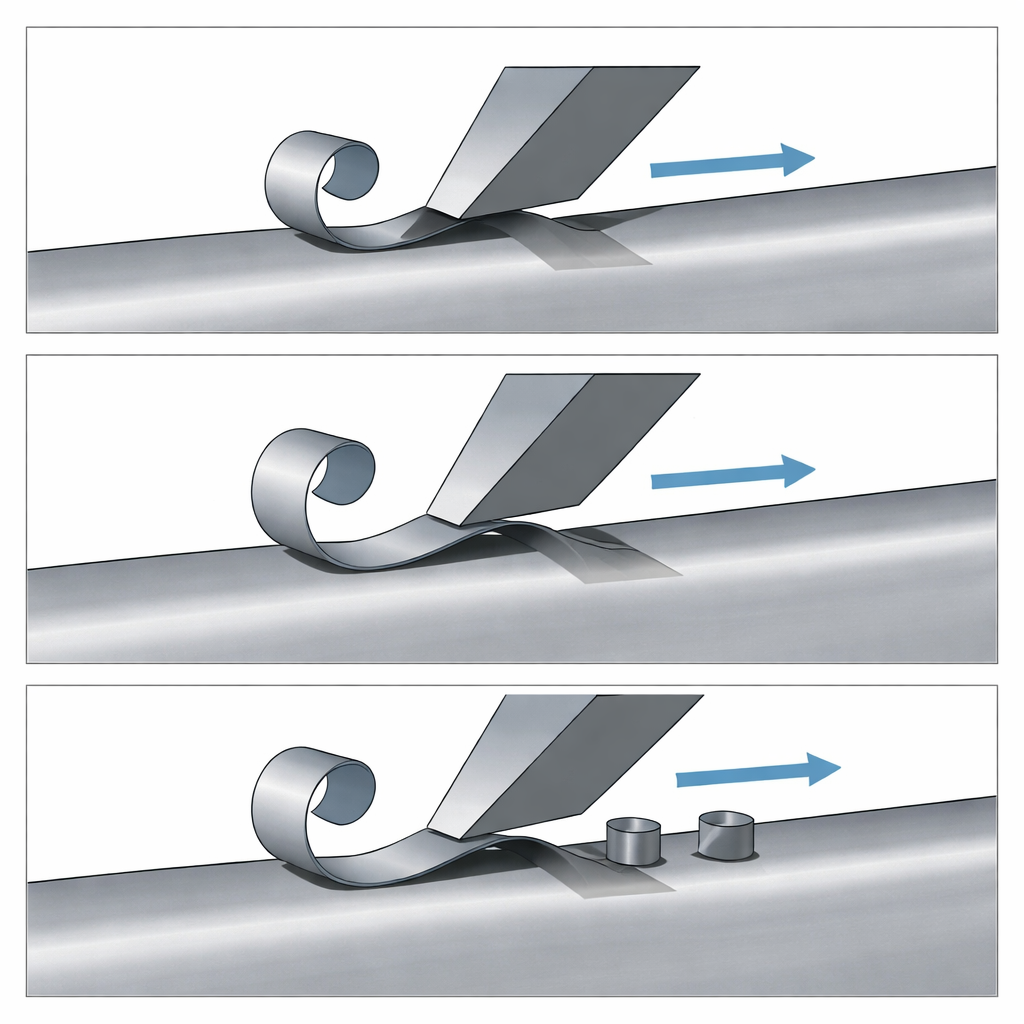
In the GICB approach, the researchers use a laser to carve microscopic grooves along the surface of a cylindrical stainless-steel workpiece before cutting begins. These pre-processed micro-grooves are only about 30 micrometers wide and 100 micrometers deep—far smaller than the thickness of the chip that will later be cut away. During turning on a computer-controlled lathe, the cutting tool periodically passes over these grooves as the workpiece spins. Each time this happens, the chip being peeled off encounters a local weakness right above the groove, making it easier to bend and break at a controlled location. By adjusting common cutting settings such as feed rate and depth of cut, the team could observe how well this groove-assisted breaking performed over a broad range of practical finishing conditions.
From snarled ribbons to neat curls
Comparing traditional cuts with GICB cuts under the same conditions, the difference in chip shape was striking. Without grooves, chips tended to be long, distorted, and prone to knotting and entangling. With grooves in place, the chips formed into short segments with remarkably similar length and curvature, indicating that they were breaking in a regular, almost clocklike pattern as the tool crossed each groove. This periodic breaking did not significantly increase the forces acting on the tool, even though the chip was being interrupted many times. In specially designed tests with multiple grooves around the workpiece, the overall cutting-force signal actually became smoother, revealing that the chaotic behavior of uncontrolled chips had been suppressed.
Smoother parts and steadier cutting
The benefits extended beyond chip shape. The researchers measured the roughness of the machined surfaces and found that the grooved sections consistently came out smoother than the ungrooved ones, with surface roughness reduced by up to about 27 percent in some finishing conditions. Because the grooves were shallower than the removed layer, they did not leave visible marks on the final surface. Instead, they quietly did their work out of sight: by breaking chips before they could whip around and collide with the freshly cut area, and by reducing fluctuations in the sideways force that tends to mar the surface. Frequency analysis of the cutting forces confirmed that the random, high-frequency components associated with unstable chip behavior dropped dramatically when GICB was used.
What this means for future manufacturing
For non-specialists, the key outcome is that a very small, inexpensive modification to the workpiece—laser-etched micro-grooves—can transform how chips form and break during cutting. The study shows that these grooves can reliably turn troublesome continuous chips into orderly segments, while at the same time improving surface finish and stabilizing the cutting process. This suggests a practical path toward quieter, safer, and more predictable machining in high-end manufacturing, particularly in the crucial finishing stages where part quality is paramount.
Citation: Kang, Z., Guo, Q., Li, Z. et al. Achieving precise chip control for high-end manufacturing. Sci Rep 16, 13223 (2026). https://doi.org/10.1038/s41598-026-43995-7
Keywords: chip control, metal machining, surface finish, laser micro-grooves, manufacturing automation