Clear Sky Science · en
Modulation of interbrain synchrony by emotional valence and maternal presence in mother–child dyads: neural links to empathy and attachment
Why Shared Feelings Between Parents and Kids Matter
Parents often say they can “feel” what their children are going through. This study asks whether that sense of connection shows up in the brain, and how it changes with different emotions. Using a brain-imaging method that works while two people are together, researchers examined how mothers and pre-teens synchronize mentally when they imagine good, bad, or neutral events in the child’s life—and whether simply imagining the mother’s presence can change both feelings and brain alignment.
Thinking Together Without Saying a Word
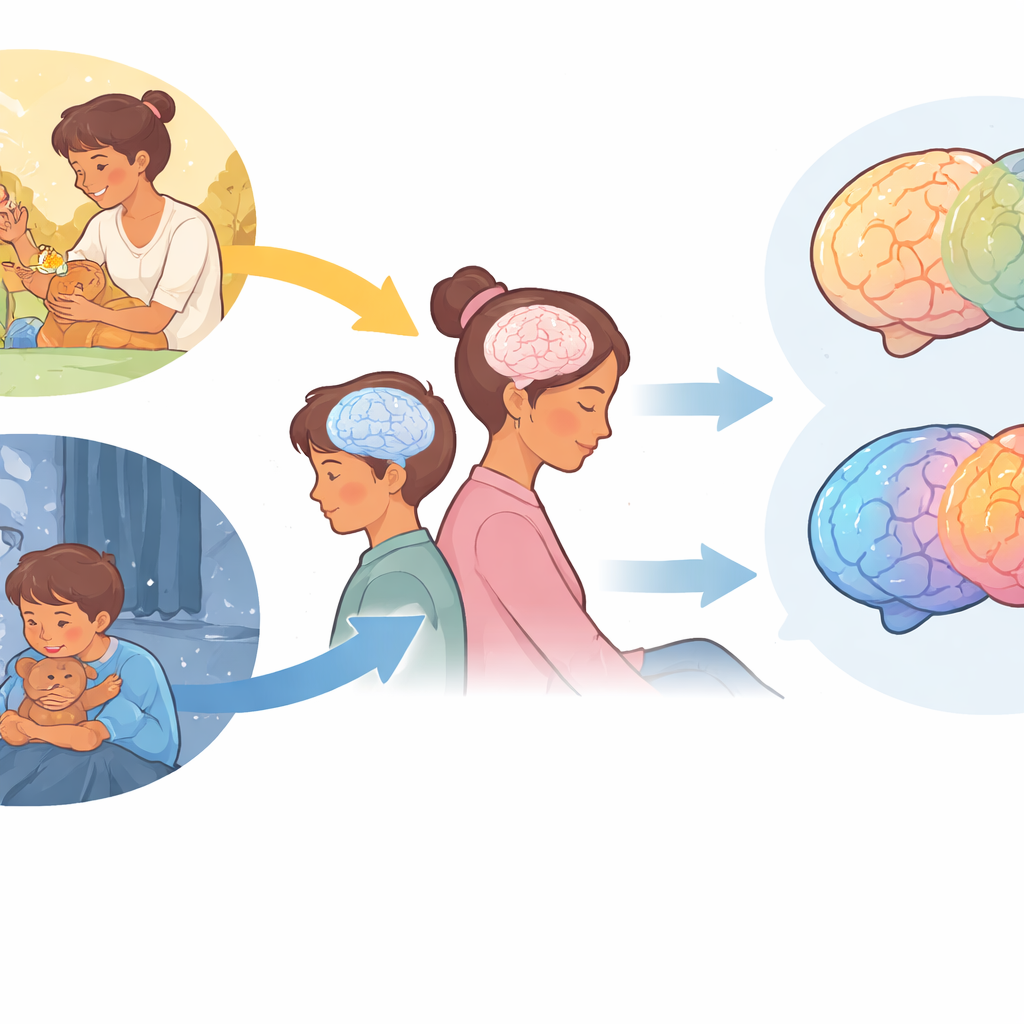
The research focused on 38 mother–child pairs with children aged 10 to 14. Each pair sat in the same room but back-to-back so they could not see each other. On separate computer screens, they viewed simple drawings of everyday situations involving the child—such as winning a game, being in the hospital, or neutral scenes. For each scene, they were asked to imagine how they would feel either if they were together (the mother present as a support figure) or apart (the child going through the event without the mother there). After each 12-second imagination period, they rated how positive or negative the situation felt using a visual scale.
Measuring Brains in Sync
While mothers and children imagined these scenes, the team recorded their brain activity at the same time using functional near-infrared spectroscopy (fNIRS). This technique tracks changes in blood oxygen in specific brain regions near the surface, allowing researchers to see when two brains show similar patterns over time—a phenomenon called interbrain synchrony. The study focused on the right side of the front of the brain, including areas involved in attention, emotion control, and understanding others’ thoughts and feelings. The researchers then used mathematical tools to estimate how closely each mother’s and child’s brain signals rose and fell together during each type of imagined situation.
Feeling Better Together—But More Alike in Tough Times
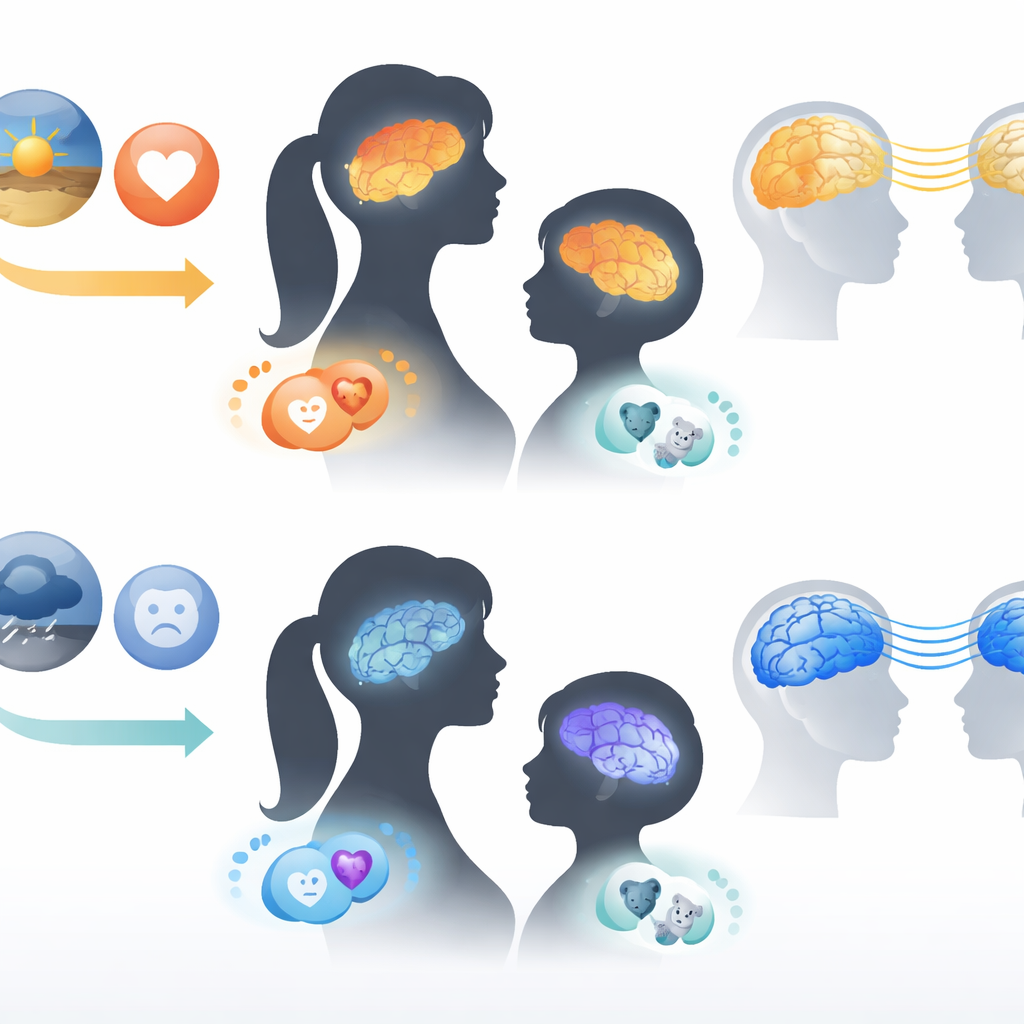
Both mothers and children felt better when they imagined facing events together rather than apart. Positive moments were rated as even more positive, and negative moments felt less bad when they imagined the mother being there. Yet the brain story was more nuanced. Differences in brain synchrony between positive and negative scenes only appeared when the pair imagined being together. In those “with each other” situations, mother–child brain synchrony was higher for negative scenes than for positive ones. Moreover, when mother and child agreed more closely on how bad a negative scene felt, their brains tended to be more in sync. On average, scenes the pair experienced as more positive were linked to slightly lower synchrony.
How Empathy and Attachment Shape the Connection
The team also measured mothers’ empathy traits and children’s sense of security in their relationship with their mother. A key finding was tied to a form of empathy called personal distress—how overwhelmed a person feels by others’ suffering. In pairs where mothers scored high on personal distress, brain synchrony was lower in positive scenes but higher in negative ones, suggesting that highly distressed mothers may tune in most strongly when imagining their child’s pain. Children’s reports of their mother as a reliable “secure base” also mattered. Surprisingly, lower feelings of security were linked to higher brain synchrony in a front region involved in monitoring one’s own and others’ feelings, hinting that some heightened alignment may act as a compensatory effort when the relationship feels less safe.
What This Means for Families
For families, these results suggest that simply imagining being together can soften emotional experiences for both children and mothers, even without speaking or touching. At the same time, the brain alignment that underlies this closeness is not always highest in happy moments; it can be strongest in shared negative situations—especially when mothers are easily distressed and children feel less secure. This implies that more synchrony is not automatically better: in some cases, it may reflect shared strain rather than smooth support. Understanding when and how parents’ and children’s brains “tune in” to each other could eventually inform approaches that help caregivers regulate their own emotions, so they can stay present and supportive when children need them most.
Citation: Rodrigues, I., Pereira, J., Costa, D. et al. Modulation of interbrain synchrony by emotional valence and maternal presence in mother–child dyads: neural links to empathy and attachment. Sci Rep 16, 13692 (2026). https://doi.org/10.1038/s41598-026-43086-7
Keywords: parent–child bonding, empathy, brain synchrony, adolescent emotion, social neuroscience