Clear Sky Science · en
The influence of diet-mediated exposure of avian influenza on adult survival, recruitment and territory occupancy in peregrine falcons
Why what falcons eat matters now
Highly contagious bird flu has swept across the globe, killing millions of wild and domestic birds. Among the species at risk is the peregrine falcon, the world’s fastest bird. This study asks a deceptively simple question with big implications for conservation: does what peregrines eat—especially virus-carrying waterbirds—change their chances of survival and the health of their breeding populations along the U.S. mid-Atlantic coast?
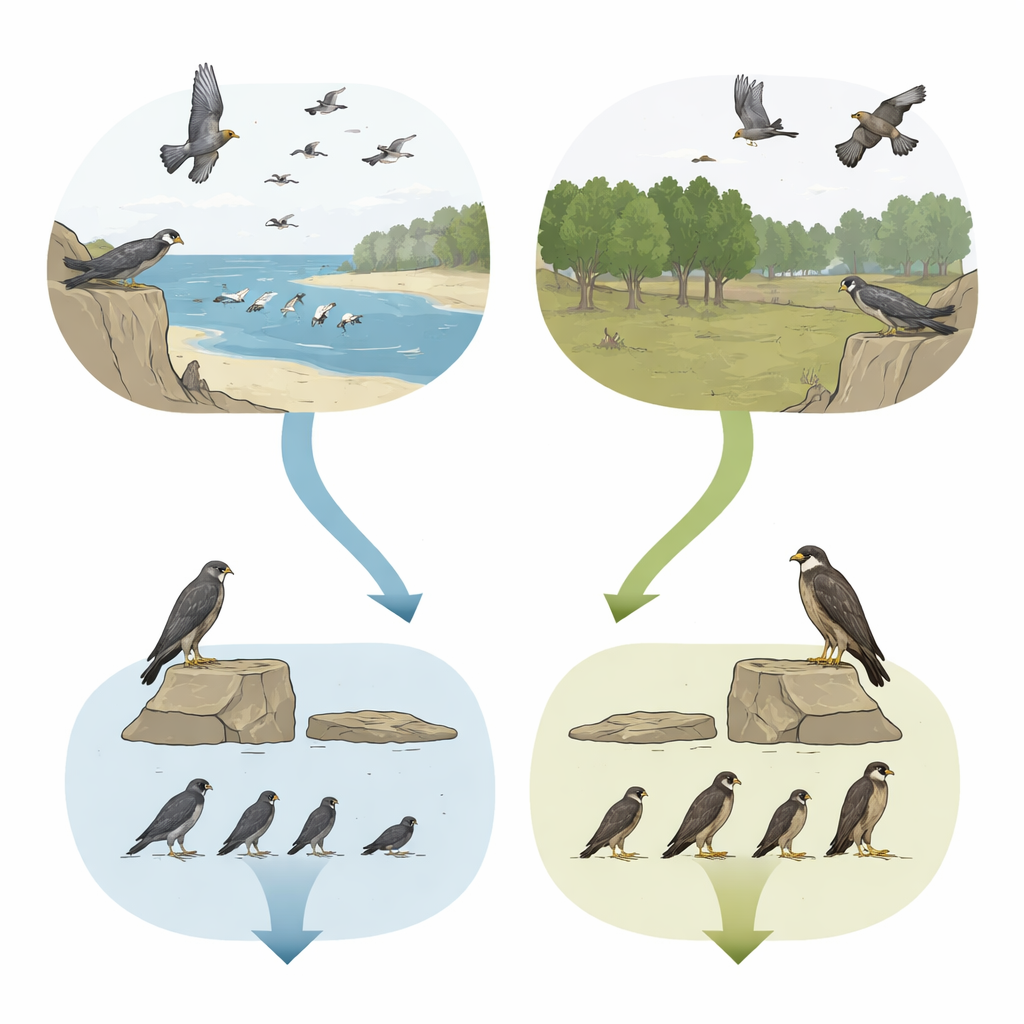
Two neighborhoods for the same top predator
Researchers focused on peregrine falcons breeding in New Jersey and Virginia between 2016 and 2025. They divided the birds into two “neighborhoods.” Coastal falcons nested near huge seasonal gatherings of shorebirds and other waterbirds, which are known reservoirs for avian influenza. Inland falcons lived farther from these staging areas and fed mostly on songbirds and other land birds. By tracking 205 individually banded adults across 79 breeding territories, the team could see how falcons in these contrasting settings fared over time as highly pathogenic avian influenza (HPAI) arrived and spread along the Atlantic Flyway.
Following falcons through time
Each breeding season, the team checked whether territories were occupied, identified which banded adults were present, and noted the age and plumage of newcomers that replaced missing birds. Because peregrines are highly faithful to their nest sites, an adult that disappeared and did not turn up elsewhere was assumed to have died. Statistical models were then used to estimate yearly adult survival, how often new birds entered the breeding population, and how likely territories were to remain occupied, all while comparing coastal and inland regions and tracking changes before and after HPAI reached the area in 2021–2022.
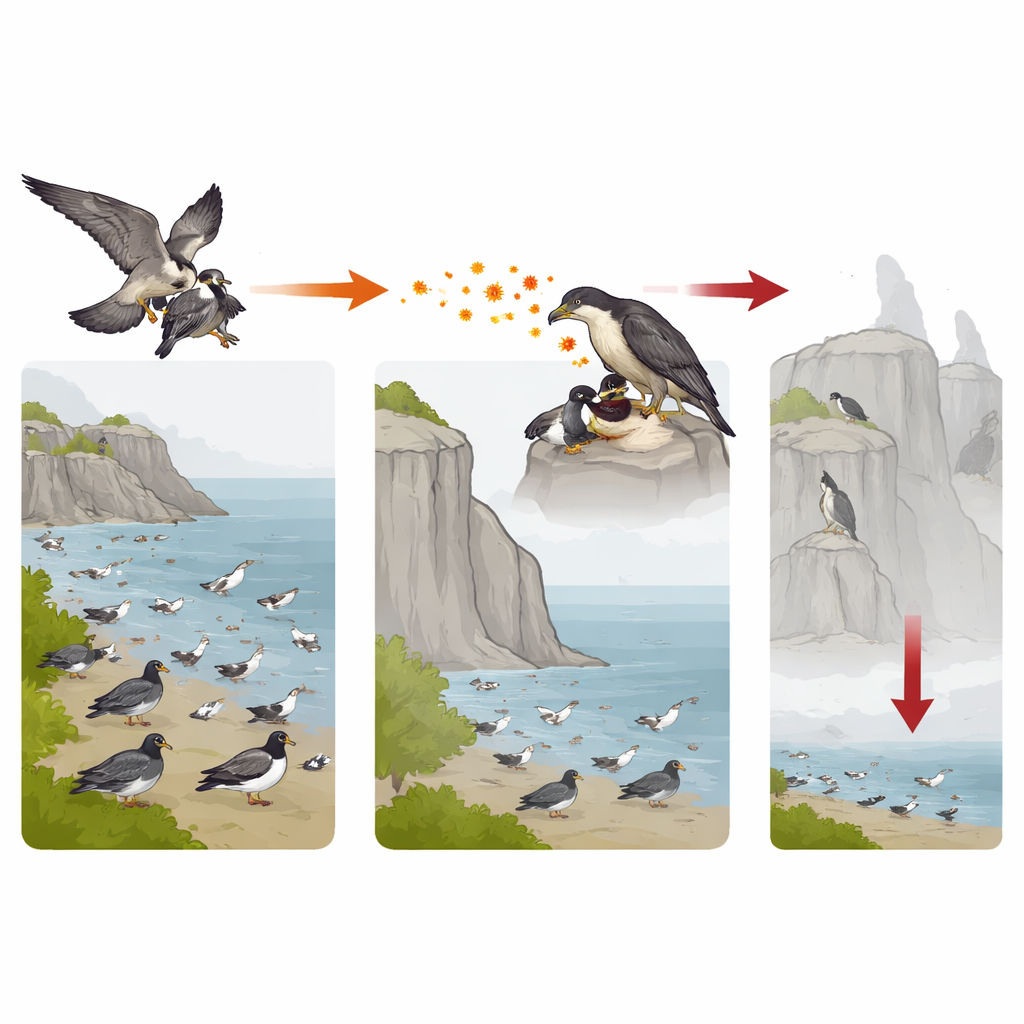
A sharp coastal crash after the virus arrives
Before bird flu appeared, adult survival was high and similar in both regions, and most breeding territories stayed occupied year after year. That picture changed abruptly for coastal birds once HPAI reached the Atlantic Coast. Coastal adult survival plunged from about eight in ten adults surviving each year in 2022 to roughly four in ten in 2023 and only one in four in 2024. By 2025, more than three-quarters of coastal adults present in 2022 were gone. Territory occupancy followed suit: after several stable years, the fraction of occupied coastal territories dropped by more than half between 2024 and 2025, while inland territories remained largely steady.
Young birds stepping in—and what that signals
When adults vanished from territories, new birds moved in. Most recruits in both regions were young adults between two and five years old, but a striking shift occurred after 2022. Juvenile-plumaged birds—essentially teenagers just finishing their first year—suddenly made up about one-fifth of new breeders, compared with only a few percent beforehand. This suggests that the usual “waiting list” of mature, nonbreeding peregrines that typically fills vacancies had been drained, forcing much younger birds into breeding roles. The pattern was strongest on the coast, where diets rely heavily on shorebirds and other waterbirds that frequently carry HPAI.
What this means for falcons and beyond
The study paints a clear picture: coastal peregrine falcons, which feed on virus-prone waterbirds, suffered steep drops in survival and territory occupancy that closely track the arrival of highly pathogenic bird flu, while inland birds on safer diets did not. For a long‑lived species that depends on high adult survival, such sustained losses can reverse decades of slow population recovery and may take many years to repair. The findings highlight how a global disease can ripple through food webs, turning prey into a hidden hazard for top predators, and underscore the need to factor diet and local exposure risk into wildlife management as emerging diseases reshape ecosystems.
Citation: Watts, B.D., Clark, K.E. & Hines, C. The influence of diet-mediated exposure of avian influenza on adult survival, recruitment and territory occupancy in peregrine falcons. Sci Rep 16, 12821 (2026). https://doi.org/10.1038/s41598-026-42721-7
Keywords: peregrine falcon, avian influenza, waterbirds, raptor conservation, wildlife disease