Clear Sky Science · en
Efficacy and safety of a novel ClearHemograsper for gastric endoscopic submucosal dissection: A prospective randomized controlled trial
Stopping Bleeding Safely Inside the Stomach
For many people in countries like South Korea, stomach cancer screening has become part of routine health care, allowing doctors to find tiny growths in the stomach before they turn deadly. These growths are often removed through a minimally invasive procedure done with a flexible camera from the mouth, sparing patients open surgery. But whenever doctors cut inside the stomach, bleeding is a serious concern. This study tests a new tool designed to quickly and safely stop such bleeding, asking whether a homegrown Korean device can match an already established imported one.
A New Tool for a Common Cancer
Gastric cancer remains one of the most common and deadly cancers in South Korea, but national screening has boosted early detection, making endoscopic submucosal dissection (ESD) a standard treatment. In ESD, a doctor uses an endoscope to slice out early tumors from the stomach wall. Bleeding is frequent during this delicate work, and while small vessels can often be sealed with the cutting knife itself, larger or pulsing vessels demand special forceps that grab and burn the vessel to stop blood flow. In Korea, a Japanese-made device called Coagrasper has dominated this role. To reduce reliance on imports and encourage domestic innovation, a Korean company developed a new hemostatic forceps called ClearHemograsper. 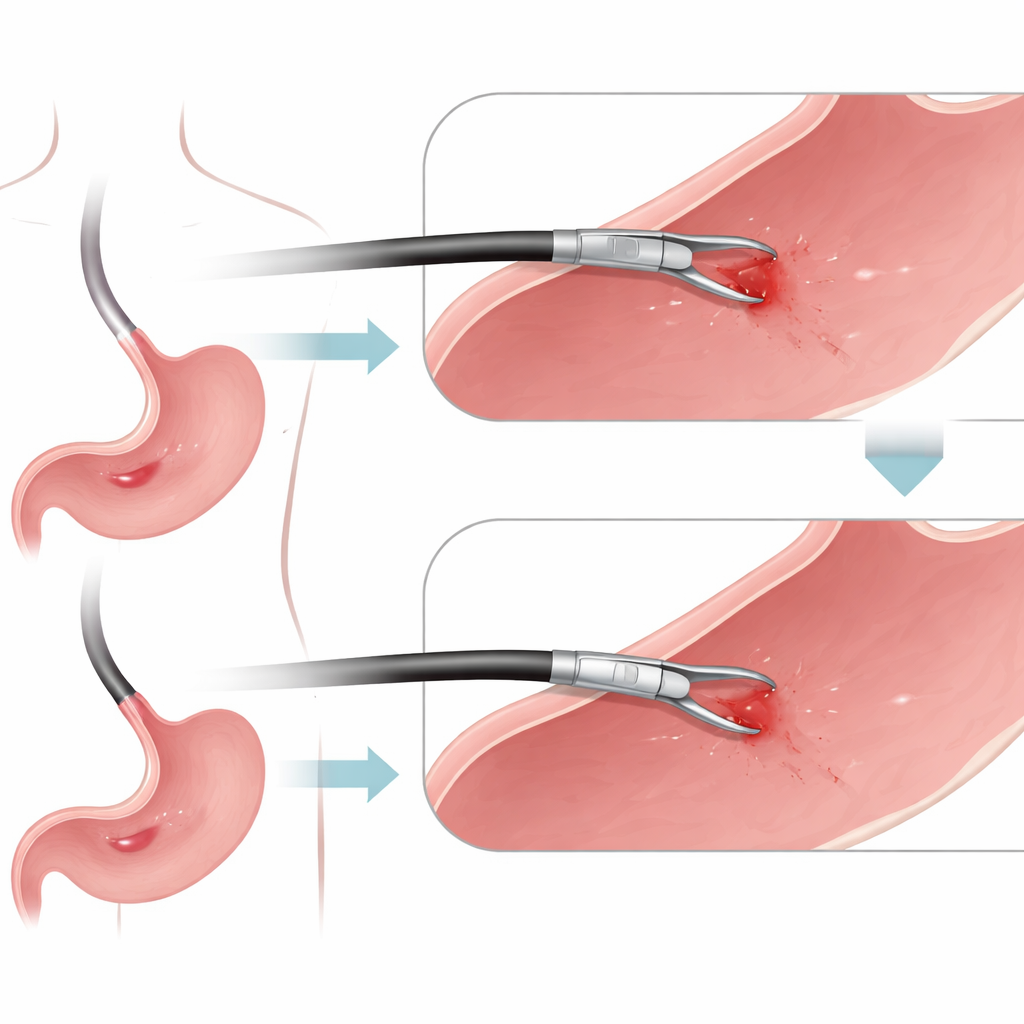
How the Study Was Set Up
The researchers ran a prospective, randomized controlled trial at a large referral hospital in Seoul. Adults aged 20 to 75 who were scheduled for ESD to remove early gastric cancers or precancerous lesions were invited to join. Patients with serious blood disorders, advanced cancer spread, or major organ failure were excluded to keep the group relatively uniform and safe. After providing consent, 157 patients were randomly assigned to have bleeding managed either with the new ClearHemograsper or with the standard Coagrasper during their ESD. The patients did not know which device was used, although the endoscopists did. Doctors timed the entire procedure, carefully measured how long it took to control all bleeding, and tracked how often bleeding returned in the hours and weeks after treatment.
What the Doctors Found
The two groups of patients were similar in age, lifestyle habits such as smoking and drinking, and most medical conditions, although heart disease was slightly more common in the ClearHemograsper group. Tumor size, location in the stomach, and initial biopsy results also looked much the same between the groups. During ESD, both devices performed impressively: in every case, the tumor was removed in one piece, an important indicator that doctors were able to cut along the correct layer without losing their view to blood. The average total procedure time was almost identical between groups, and the time specifically spent stopping bleeding differed only by a few seconds, a gap too small to be meaningful. Pathology results after removal also showed similar rates of complete and curative resection between the two devices. 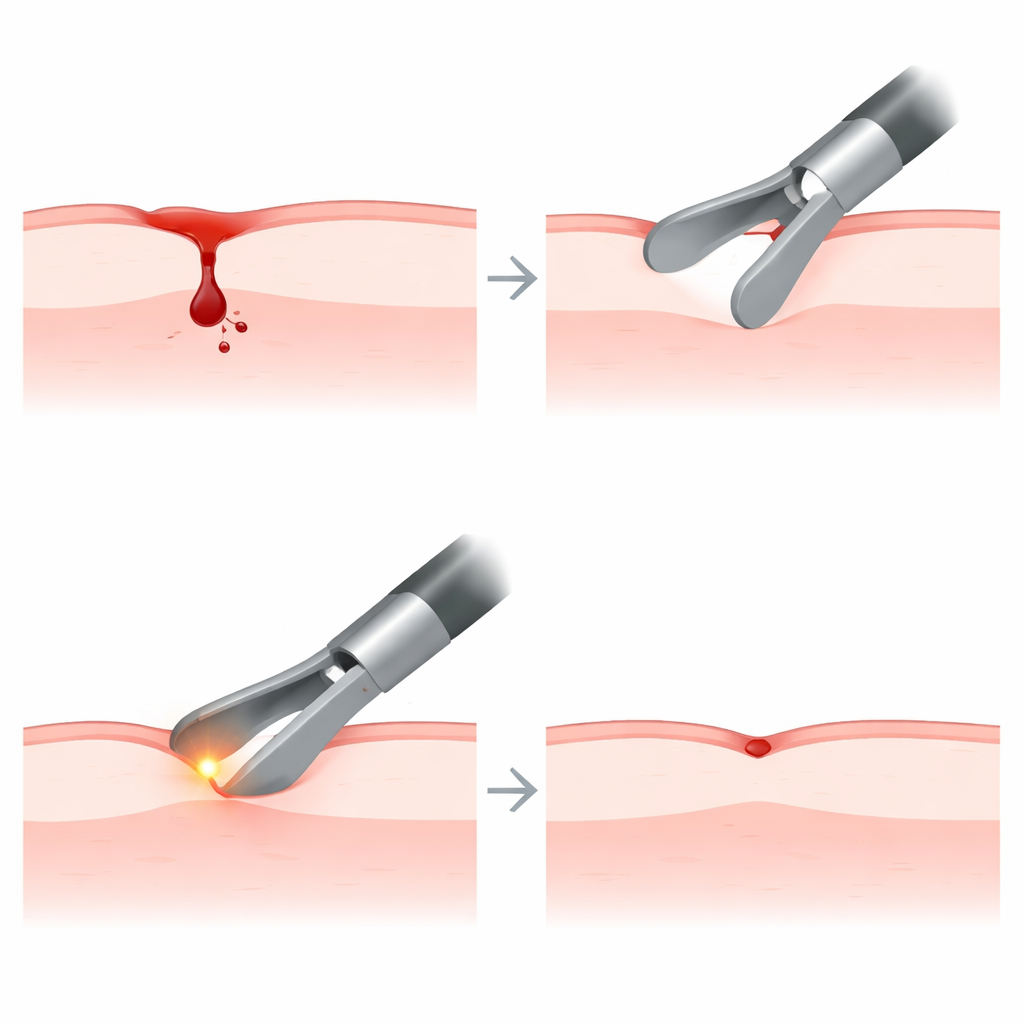
Bleeding Risks and Patient Safety
Because bleeding is the most feared complication of ESD, the team closely watched patients after their procedures. Everyone stayed in the hospital for monitoring, had a second endoscopy within 48 hours, and was followed for up to a month. Early bleeding—small oozes seen on that second look—appeared a bit more often in the ClearHemograsper group than in the Coagrasper group, but this difference was not statistically significant and may be linked to the higher rate of heart disease in those patients, which often goes hand-in-hand with blood-thinning medications. Delayed bleeding, which can be more dangerous, was rare in both groups and did not occur at all among ClearHemograsper users. Importantly, every bleeding episode in both groups was handled endoscopically, without any need for emergency surgery or blood vessel embolization.
What This Means for Patients and Health Systems
Overall, the new ClearHemograsper appeared to work just as well and as safely as the long-standing Coagrasper for controlling bleeding during stomach tumor removal. Because the study enrolled fewer patients than originally planned, the authors stress that their results are preliminary rather than final proof. Still, the findings support the idea that domestically produced devices can match imported ones in quality and performance. For patients, this could translate into more secure access to essential tools, potential cost savings, and continued refinement of techniques that make early stomach cancer treatment both less invasive and safer. Larger, multi-hospital studies with longer follow-up will be needed to confirm these encouraging early results.
Citation: Noh, J., Kim, D., Na, H. et al. Efficacy and safety of a novel ClearHemograsper for gastric endoscopic submucosal dissection: A prospective randomized controlled trial. Sci Rep 16, 13044 (2026). https://doi.org/10.1038/s41598-026-41778-8
Keywords: gastric cancer, endoscopic submucosal dissection, hemostatic forceps, gastrointestinal bleeding, medical devices