Clear Sky Science · en
Clinical efficacy of high versus low intensity diode laser as an adjunct to non-surgical periodontal therapy in periodontitis: randomized controlled clinical trial
Why this matters for everyday dental health
Gum disease is one of the leading causes of tooth loss in adults, yet treatment often relies on a simple deep cleaning of the teeth and roots. This study asks a practical question that many patients and dentists care about: can adding laser light to standard treatment help gums heal better, especially around deep, hard-to-clean pockets? By comparing two different laser strengths, the research offers clues about which approach may give patients the best short‑term boost in healing.
The problem with stubborn gum infections
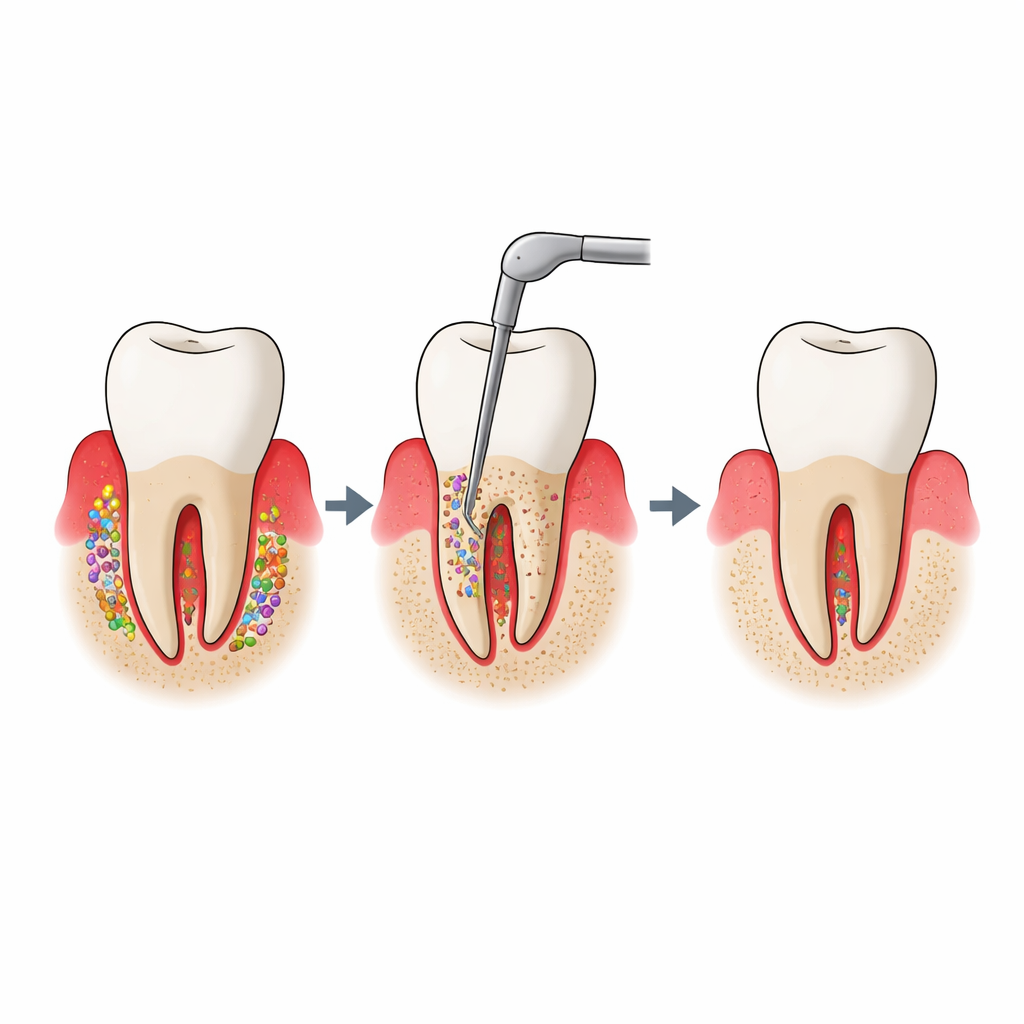
Periodontitis is a long‑lasting infection of the tissues that hold teeth in place. Bacteria build up in sticky biofilms below the gum line, triggering inflammation that slowly erodes the ligament and bone supporting each tooth. The usual nonsurgical treatment, called scaling and root planing, involves scraping away plaque and tartar from the tooth surfaces. This treatment works well in many cases, but it can struggle in deep pockets and complex root shapes, where bacteria hide and tissue damage is already advanced. As a result, some patients see only limited healing or need repeated procedures.
Using light as a helper in gum treatment
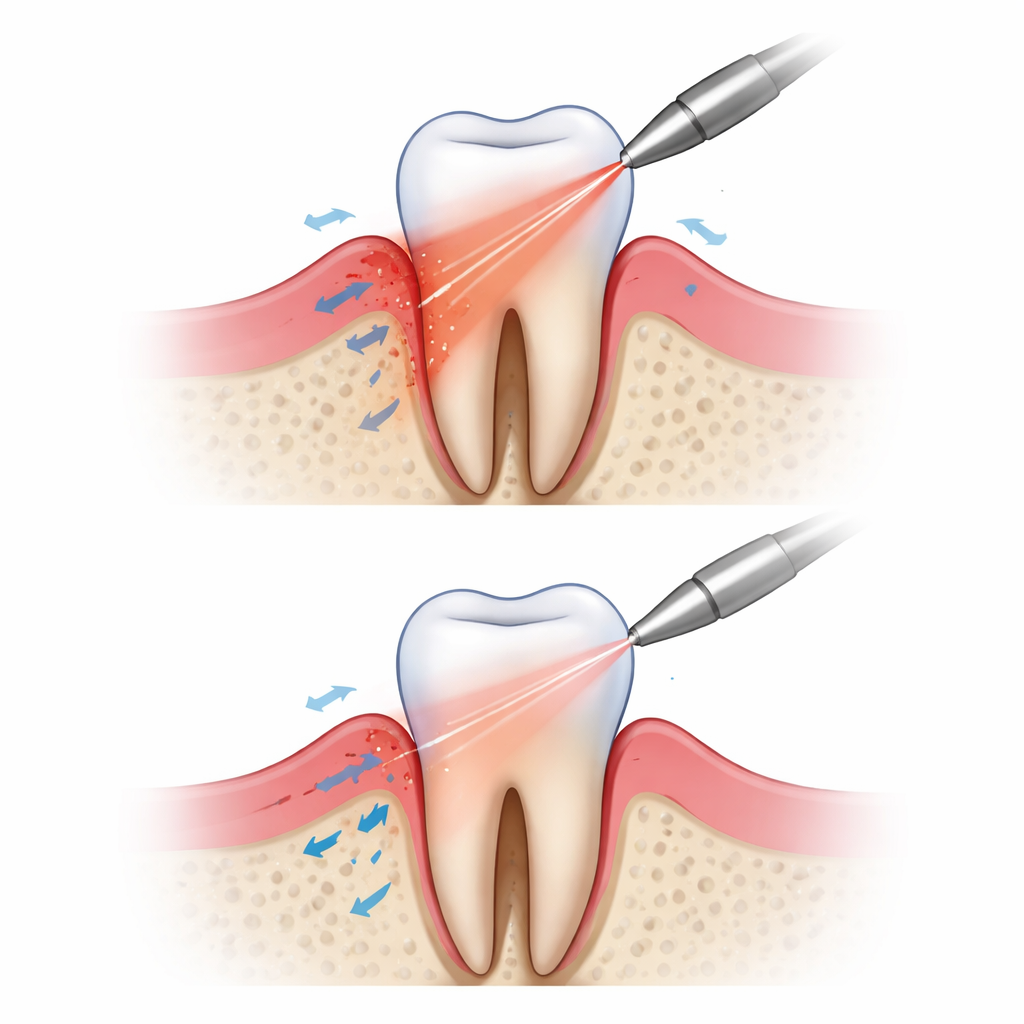
Diode lasers are small dental lasers that emit light in the near‑infrared range. Dentists can use them in two main ways. At higher power, the laser generates heat that helps remove diseased lining inside the pocket and kills bacteria. At lower power, the light is gentler and is thought to encourage cell repair, new blood vessel growth, and collagen formation without significant heating. Earlier studies suggested both approaches might improve gum health when combined with deep cleaning, but differences in devices and techniques made it hard to know which settings truly work best.
How the study was set up
The researchers enrolled 27 adults with generalized periodontitis, each with multiple deep pockets around their teeth. Within each patient, three separate sites were randomly assigned to one of three treatments: standard deep cleaning alone, deep cleaning plus high‑intensity diode laser, or deep cleaning plus low‑intensity diode laser. This "within‑patient" design meant each person served as their own comparison, reducing the impact of differences in general health or oral hygiene. The team measured four familiar clinical signs—plaque buildup, gum redness and swelling, pocket depth, and how firmly the tooth is attached—before treatment, then one month and three months later.
What the researchers found
All three treatments improved gum health over three months. Plaque levels dropped, gums became less inflamed, pockets became shallower, and tooth attachment improved. However, adding the high‑intensity laser produced the most noticeable gains, especially in how firmly the tooth reattached to the surrounding tissue. Sites treated with the stronger laser showed greater short‑term attachment gains than those receiving cleaning alone or cleaning with the low‑intensity laser, and this edge persisted at three months. The low‑intensity laser sites did better than cleaning alone but provided only modest extra benefit. Importantly, no burns, ulcers, or other laser‑related harms were reported.
What this means for patients and dentists
For people facing treatment for moderate to advanced gum disease, the study suggests that adding a carefully controlled high‑intensity diode laser to standard deep cleaning can offer a short‑term boost in healing, particularly by helping the tooth reattach more firmly and calming inflammation. Lower‑intensity laser use appears to provide gentler, supportive benefits but is less powerful on its own. The authors caution that the improvements, while measurable, are modest and were tracked for only three months. Longer studies in larger groups are needed to see whether the gains last and to clarify how best to use lasers in everyday dental practice. Still, the findings point toward high‑intensity diode laser therapy as a promising assistant, rather than a replacement, for the deep cleaning that remains the foundation of gum disease care.
Citation: Al-Sharani, A.A., Al-Hajj, W.A. & Madfa, A.A. Clinical efficacy of high versus low intensity diode laser as an adjunct to non-surgical periodontal therapy in periodontitis: randomized controlled clinical trial. Sci Rep 16, 10100 (2026). https://doi.org/10.1038/s41598-026-40879-8
Keywords: gum disease treatment, diode laser therapy, scaling and root planing, periodontal healing, nonsurgical dentistry