Clear Sky Science · en
The overlooked threat of democratic neutrality in the USA
Why sitting out can still change the game
Many Americans care deeply about the future of their democracy, yet elections keep elevating leaders who question or bend basic rules of the system. This article argues that the problem is not just those who openly cheer for such rule-breaking, but also the large share of citizens who shrug, feel uncertain or choose not to take a side when asked about attacks on democratic norms. Their neutrality, the authors contend, quietly opens the door for politicians who are willing to undermine democracy.
The danger of neither yes nor no
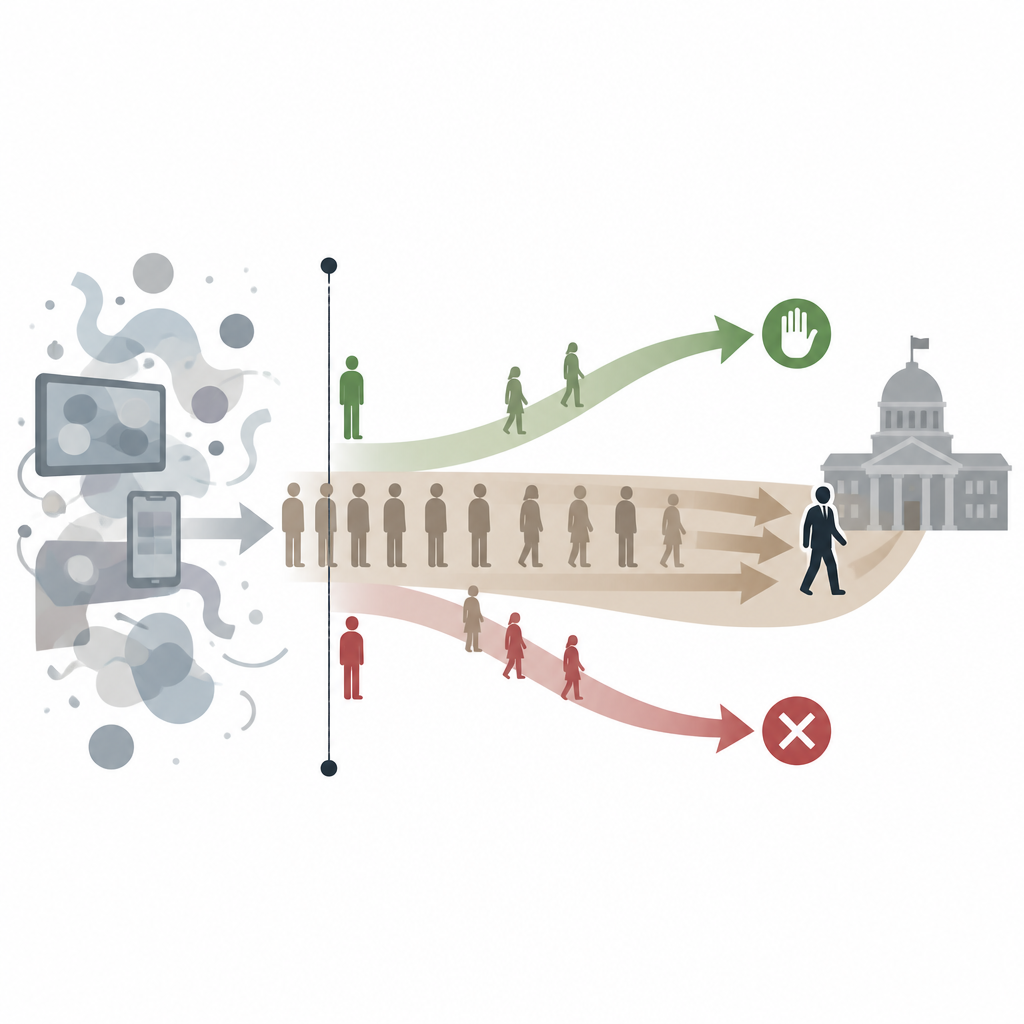
The researchers focus on what they call democratic neutrality: people who, when asked about actions that clearly cut against democratic rules, select survey options like “neither agree nor disagree.” These actions include things such as reducing polling places in rival party areas, ignoring court rulings by judges from the other party, or punishing unfriendly media. Earlier studies often lumped neutral respondents together with those who disagreed with such actions, treating both as if they were firmly pro-democracy. By separating neutrals from opponents, the authors show that this middle group is both sizable and politically important.
How common quiet neutrality really is
Using three large surveys of more than 48,000 adults in the United States, the team measured how often people supported, opposed or stayed neutral toward several undemocratic practices. As expected, only a minority openly supported these actions. But neutrality was more common than support: roughly half of Americans chose the middle option at least once, and about a quarter did so on multiple questions. When support and neutrality are combined, as many as two thirds of respondents either tolerated or endorsed at least one clear break with democratic norms. This pattern holds across multiple independent samples.
What neutrality means beneath the surface
Neutral answers could be dismissed as lazy button-clicking, so the authors probed their meaning in more detail. In one survey, they tracked whether people failed attention checks and found that inattention did not explain neutral responses. They then asked hundreds of neutral respondents to explain why they chose the midpoint. People cited a mix of reasons: feeling unsure or poorly informed, not wanting to get involved, seeing good and bad sides at once, believing “it depends” on the situation, or wanting to avoid looking like they hold unpopular views. Follow-up questions and statistical tests showed that neutrality was linked to lower education and news use, lower political participation, mixed feelings about the other party, low trust in the political system and a tendency to quietly hold anti-democratic values while avoiding saying so outright.
Different from clearly standing up for democracy
To see whether neutrality and active opposition to undemocratic practices were truly distinct, the researchers compared how each related to a wide range of political traits. People who opposed undemocratic actions tended to be better informed, more engaged, more trusting of institutions and less drawn to anti-democratic ideas. Those who were neutral showed the opposite pattern. Across every measure examined, neutrality and opposition pointed in different directions. This means that treating neutrals as if they were defenders of democracy paints a much rosier picture of public attitudes than the data justify.
When neutrality meets the voting booth
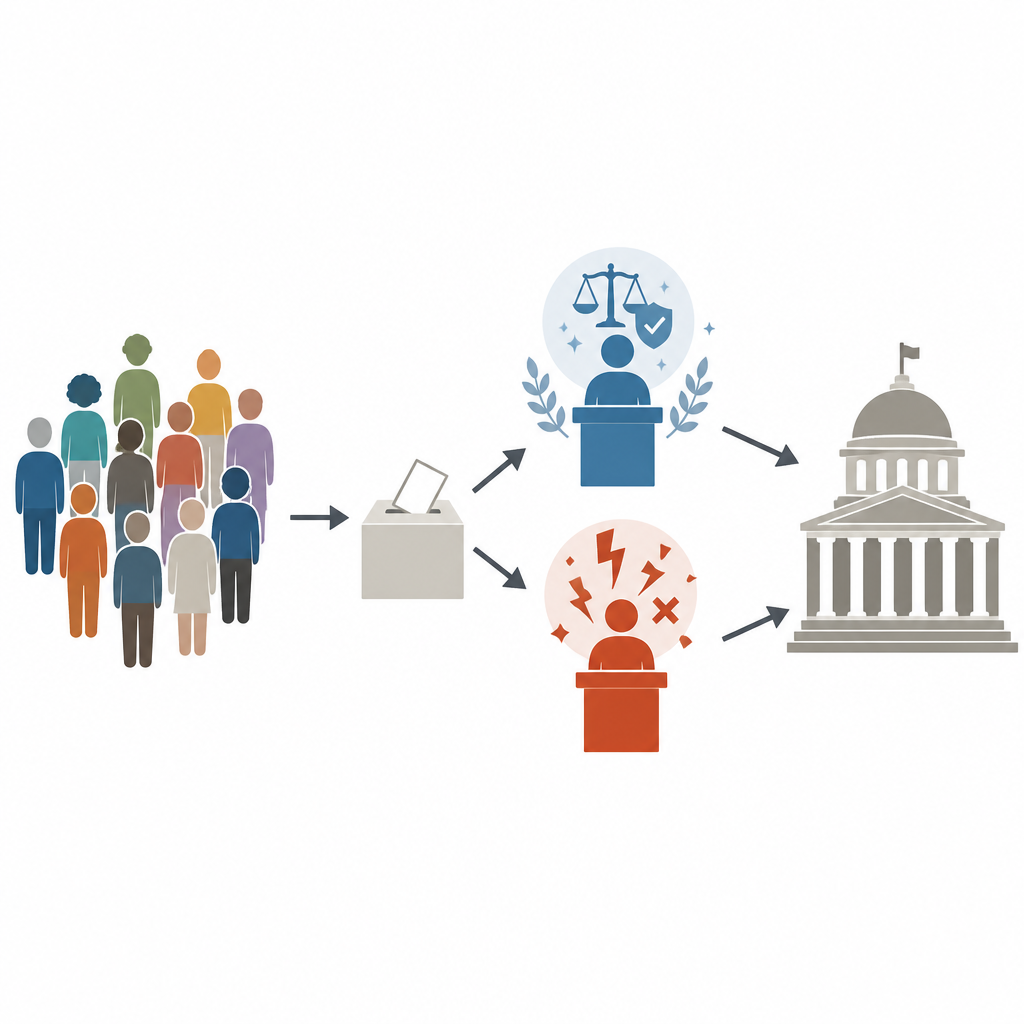
The most striking evidence came from an election-style experiment. Survey participants were shown pairs of hypothetical candidates whose traits, including their stance on democratic rules, were randomly varied. On average, people preferred candidates who respected democratic norms over those who were willing to violate them. But this changed once the researchers looked separately at three groups: supporters of undemocratic practices, opponents and neutrals. Both supporters and neutrals were far less likely to punish a candidate for taking an anti-democratic stance. In fact, neutrals behaved almost identically to open supporters: a candidate’s willingness to cut corners on democracy barely hurt that candidate’s appeal among either group.
What this means for everyday citizens
In plain terms, the study concludes that democracy in the United States is not mainly threatened by a small band of loud opponents of democratic rules, but by the much larger crowd of people who are willing to look the other way. Neutrality toward actions that chip away at fair elections, free media and independent courts allows politicians to stretch or break the rules without paying a price at the ballot box. For those who want to protect democracy, the authors suggest that reducing this neutrality—by improving political knowledge, addressing distrust and helping citizens see what is at stake—may be as important as confronting the more visible enemies of democratic norms.
Citation: Hall, M.E.K., Leigh, B.T. & Solomon, B.C. The overlooked threat of democratic neutrality in the USA. Nat Hum Behav 10, 896–905 (2026). https://doi.org/10.1038/s41562-026-02430-7
Keywords: democratic neutrality, public opinion, American democracy, political attitudes, undemocratic practices