Clear Sky Science · en
Changing drivers of the Great Atlantic Sargassum Belt from physical forcing to ecological control
Why seaweed suddenly matters
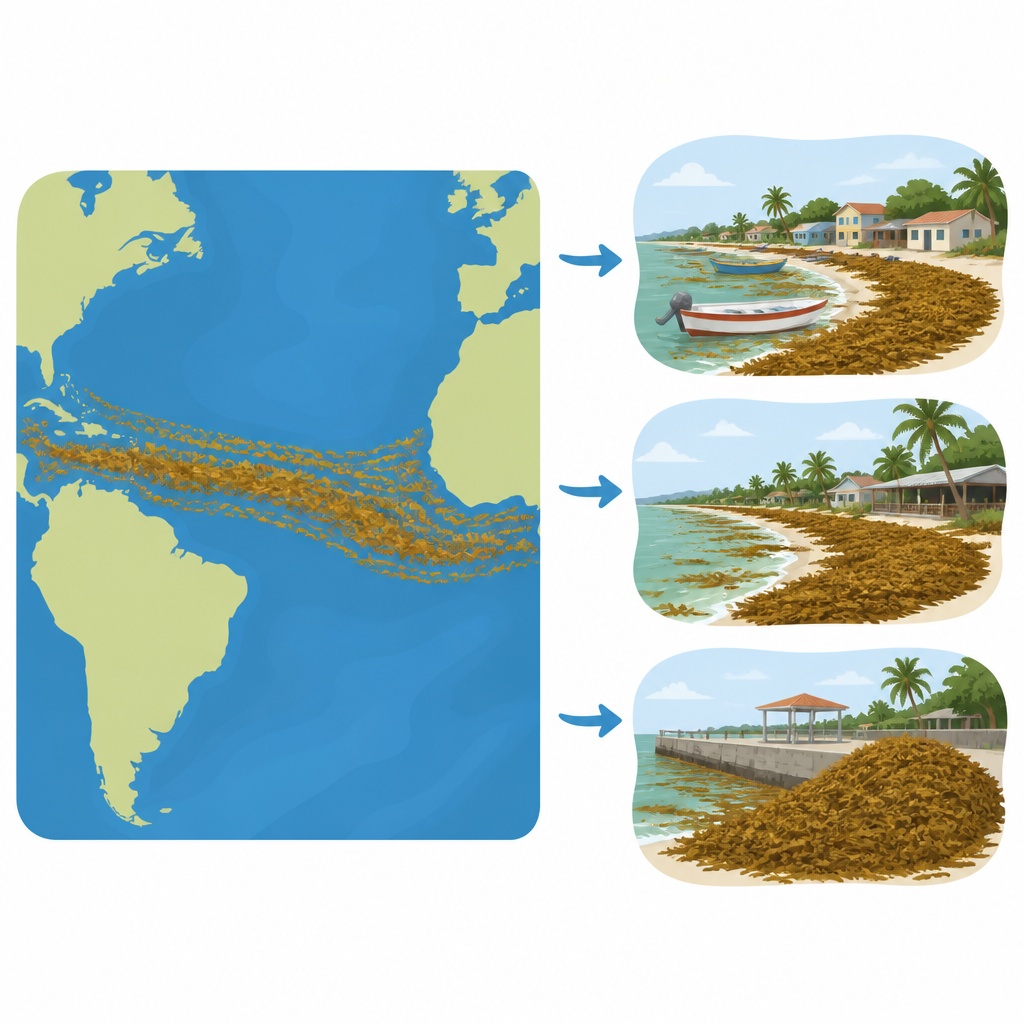
Over the past decade, vast rafts of floating seaweed called Sargassum have grown into a sprawling band across the tropical Atlantic, washing ashore on beaches from West Africa to the Caribbean. These brown, tangled mats foul tourism, harm coastal ecosystems, and are costly to clean up, but they also hold potential as a source of renewable energy. This study asks a deceptively simple question with big practical stakes: what is driving this massive seaweed boom today, and can we predict what will happen next?
A new seaweed highway across the Atlantic
Sargassum has long been a natural part of the North Atlantic, especially in the calm Sargasso Sea. Since 2011, however, satellite images have revealed a recurring “Great Atlantic Sargassum Belt” stretching more than 8000 kilometers across the ocean. Every year since 2018, its peak mass has exceeded 20 million tonnes, with projections topping 30 million tonnes in 2025. The belt now regularly invades the Caribbean, Gulf of Mexico, and tropical Atlantic coasts, challenging countries with limited resources to deal with thick seaweed landings that disrupt fisheries, tourism, and local livelihoods.
Looking beyond rivers and warming seas
Scientists have proposed many explanations for this surge, including fertilizer-rich river runoff, dust from the Sahara, stronger coastal upwelling, and warmer surface waters. Yet none of these alone can fully account for the scale and persistence of the blooms. In this work, the authors assembled long records of ocean conditions such as surface temperature, salinity, wind-driven mixing, and airborne dust, together with estimates of Sargassum mass from 2011 to 2024. They then built a non-linear statistical model to test which changes in the ocean environment actually align with the growth and year-to-year swings of the Great Atlantic Sargassum Belt.
Deep mixing and a self-feeding seaweed community
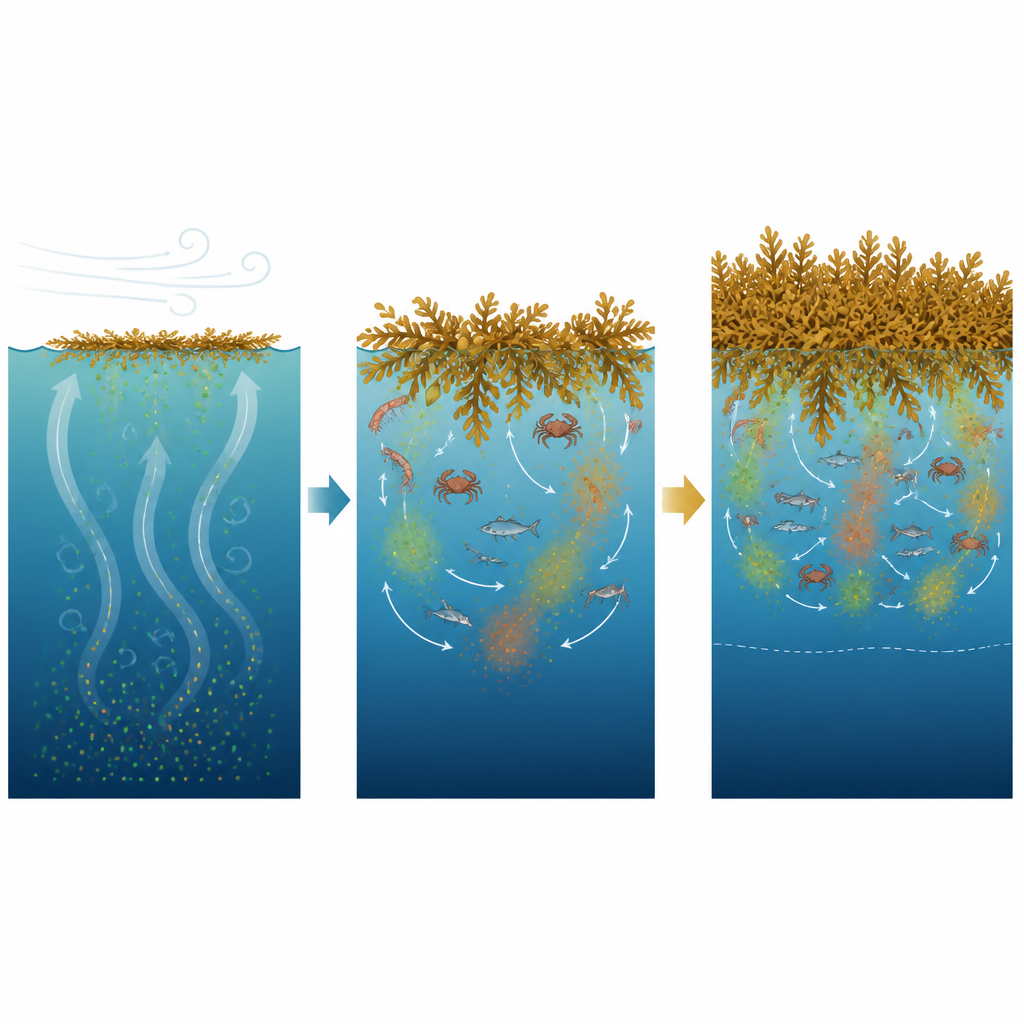
The model highlights two key players. Early in the bloom record, stronger winds deepened the sunlit “mixed layer” of the ocean, drawing up extra nitrogen- and phosphorus-rich water from below. This pulse of nutrients helped Sargassum expand. But from about 2018 onward, the model shows a growing role for something more surprising: a self-fertilizing community that lives in and around the seaweed itself. Fish, shrimp, crabs, and other companions feed on plankton drawn to the Sargassum mats and release nutrient-rich waste directly where the seaweed floats. Old and decaying mats also leak nutrients that stay trapped in the strongly layered tropical surface ocean, where they can fuel the next year’s growth.
Clues from the chemistry of nitrogen
To test this “Sargassumsphere” idea, the researchers measured the natural chemical fingerprint of nitrogen in both Sargassum and the animals living among it. The ratios they found are more consistent with nitrogen recycled through animal waste than with nutrients coming only from deep ocean water or from nitrogen-fixing microbes. This supports the view that the seaweed community has effectively built its own nutrient loop, recycling and concentrating food within the surface layer instead of relying solely on new supplies from below.
What this means for forecasts and clean-up plans
By combining physical changes in the ocean with this self-fertilizing effect, the model reproduces past Sargassum masses with high accuracy and successfully predicts the size of the blooms in 2023 and 2024. That predictive power matters: if managers can foresee seaweed build-up a few months ahead, they can plan offshore collection before it hits beaches, estimate how much biomass will be available for biofuel or other uses, and size the workforce and costs. The study also suggests that, because the Sargassum belt is now strongly sustained by its own ecology as well as by climate-driven mixing, these large blooms are likely to persist in the near future. Any strategy that turns this nuisance into a resource must therefore balance harvesting with leaving enough seaweed to maintain the natural cycle and the many creatures that depend on it.
Citation: Zhou, X., Novi, L., Hay, M.E. et al. Changing drivers of the Great Atlantic Sargassum Belt from physical forcing to ecological control. Nat Commun 17, 4600 (2026). https://doi.org/10.1038/s41467-026-72183-4
Keywords: Sargassum, Atlantic Ocean, seaweed blooms, marine ecosystems, biofuel potential
See more on the researcher's website: https://www.cmcc.it/people/bracco-annalisa